USAID DEC
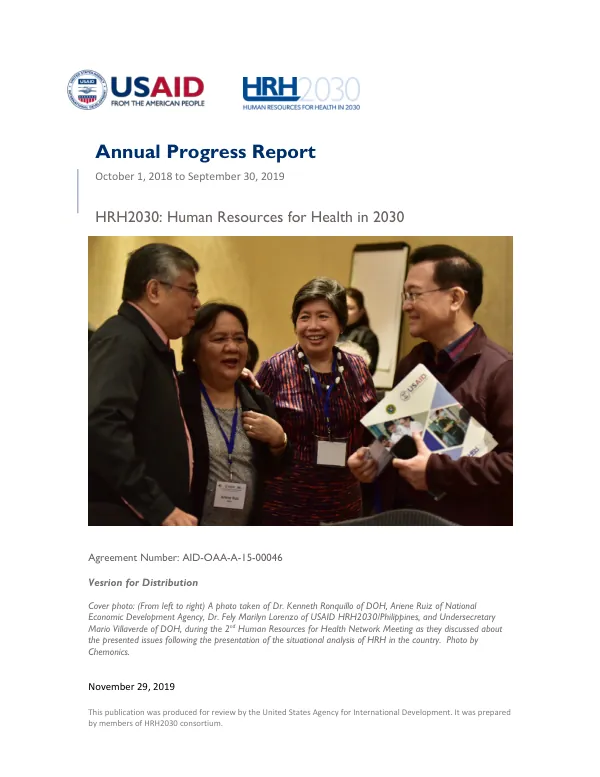
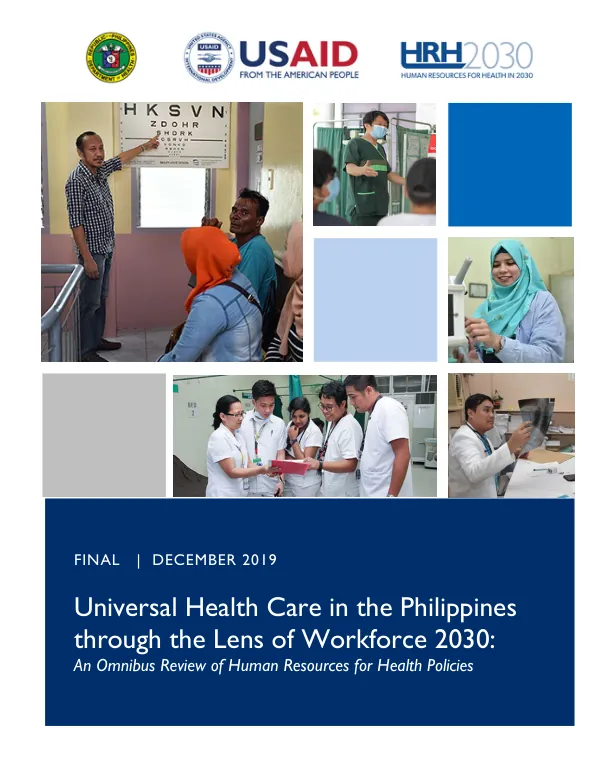
Universal Health Care in the Philippines through the Lens of Workforce 2030: An Omnibus Review of Human Resources for Health Policies
Sign inCHEMONICS
Universal Health Care in the Philippines through the Lens of Workforce 2030: An Omnibus Review of Human Resources for Health Policies
The Philippines' health workforce plays a crucial role in achieving universal health care (UHC).
2019 · 50 pages
Sign in to readA free account is required to download.
Abstract
A sufficient number of appropriately skilled and motivated health workers is essential for improving the country's health outcomes. The USAID's Human Resources for Health in 2030 in the Philippines (HRH2030/Philippines) Activity aims to strengthen the health workforce for better tuberculosis (TB), family planning (FP), and maternal and child health (MCH) services. The activity focuses on improving human resources (HR) planning and workforce systems for deployment, distribution, and skills mix. It also strengthens competency development through e-learning and post-training evaluation (PTE). Additionally, the activity improves human resources for health (HRH) data for decision making and strengthens national HRH governance through developing a National HRH Masterplan (HRHMP). In response to the UHC law enacted in 2019, USAID's HRH2030/Philippines will support the development of the 2020-2040 HRH Masterplan. This masterplan will guide the country in addressing its HRH challenges and will include short-, medium-, and long-term operational plans. The development of the masterplan takes off from a completed policy scoping review that assessed 54 health-related policies issued by the Department of Health (DOH). An omnibus policy review was conducted to encompass 134 policies that relate to the spectrum of a health worker's movement across the World Health Organization's (WHO) Working Lifespan Strategy. The review aimed to determine the scope of existing policies that impact HRH management and development. Guided by the Health Labor Market (HLM) framework towards UHC accomplishment, the review identified key policy developments and policy issues by assessing the content of existing policies vis-à-vis the provisions of the UHC law and global standards set by the WHO. The policy content assessment using the HLM framework showed that the policy environment is generally supportive of the HRH provisions introduced by the UHC Act. Most of the supportive policies focus on HRH production and management, with some policies addressing HRH distribution and skills mix. However, the review also identified policy gaps and areas that require further development to support HRH management and development in support of UHC. The review's findings will guide the proposal of priority policies to support HRH management and development. These policies will be aligned with the provisions of the UHC law and global standards set by the WHO. The development of these policies will be crucial in addressing the HRH challenges facing the Philippines and achieving UHC. The Department of Health (DOH) plays a crucial role in implementing the policies related to HRH management and development. The DOH has various programs and initiatives aimed at improving the health workforce, including the deployment of health workers to geographically isolated and disadvantaged areas (GIDA). The DOH also has a National Database of Selected Human Resources for Health (NDHRHIS) that provides data on the health workforce. The health labor market (HLM) framework is a key tool in understanding the HRH challenges facing the Philippines. The HLM framework provides a comprehensive approach to addressing HRH management and development, including the production, distribution, and skills mix of the health workforce. The framework also emphasizes the importance of HRH data for decision making and the need for strong national HRH governance. The development of the 2020-2040 HRH Masterplan will be a critical step in addressing the HRH challenges facing the Philippines. The masterplan will provide a roadmap for improving the health workforce and achieving UHC. It will also guide the development of policies and programs aimed at addressing the HRH challenges facing the country.