USAID DEC
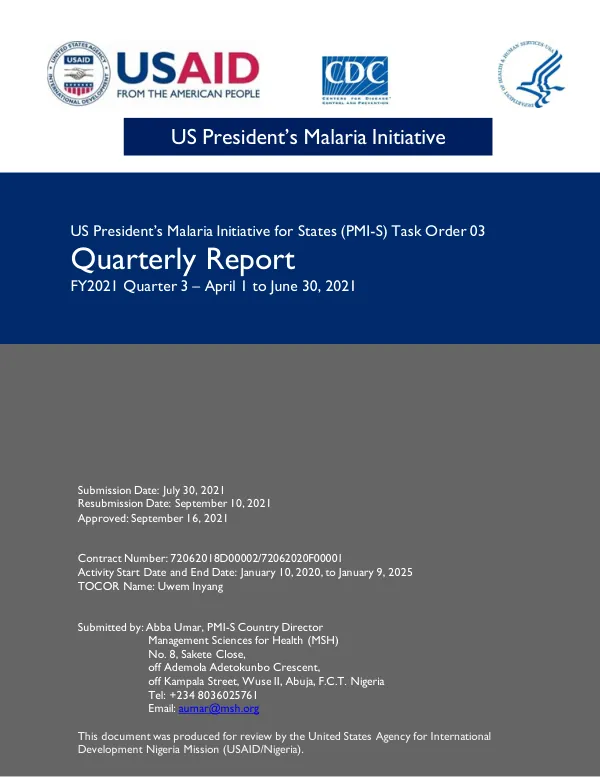
US President’s Malaria Initiative for States (PMI-S) Task Order 03 Quarterly Report FY2021 Quarter 1 – October 01 to December 31, 2020
Sign inBANYAN GLOBAL
US President’s Malaria Initiative for States (PMI-S) Task Order 03 Quarterly Report FY2021 Quarter 1 – October 01 to December 31, 2020
The US President's Malaria Initiative for States (PMI-S) project is a five-year USAID flagship malaria project implemented by Management Sciences for Health (MSH) with consortium partners Thinkwell, Banyan Global, and the Nigeria Interfaith Action Association (NIFAA).
2021 · 35 pages
Sign in to readA free account is required to download.
Abstract
The project supports the Government of Nigeria through its agencies at the federal, state, local government area (LGA), and community levels to reduce malaria-related mortality by delivering quality services for management of malaria and its complications, and prevention of malaria during pregnancy and in children under five. Task Order 03 (TO 03) supports the State Malaria Elimination Programs (SMEPs) in Akwa Ibom, Cross River, Ebonyi, and Oyo states. The project has four objectives: (1) Improve the quality of and access to comprehensive malaria case management; (2) Improve data quality, interpretation, and use; (3) Improve drug-based prevention and treatment approaches (Intermittent Preventive Treatment of Malaria in pregnancy [IPTp]); and (4) Strengthen existing health systems and improve SMEP management. TO 03 states collectively implemented 66% of Q1 work plan activities, with Akwa Ibom, Cross River, Ebonyi, and Oyo states achieving varying levels of completion. All four states met the target for the proportion of persons with fever (suspected malaria) who received a parasitological test, and all states achieved their targets for the proportion of patients with confirmed malaria who received first-line antimalarial treatment according to national policy. However, only Akwa Ibom recorded target achievement for the proportion of expected reports from health facilities, and all states except Oyo met the target for the proportion of pregnant women attending antenatal care (ANC) who receive at least two doses of IPTp. The project has made significant progress in IPTp coverage, with marked improvement in the four states compared to the previous reporting periods. Across the states, PMI-S trained a total of 1,963 persons, composed of 17.2% males and 82.8% females. Some data quality issues with reporting were discovered and will be followed up with the SMEP and Department of Planning, Research and Statistics (DPRS). To improve malaria case management in health facilities, PMI-S supported the training of 225 state and LGA supervisory team members in Cross River, Ebonyi, and Oyo states on management of uncomplicated malaria, including referral for severe malaria. PMI-S also trained 223 primary health care workers from 166 health facilities on the use of behavioral economics (BE) prototypes for fever case management in Akwa Ibom, and post-training follow-up has been conducted in 60 of these health facilities to address initial challenges with implementation of the BE prototypes. The project concluded the baseline analysis of malaria program implementation in the four states, with data collection in selected health facilities, LGAs, and communities. Results of the analysis will provide useful inputs for the finalization of the TO 03 Activity Monitoring and Evaluation Plan (AMELP), including setting indicator baselines. PMI-S supported the states to train a total of 108 state and LGA data validation teams on data quality assessment (DQA) processes and provided logistics support and technical assistance for data validation meetings, data entry into DHIS2, data analysis, and resolution of data errors. However, the project faced several challenges, including protests to end the activities of Special Anti-Robbery Squad (referred to as ENDSARS protests) that resulted in heightened insecurity and restrictions on movement in most parts of the country. Many of the planned activities that required physical presence, such as trainings and visits to health facilities, were put on hold during the 2-3 week period when protests were ongoing. The desktop computer provided by PMI-S for the Cross River SMEP unit and some other office equipment were reportedly stolen during the ENDSARS protest. Statewide immunization activities, especially measles and yellow fever immunization campaigns as well as Integrated Medical Outreach Program (IMOP), conflicted with PMI-S planned activities such as training of health facility staff on BE prototypes, case management training for health providers, orientation of ANC providers on current IPTp guidelines, and data validation meetings. However, some of these activities were rescheduled and conducted in the reporting quarter while others were rolled over to Q2. The project has also identified several lessons learned, including the need to include private sector healthcare entities in the official lists of private outlets provided by the state governments and professional associations. Through the private sector mapping exercise, PMI-S found 105 unlisted private health outlets (clinics, community pharmacies, and laboratories) in Akwa Ibom and 136 unlisted outlets in Oyo. This finding has implications for the states' abilities to support and oversee the private sector. PMI-S will apply this finding in co-creating the private sector engagement strategies with State Ministry of Health (SMOH)/SMEP. Initial post-training follow-up visits conducted to 60