FINTRAC
USAID ACCESO Monthly Update June 2011
The agricultural development initiative in Honduras, known as USAID ACCESO, began in 2011 with funding from the United States Agency for International Development (USAID).
2011 · 4 pages
Sign in to readA free account is required to download.
Abstract
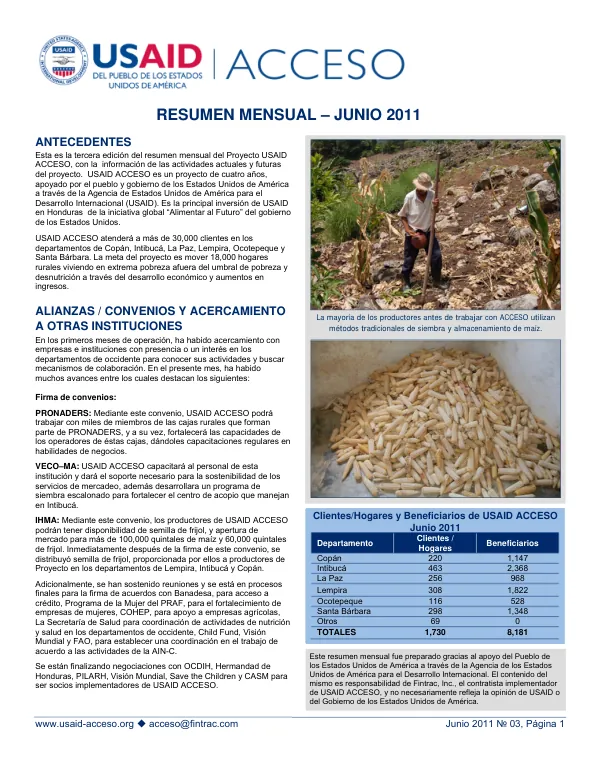
The project's primary goal is to move 18,000 rural households living in extreme poverty and malnutrition above the poverty threshold through economic development and increased income. USAID ACCESO will serve over 30,000 clients in the departments of Copán, Intibucá, La Paz, Lempira, Ocotepeque, and Santa Bárbara. As of June 2011, the project has registered 1,730 households, with 8,181 beneficiaries. These households have participated in training and received individual or group technical assistance in various areas. A total of 72% of the registered households are living in extreme poverty, and 6% are living in poverty. The project has also incorporated hundreds of new clients, with 1,046 new households registered in June 2011. The project's focus on technical assistance in production has increased, with 1,095 visits conducted in June 2011. The technical assistance has focused on preparing soils, leveling curves, high beds, and drainage to prevent flooding, seed density, seed selection, fertilizer programs for specific crops, weed control, and other areas. The project has also initiated assistance in the production of tilapia for consumption and sale, including sex determination, weight sampling, and the relationship between concentrate, final weight, and harvest time. The project has also conducted 459 training events in production, with 5,278 participants. The training areas or topics that were emphasized in June 2011 included implementing basic practices, nutrition-fertilization, soil preparation, and soil conservation using leveling curves, and planting and transplanting. The project is working in coordination with several municipalities to provide technical assistance to producers who are beneficiaries of the technological bonus. The project has also determined several potential crops for exportation, including pataste, plantain, oriental vegetables, radicchio, and eggplant, with the assistance of several export companies. Additionally, the project has provided training to all production personnel on managing coffee farms, with the goal of strengthening their knowledge in this crop. The project's main objectives are to surpass the poverty threshold of 18,000 rural households living in extreme poverty, generate $73.95 million in net income for assisted clients, and create 10,425 permanent jobs in assisted communities. The project is also working to stimulate the presence of the private sector and organizations for development in the western region.