FINTRAC
USAID-ACCESO Monthly Update - April 2011
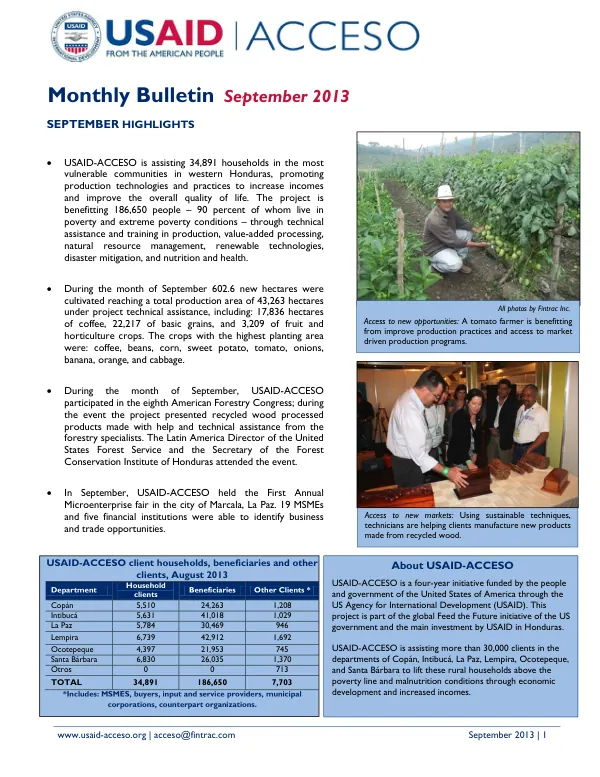
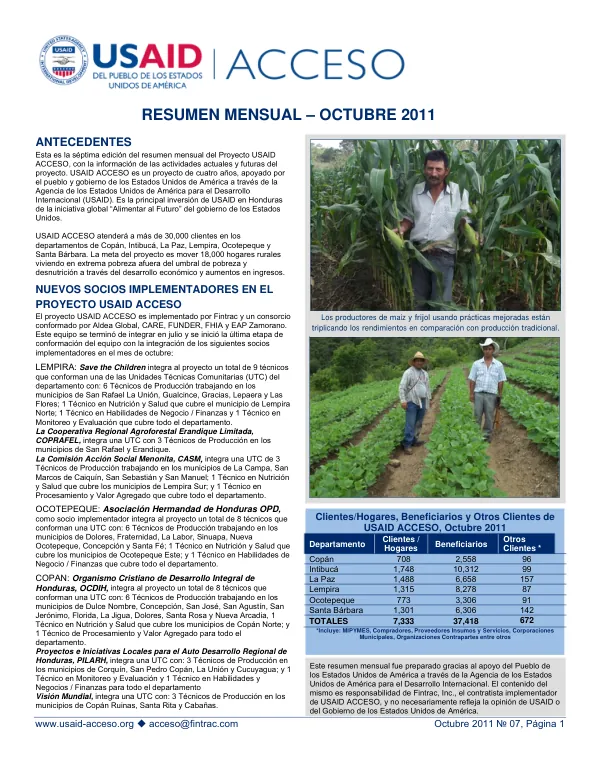
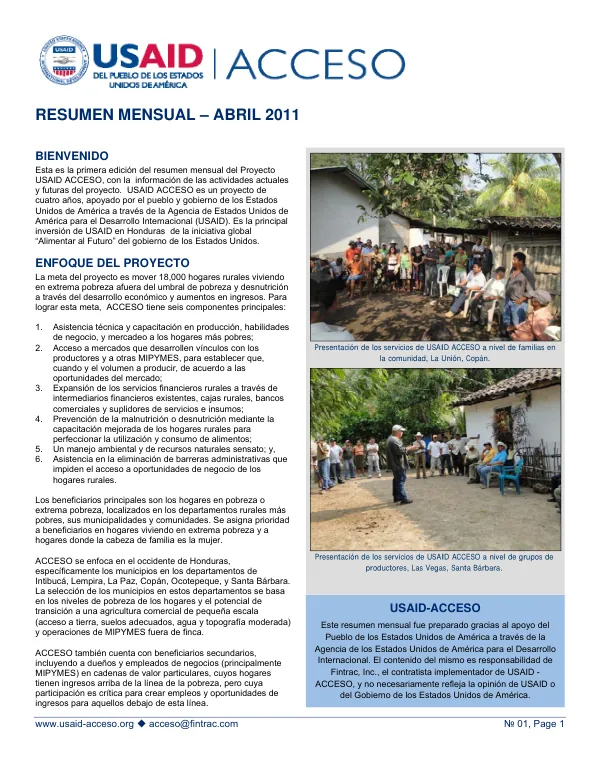
The agricultural development initiative in Honduras, known as USAID-ACCESO, aims to move 18,000 rural households living in extreme poverty above the poverty and malnutrition threshold through economic development and income increases.
2011 · 3 pages
Sign in to readA free account is required to download.
Abstract
To achieve this goal, ACCESO has six main components: technical assistance and training in production, business skills, and marketing for the poorest households; access to markets that develop links with producers and other micro, small, and medium-sized enterprises (MIPYMES); expansion of rural financial services through existing financial intermediaries, rural banks, commercial banks, and suppliers of services and inputs; prevention of malnutrition or malnutrition through improved training of rural households to perfect the use and consumption of food; sensible environmental and natural resource management; and assistance in eliminating administrative barriers that prevent rural households from accessing business opportunities. The main beneficiaries are households in poverty or extreme poverty, located in the poorest rural departments, municipalities, and communities. Priority is given to beneficiaries in households living in extreme poverty and households where the head of the household is a woman. ACCESO focuses on western Honduras, specifically the municipalities in the departments of Intibucá, Lempira, La Paz, Copán, Ocotepeque, and Santa Bárbara. The selection of municipalities in these departments is based on household poverty levels and the potential for transition to commercial-scale agriculture (access to land, suitable soils, water, and moderate topography) and MIPYMES operations outside the farm. ACCESO also has secondary beneficiaries, including business owners and employees (mainly MIPYMES) in specific value chains, whose households have incomes above the poverty line, but whose participation is critical for creating jobs and income opportunities for those below this line. The project USAID-ACCESO is a four-year project, supported by the people and government of the United States of America through the United States Agency for International Development (USAID). It is the main investment of USAID in Honduras under the global initiative "Feed the Future" of the US government. The project's main objectives are to surpass the poverty threshold of 18,000 rural households living in extreme poverty, generate $73.95 million in net income for assisted clients, and create 10,425 permanent jobs in assisted communities. The project will serve 31,800 clients in the six departments, distributed as follows: 18,000 households in extreme poverty, 7,000 households living in poverty, 5,000 coffee producers, 1,000 commercial horticultural producers, and 800 rural non-agricultural businesses and processing operations. ACCESO establishes production programs directed by the market that link small producers with local, regional, and international buyers. It also focuses on high-value crops and opportunities for added value, including vegetables, roots and tubers, fruits, and coffee. As part of a "farm integral" system, ACCESO promotes increasing productivity and added value of traditional crops (maize and beans) on the farms of beneficiaries. This system emphasizes improving household diet (nutrition), maximizing income sources for all productive family members, reducing risk through diversification, achieving a balance in the use of natural resources, increasing access to better health services, and promoting technologies that use renewable energy sources. ACCESO will coordinate its activities with the government of Honduras at the central and local levels, as well as with the private sector, NGOs, and other counterparts to ensure that the project's goals are met through a unified effort of all parties involved, maximizing the impact on Honduran households. It is associating with solid organizations with community presence and technical knowledge to provide coordinated support to small producers and other rural MIPYMES.