USAID DEC
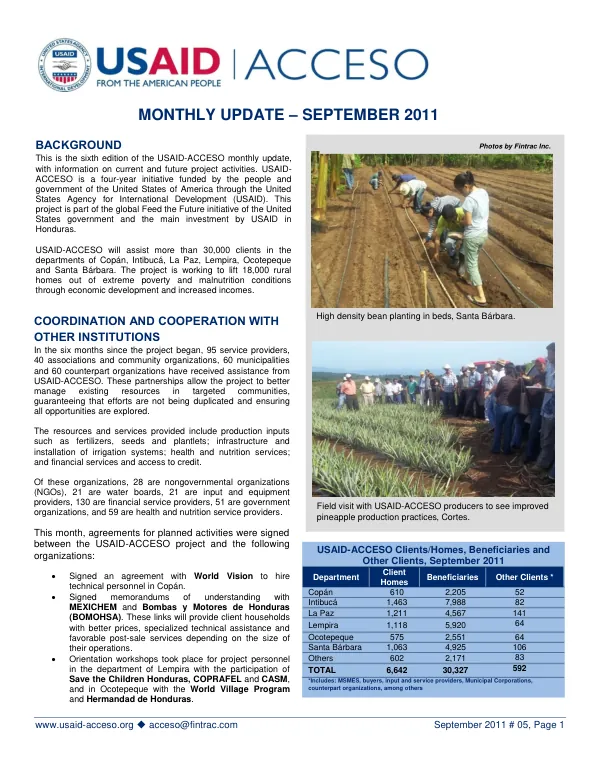
Monthly Update – September 2011: USAID-ACCESO Clients/Homes, Beneficiaries and Other Clients
Sign inFINTRAC
Monthly Update – September 2011: USAID-ACCESO Clients/Homes, Beneficiaries and Other Clients
The USAID-ACCESO project is a four-year initiative funded by the United States Agency for International Development (USAID) to support economic development and poverty reduction in rural Honduras.
2011 · 4 pages
Sign in to readA free account is required to download.
Abstract
The project aims to lift 18,000 rural homes out of extreme poverty and malnutrition conditions through economic development and increased incomes. The main goals of ACCESO include generating $73.95 million in net profits for clients, creating 10,425 permanent jobs, and bringing 18,000 rural homes above the poverty threshold. As of September 2011, the project has assisted over 30,000 clients in the departments of Copán, Intibucá, La Paz, Lempira, Ocotepeque, and Santa Bárbara. The project has provided technical assistance to 95 service providers, 40 associations, and 60 municipalities, as well as 60 counterpart organizations. These partnerships have allowed the project to better manage existing resources in targeted communities, ensuring that efforts are not duplicated and all opportunities are explored. The project has made significant progress in production, with 2,754 hectares planted and 5,796 technical assistance visits conducted. A total of 683 trainings were held with 7,761 participants, covering topics such as animal production, good agricultural practices, and postharvest handling. The project has also invested $124,298 in production infrastructure, with client homes investing $42,147 and counterpart organizations investing $82,015. In terms of access to markets, the project has conducted market visits in several cities to find new contacts, coordinate with informal buyers, and verify prices. The project has also developed a directory of local buyers of corn, beans, and coffee, which are the most prevalent crops in the areas of assistance. Five training events were held with 105 participants, and 41 technical assistance visits were made to buyers and clients. The project has also made progress in management and mitigation of natural disasters, providing technical assistance to the Municipal Corporation of Yarula and the Council of Chuna Chinguire to evaluate damage caused by a storm in August. Recommendations included stabilization and surveillance of the most vulnerable zones. In addition, the project has made significant progress in finance and business skills, with a total of 65 training events held with 1,041 participants. The project is assisting 130 financial service providers, 107 of which are rural savings and loan associations. The project has also assisted two rural savings and loan associations in Santa Bárbara to develop charter agreements and has held trainings on administrative and organizational skills for cooperatives and rural savings and loan associations. The project has also made progress in nutrition and health, holding its first orientation and training on the Antención Integral a la Niñez en la Comunidad (AIN-C) strategy at the USAID-ACCESO office in La Esperanza, Intibucá. The project has also held 18 training events for 296 participants, covering topics such as breastfeeding, hand washing, safe water preparation, and healthy recipes with local ingredients. Finally, the project has made progress in value addition and microenterprises, providing technical assistance to the development of new products that generate higher profit margins by using readily-available raw materials and complying with sanitary licenses. Processing specialists have trained 245 participants at 27 events, covering topics such as product costs, processing records, packaging, and labeling.