AED
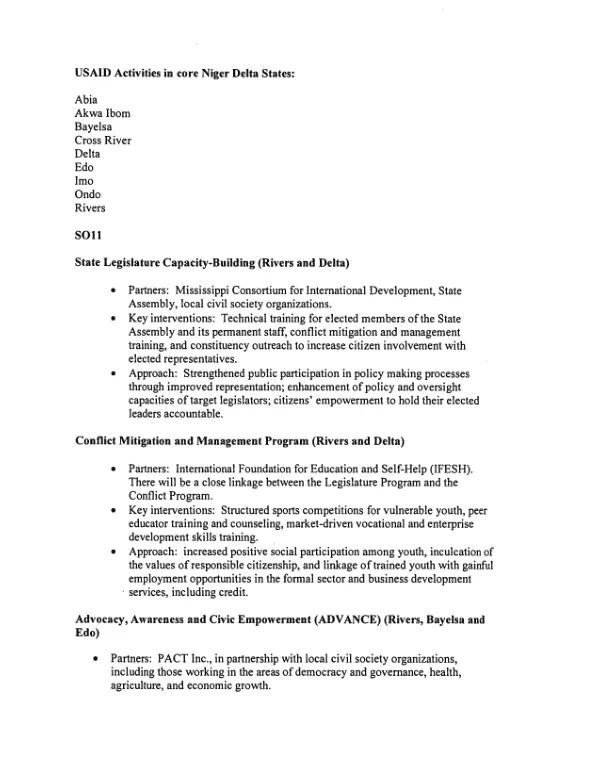
USAID Activities in core Niger Delta States
The agricultural development initiative in Niger Delta States began with funding from USAID's Food Security Program.
2010 · 5 pages
Sign in to readA free account is required to download.
Abstract
The initiative focused on improving agricultural productivity, market access, and farmer livelihoods in the region. Key interventions included technical training for farmers, infrastructure development, and market linkage facilitation. In Abia State, the Cassava Enterprise Development Program aimed to reduce the impact of virulent cassava mosaic disease, increase cassava productivity, and develop post-harvest processing and marketing outlets for cassava products. The program employed an integrated approach combining private-sector driven extension services, producer associations, and community-based processing facilities. In Akwa Ibom State, the Cassava Competitiveness Cluster program focused on cassava market development and improved input supply and production systems. The program built a cassava cluster competitiveness program that employed a commodity value chain methodology. Additionally, the Maximizing Agricultural Revenue and Key Enterprises in Targeted Sites (MARKETS) project aimed to expand economic opportunities in the Nigerian agricultural sector by increasing agricultural productivity, improving competitiveness, and creating an enabling environment for investment and demand-driven, private-sector led growth and development. In Cross River State, the Sustainable Practices in Agriculture for Critical Environments (SPACE) program promoted sustainable agricultural practices such as agroforestry, sustainable extraction of non-timber forest resources, and community-based conservation of buffer zones adjacent to natural reserves. The program implemented an integrated commodity chain development strategy that addressed production, processing, and marketing, and built community capacity for sustainable management and utilization of the natural resource base. In Delta State, the Malaria Prevention and Treatment program aimed to reduce malaria cases through social marketing of pre-packaged treatment, demand creation of insecticide-treated nets, case management, and capacity building of primary health workers, patent medicine vendors, and mothers and other caregivers. The program built partnerships with community-based organizations, ITNs retailers, and patent medicine vendors to improve access to ITNs and pre-packaged treatments. In Rivers State, the Accelerated Education Youth-to-Work in Nigeria (YES) program focused on improving the basic educational skill level of young people, mainly adolescents and young adults, in communities where ChevronTexaco has operations. The program provided enhanced instruction in literacy, numeracy, and work skills for unemployed youth, with a special focus on ensuring that 50% of participants were girls. The State Legislature Capacity-Building program in Rivers and Delta states aimed to strengthen public participation in policy-making processes through improved representation, enhancement of policy and oversight capacities of target legislators, and citizens' empowerment to hold their elected leaders accountable. The program provided technical training for elected members of the State Assembly and its permanent staff, conflict mitigation and management training, and constituency outreach to increase citizen involvement with elected representatives. The Conflict Mitigation and Management Program in Rivers and Delta states focused on increasing positive social participation among youth, inculcating the values of responsible citizenship, and linking trained youth with gainful employment opportunities in the formal sector and business development services. The program employed structured sports competitions for vulnerable youth, peer educator training and counseling, and market-driven vocational and enterprise development skills training. The Advocacy, Awareness, and Civic Empowerment (ADVANCE) program in Rivers, Bayelsa, and Edo states aimed to strengthen advocacy capacity, increase awareness, and empower citizens to effectively engage with policy makers and public officials and hold them accountable. The program employed organizational and institutional strengthening, civic awareness and advocacy training, and anti-corruption interventions. The Trafficking in Persons program in Edo or Rivers states aimed to provide technical assistance to NAPTIP and affiliated agencies to manage trafficking-related information and improve the agency's track record in investigating and prosecuting trafficking cases. The program also provided job skills assistance and crisis prevention services for potential victims of trafficking and for children and women repatriated to Nigeria from abroad. The Sustainable Tree Crops Program in Ondo state aimed to establish cocoa-based agroforestry systems on already deforested lands or in the savanna forest transition zone or savanna grasslands. The program introduced leguminous nitrogen-fixing shade tree species, fruit trees, and timber species with improved cocoa hybrids planted into the system. The program employed an integrated approach combining trade and information systems, capacity development of farmers' organizations, and participatory training and extension with a focus on cocoa IPM and the rehabilitation of degraded land use systems. The Contraceptive Social Marketing program in all states aimed to develop and implement radio campaigns, mid-mass media campaigns, and special events to disseminate key family planning messages targeting youth and the general population. The program produced and distributed print materials to support access to and consumer use of family planning products and expanded access to family planning products in rural areas. The JOBS program in Cross River state aimed to provide job creation and placement, employment generation, business services development, micro-enterprise development with access to credit, and agri-business development. The program trained and skilled at-risk youths to become gainfully employed or self-employed, provided job placement services, and microenterprise development training. The Contraceptive Social Marketing program in all states aimed