FEDERAL MINISTRY OF HEALTH
Scaling Up Chlorhexidine for Umbilical Cord Care in Nigeria
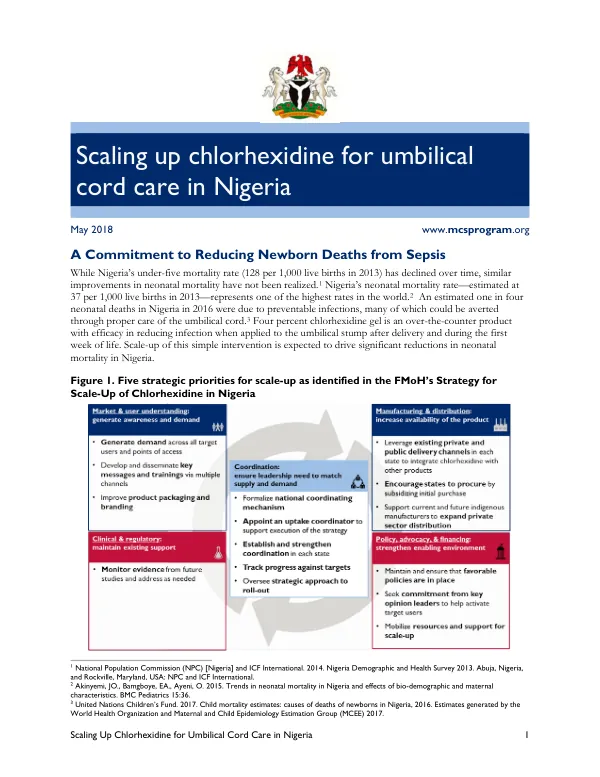
The National Strategy for Scale-Up of Chlorhexidine in Nigeria was developed in 2016 by the Federal Ministry of Health (FMoH) with technical assistance from USAID's Center for Accelerating Innovation and Impact.
2018 · 6 pages
Sign in to readA free account is required to download.
Abstract
The strategy outlines strategic interventions, guides programming, and sets a concrete target of 52% coverage of chlorhexidine after the fifth year of scale-up, estimated to avert 55,000 neonatal deaths over five years. The strategy identifies ways to leverage existing systems, processes, and markets to ensure gains in coverage are sustained over time. It proposes scale-up indicators at national and state levels and includes cost projections to guide resource mobilization. The National Strategy also envisions distribution of chlorhexidine through both public and private sector channels. The government has adopted use of chlorhexidine for newborns, both in facility and home settings. In Nigeria's decentralized governance system, national policy is set at the national level and implemented by the 36 states, the Federal Capital Territory, and the local government areas (LGAs). Each state-level ministry of health and primary health care development agency must take deliberate actions to implement the National Strategy. State-level ministries of health oversee the entire public health program while the state primary health care development agencies oversee primary health care activities at the LGA level. To ensure seamless implementation of the strategy, the FMoH partnered with USAID's flagship Maternal and Child Survival Program (MCSP) to secure a full-time scale-up coordinator and foster key partnerships. The Family Health Department of the FMoH engaged other departments and agencies, states, implementing partners, donors, professional health associations, manufacturers, and other stakeholder groups on multiple occasions through a series of consultative meetings to build capacity for implementation of the National Strategy. By 2017, chlorhexidine was incorporated into the national training curricula and appended to the National Essential Medicines List. The FMoH led participation at annual conferences of major professional associations and provided technical assistance to build sustainable financing and distribution models, including regular engagement with local manufacturers. FMoH encouraged state reproductive health and maternal child health coordinators to create a WhatsApp group in early 2018 to share experiences among states and maintain frequent communication on implementation progress. Many states have used their funds or funds from the Saving One Million Lives program to procure and distribute the product to health facilities, while other states have undertaken advocacy efforts to raise funds from partners. In addition, states have launched advocacy efforts to build champions among gatekeepers and influential figures such as hospital administrators, politicians, and community volunteers. Many states have also undertaken efforts to sensitize end users—including providers, traditional birth attendants, and families—on the importance of proper umbilical cord care using chlorhexidine. Across Nigeria, stakeholders have marshaled human and financial resources to implement the National Strategy. Early data suggest that their efforts will provide a return-on-investment in the form of increased coverage as well as institutionalization. Many states have met key milestones to plan for scale-up and to institutionalize chlorhexidine through integration in routine systems and processes. Major purchasers, including state governments, development partners, and hospitals, are procuring larger volumes of chlorhexidine. In Ebonyi State, 1,200 units of chlorhexidine were procured in the month following a two-day multi-stakeholder engagement organized by MCSP. Local manufacturers reported distributing an estimated 532,008 units of chlorhexidine within Nigeria in 2015; 1,536,532 in 2016; and 688,395 in 2017. The high quantity distributed in 2016 was in part due to a partnership with Society for Family Health through which 600,000 tubes were procured to stimulate the private sector. Efforts are underway within the FMoH to integrate chlorhexidine indicators into routine reporting systems at facility and community levels. Such national coverage data would enable coordinators and decision-makers to adapt their scale-up strategies and allocate human or financial resources where needed. The FMoH has also successfully advocated for data on utilization of chlorhexidine to be collected in the 2018 Demographic and Health Survey.