USAID DEC
USAID Alternatives to Charcoal Quarterly Performance and Financial Reports: Fiscal Year 2023 Quarter 1
Sign inTETRA TECH
USAID Alternatives to Charcoal Quarterly Performance and Financial Reports: Fiscal Year 2023 Quarter 1
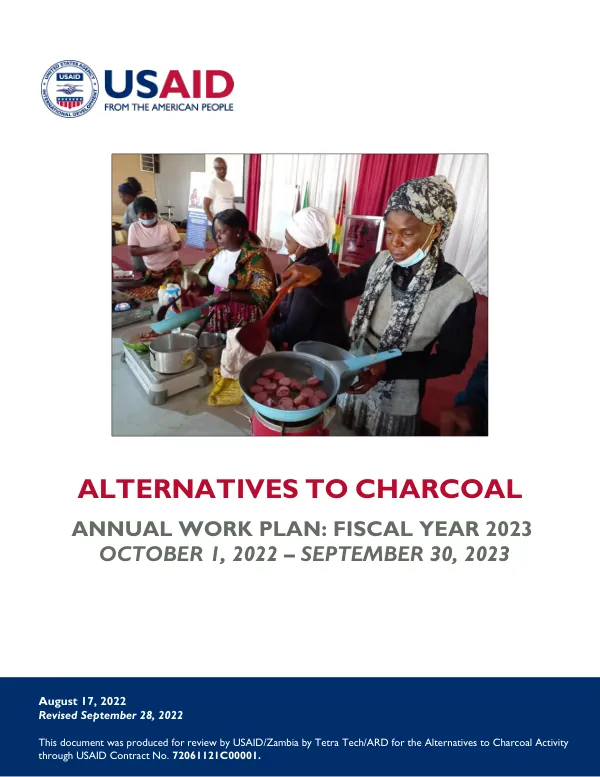
The Alternatives to Charcoal Activity in Zambia began in January 2021 and is set to conclude in January 2026.
2023 · 48 pages
Sign in to readA free account is required to download.
Abstract
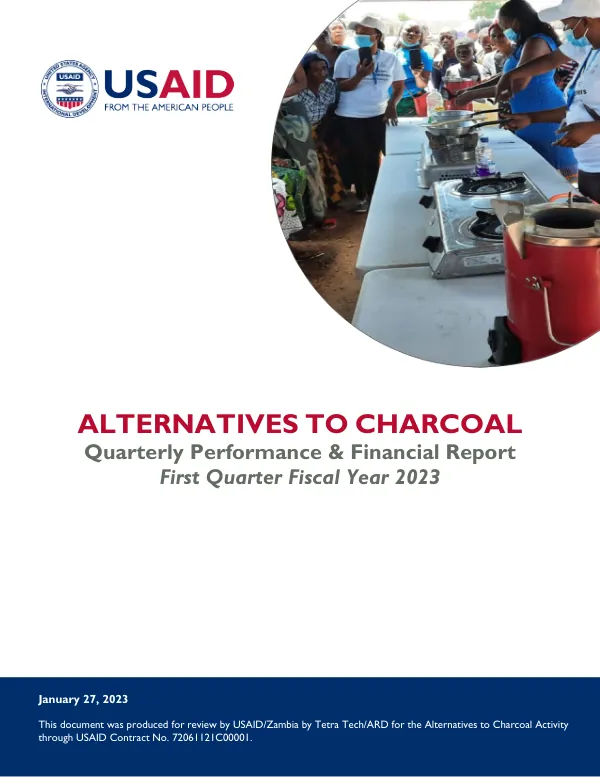
The activity is funded by the United States Agency for International Development (USAID) through a contract with Tetra Tech/ARD. The primary objective of the activity is to reduce the reliance on charcoal as a cooking fuel in Zambia by promoting the adoption of alternative technologies and fuels. The activity focuses on five key objectives: identifying and removing market barriers, strengthening the business enabling environment for low emission charcoal alternatives, promoting social behavior change and communications, providing alternative livelihoods and improving regulation and enforcement of the charcoal supply chain, and adaptive management. The activity also places emphasis on cross-cutting issues such as monitoring, evaluation, and learning, grants under contract, gender and youth integration, and environmental compliance. During the first quarter of fiscal year 2023, the activity made significant progress in achieving its objectives. The activity submitted several deliverables, including a report on the status of the activity, a summary of clean cooking demonstrations held, and a summary of A2C grant awards. The activity also conducted a consumer preferences survey to gather data on household energy use and preferences. The activity has also made progress in promoting the adoption of alternative technologies and fuels. A total of 2,500 households were reached through clean cooking demonstrations, and 1,500 households were provided with alternative cooking solutions. The activity has also established partnerships with local organizations to promote the adoption of alternative cooking fuels. The activity has also made progress in strengthening the business enabling environment for low emission charcoal alternatives. The activity has worked with local businesses to develop business plans and provide training on entrepreneurship and marketing. The activity has also established a grants program to support local businesses in developing and marketing alternative cooking fuels. The activity has also made progress in promoting social behavior change and communications. The activity has conducted a series of community outreach programs to raise awareness about the benefits of alternative cooking fuels. The activity has also established a network of community influencers to promote the adoption of alternative cooking fuels. The activity has also made progress in providing alternative livelihoods and improving regulation and enforcement of the charcoal supply chain. The activity has worked with local communities to develop sustainable forest management practices and establish community forestry management areas. The activity has also established a program to provide training and support to local communities in developing and marketing alternative cooking fuels. The activity has also made progress in adaptive management. The activity has established a monitoring and evaluation system to track progress and identify areas for improvement. The activity has also established a learning and adaptation program to share knowledge and best practices with local stakeholders. The activity has also made progress in cross-cutting issues such as monitoring, evaluation, and learning, grants under contract, gender and youth integration, and environmental compliance. The activity has established a system to track progress and identify areas for improvement. The activity has also established a program to provide training and support to local communities in developing and marketing alternative cooking fuels. The activity has also made progress in strengthening the business