TETRA TECH
Zambia Alternatives to Charcoal Annual Work Plan FY 2023
The Alternatives to Charcoal Activity in Zambia began in January 2021 and is scheduled to conclude in January 2026.
2023 · 59 pages
Sign in to readA free account is required to download.
Abstract
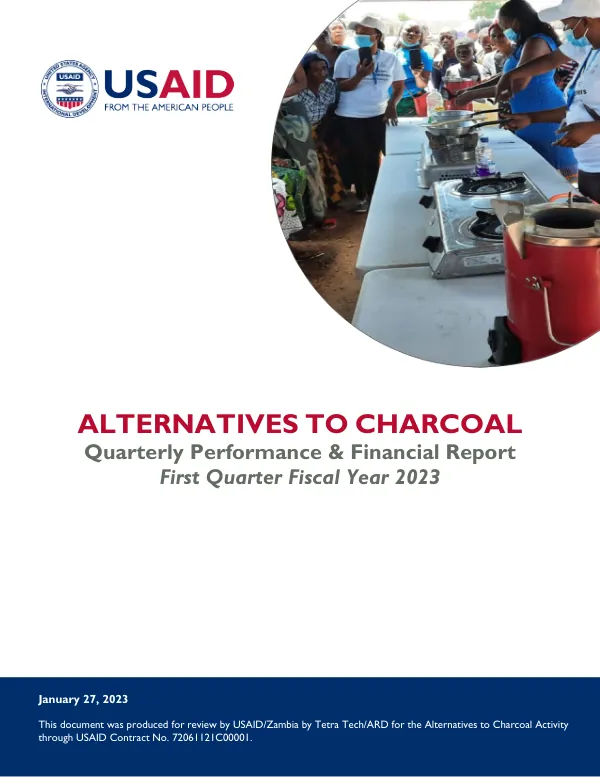
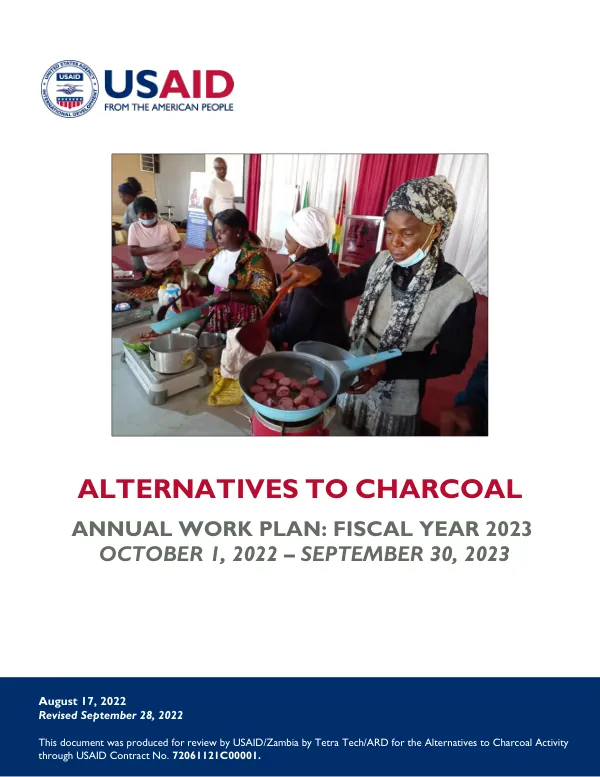
The activity aims to reduce the demand for charcoal and promote the use of alternative technologies and fuels (ATFs) in Zambia. The activity is funded by the United States Agency for International Development (USAID) through a contract with Tetra Tech/ARD. The activity's objectives are to identify and remove market barriers for ATFs, improve the business enabling environment for ATFs, promote social behavior change for ATFs, improve regulation of charcoal supply chains and sustainable livelihoods, and implement adaptive management. The activity will focus on five key objectives, which are outlined in the work plan. The activity will be implemented in collaboration with various stakeholders, including government agencies, non-governmental organizations, and private sector companies. The activity will also engage with community influencers and leaders to promote the adoption of ATFs. The activity's conceptual approach is based on a community-led approach, which involves working with local communities to identify and address their energy needs. The activity will be managed and administered by a team of staff, including a chief of party, project manager, and deputy project manager. The activity will also have a collaboration, learning, and adaptation (CLA) team that will be responsible for facilitating learning and adaptation among stakeholders. The CLA team will also be responsible for monitoring and evaluating the activity's progress. The activity's work plan for fiscal year 2023 includes several key activities, including the identification and removal of market barriers for ATFs, improvement of the business enabling environment for ATFs, promotion of social behavior change for ATFs, and improvement of regulation of charcoal supply chains and sustainable livelihoods. The activity will also implement adaptive management to ensure that the activity remains responsive to changing circumstances. The activity will also focus on cross-cutting areas, including communications, gender and youth integration, environmental compliance, and monitoring, evaluation, and learning. The activity will use various tools and approaches to promote the adoption of ATFs, including demonstration events, awareness-raising meetings, and television advertisements. The activity's indicators and targets for year 3 are outlined in appendix A of the work plan. The activity's Gantt chart is also included in appendix B, which outlines the key milestones and deadlines for the activity. The activity's organizational chart is included in appendix C, which outlines the roles and responsibilities of key personnel. The activity's illustrative budget is included in appendix D, which outlines the estimated costs for the activity. The activity's deliverable schedule is included in appendix E, which outlines the key deliverables and deadlines for the activity. The activity's conceptual approach is based on a community-led approach, which involves working with local communities to identify and address their energy needs. The activity's key metrics are outlined in figure 7, which includes indicators such as the number of households using ATFs, the number of community influencers promoting ATFs, and the number of charcoal supply chains regulated. The activity's acronyms and abbreviations are outlined in appendix II, which includes definitions for terms such as ATF, ACE, AMELP, APS, and CEEZ. The activity's figures and tables are also included in the appendix, which include illustrations of community influencers cooking eggs on an ATF, Lusaka's Catholic Church leadership members after an A2C awareness-raising meeting, and steps in establishing a community forest management group.
Related documents