ARD INC
USAID Anticorruption Strategy: Supporting Anticorruption Reform
Addressing corruption is a critical U.S.
2013 · 2 pages
Sign in to readA free account is required to download.
Abstract
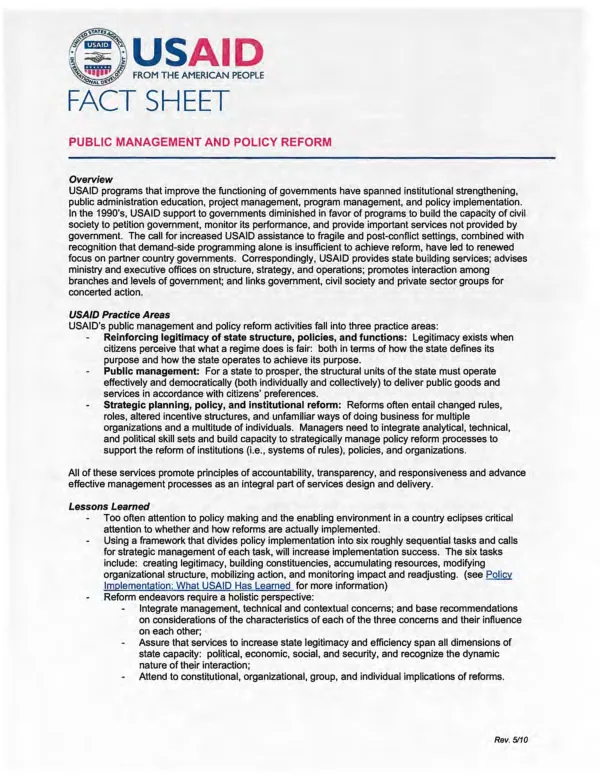
foreign policy objective, with a strong global consensus that fighting corruption and supporting good governance are essential for the development of people, markets, and nations. Corruption undermines social cohesion and broad participation in economic and political life by distorting the allocation of resources and the delivery of public services, usually in ways that particularly harm the poor. It also damages prospects for economic growth by reducing foreign direct investment, skewing public investment toward unproductive projects, encouraging firms to operate in the informal sector, and weakening the rule of law and protection of property rights. The USAID Anticorruption Strategy defines corruption as the abuse of entrusted authority for private gain, an intentionally broad way of conceptualizing the problem. Since corruption is manifested in so many different ways, at so many levels, and with so many linkages to broader political and economic interests, the challenge for anticorruption programming is to make strategic choices and avoid programs that address capacity weaknesses without first assessing the impact of vested interests and political will. USAID's Anticorruption Assessment Framework is used to comprehensively assess reform needs and opportunities. USAID's Development Group (DG) programs address corruption in the public sector through both government reforms and civil society activities. The majority of programs focus on corruption prevention and education, though USAID also supports prosecution and enforcement through rule of law programming. Government reforms focus on regulatory and procedural reform and increasing management capacity within the executive, or strengthening the oversight capacity of the judicial and legislative branches of government. Programs also help strengthen the effectiveness and responsiveness of line ministries, local governments, and anticorruption bodies, such as anticorruption commissions and ombudsman offices. Civil society approaches support anticorruption research, monitoring government processes, civic education, and advocacy among NGOs, business associations, service users, and civic groups in all sectors. Civil society programs foster constituencies for reform to demand greater transparency and accountability of government and to increase opportunities to participate effectively in oversight of public activities. Other USAID programs work to improve transparency and accountability in political finance and electoral processes. Lessons learned from the field of anticorruption include the importance of assessing the interests that will be affected when proposing responses for corruption problems, the need for preventive reforms as well as external oversight, and the importance of context and multi-pronged approaches. USAID works closely with USG interagency colleagues, bilateral donors, and multilateral organizations to coordinate efforts and develop policy around initiatives like the United Nations Convention Against Corruption and the Extractive Industry Transparency Initiative. The agency has developed guidance to enhance anticorruption programming and capture lessons learned regarding anticorruption commissions, extractive industries, access to information, post-conflict settings, social auditing, and other areas. USAID also conducts anticorruption mainstreaming workshops to help Missions develop cross-sectoral approaches to fighting corruption.
Related documents