ACADEMY FOR EDUCATIONAL DEVELOPMENT
Public Management and Policy Reform Fact Sheet
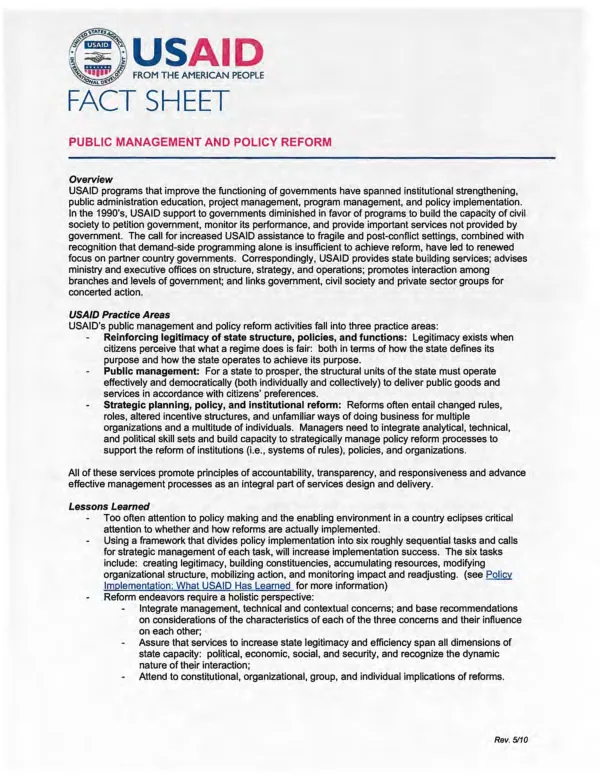
USAID programs aimed at improving the functioning of governments have spanned institutional strengthening, public administration education, project management, program management, and policy implementation.
2013 · 2 pages
Sign in to readA free account is required to download.
Abstract
Institutional strengthening efforts have focused on building the capacity of governments to deliver public goods and services effectively and democratically. Public administration education has been provided to enhance the skills of government officials in areas such as policy analysis, budgeting, and human resource management. In the 1990s, USAID support to governments diminished in favor of programs to build the capacity of civil society to petition government, monitor its performance, and provide important services not provided by government. However, the call for increased USAID assistance to fragile and post-conflict settings, combined with recognition that demand-side programming alone is insufficient to achieve reform, has led to renewed focus on partner country governments. USAID provides state building services, advises ministry and executive offices on structure, strategy, and operations, promotes interaction among branches and levels of government, and links government, civil society, and private sector groups for concerted action. USAID's public management and policy reform activities fall into three practice areas: reinforcing legitimacy of state structure, policies, and functions; public management; and strategic planning, policy, and institutional reform. Legitimacy exists when citizens perceive that what a regime does is fair, both in terms of how the state defines its purpose and how the state operates to achieve its purpose. Public management involves the structural units of the state operating effectively and democratically to deliver public goods and services in accordance with citizens' preferences. Strategic planning, policy, and institutional reform involve reforms that entail changed rules, roles, altered incentive structures, and unfamiliar ways of doing business for multiple organizations and individuals. Lessons learned from USAID's experience in public management and policy reform highlight the importance of strategic management of policy implementation. A framework that divides policy implementation into six roughly sequential tasks - creating legitimacy, building constituencies, accumulating resources, modifying organizational structure, mobilizing action, and monitoring impact and readjusting - can increase implementation success. Reform endeavors require a holistic perspective, integrating management, technical, and contextual concerns, and attending to constitutional, organizational, group, and individual implications of reforms. Leadership training and monitoring management recommendations to assure that they take local culture, values, and modes of operation into account are also essential.