ENCOMPASS, LLC
USAID Applying Science to Strengthen and Improve Systems Project
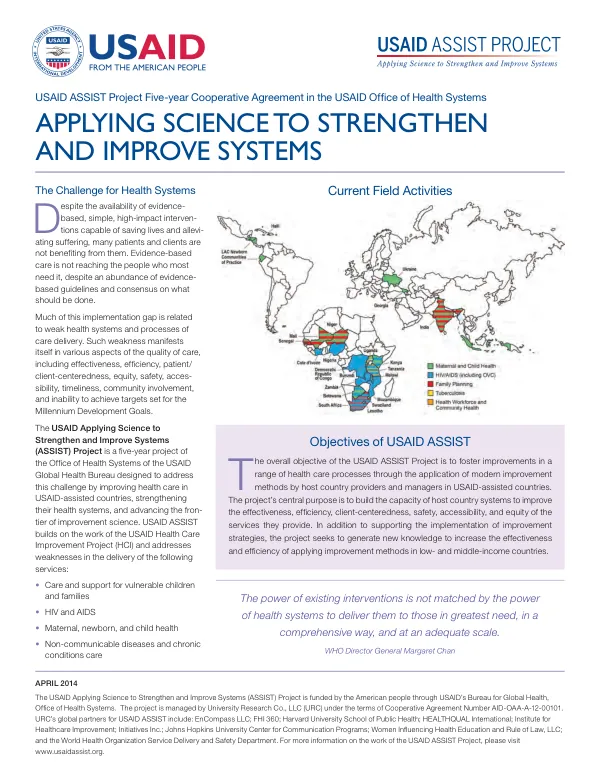
The USAID Applying Science to Strengthen and Improve Systems (ASSIST) Project is a five-year initiative aimed at improving health care in USAID-assisted countries.
2014 · 4 pages
Sign in to readA free account is required to download.
Abstract
Funded by the American people through USAID's Bureau for Global Health, Office of Health Systems, the project is managed by University Research Co., LLC (URC) under the terms of Cooperative Agreement Number AID-OAA-A-12-00101. URC's global partners for USAID ASSIST include EnCompass LLC; FHI 360; Harvard University School of Public Health; HEALTHQUAL International; Institute for Healthcare Improvement; Initiatives Inc.; Johns Hopkins University Center for Communication Programs; Women Influencing Health Education and Rule of Law, LLC; and the World Health Organization Service Delivery and Safety Department. The project addresses the challenge of weak health systems and processes of care delivery, which hinder the implementation of evidence-based, simple, high-impact interventions capable of saving lives and alleviating suffering. Despite the availability of evidence-based guidelines and consensus on what should be done, many patients and clients are not benefiting from these interventions. The project seeks to build the capacity of host country systems to improve the effectiveness, efficiency, client-centeredness, safety, accessibility, and equity of the services they provide. The overall objective of the USAID ASSIST Project is to foster improvements in a range of health care processes through the application of modern improvement methods by host country providers and managers in USAID-assisted countries. The project's central purpose is to build the capacity of host country systems to improve the effectiveness, efficiency, client-centeredness, safety, accessibility, and equity of the services they provide. In addition to supporting the implementation of improvement strategies, the project seeks to generate new knowledge to increase the effectiveness and efficiency of applying improvement methods in low- and middle-income countries. The project focuses on several key areas, including care and support for vulnerable children and families, HIV and AIDS, maternal, newborn, and child health, and non-communicable diseases and chronic conditions care. The project also works to strengthen the performance of the health workforce as well as community-based services and community linkages with facility-based care. USAID ASSIST builds the capacity of host country implementers to apply the science of improvement to health care and other services for vulnerable populations, to ensure that high-impact interventions reach every patient or client, every time, and improve outcomes. The project's learning agenda seeks to contribute to global U.S. Government initiatives and inform the larger field of health care improvement. Research supported under USAID ASSIST will address key implementation challenges for the Global Health Initiative (GHI), such as how to better meet the needs of women and girls and strengthen country ownership and local partnerships. Each program will also document how the improvement strategy has addressed gender issues. To enable learning at the local level, USAID ASSIST will incorporate knowledge management strategies and approaches in each country program. The project's knowledge portal, www.usaidassist.org, will be the central repository of improvement knowledge that is generated by every project activity and country program. The knowledge generated through improvement activities supported by USAID ASSIST will be used in each country in the form of knowledge packaged and disseminated locally through coaching visits, learning sessions, knowledge-sharing events, local websites, resource repositories in local institutions, competency development, and local publications. The USAID ASSIST Knowledge Portal will organize this packaged knowledge to make it available globally and add to it knowledge developed through project-level activities and research. The project applies the science of improvement to health care, integrating technical content and organization of care processes. This approach emphasizes the importance of understanding and changing processes and systems to produce better results. The project also recognizes the importance of working in teams, testing changes, and using data to analyze processes and identify problems. By applying the science of improvement, the project seeks to improve the effectiveness, efficiency, client-centeredness, safety, accessibility, and equity of the services provided by host country systems.