OVERSEAS PRIVATE INVESTMENT CORPORATION USA
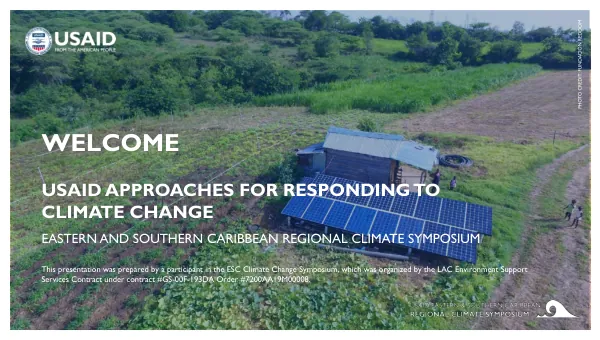
USAID Approaches for Responding to Climate Change
USAID Approaches for Responding to Climate Change in the Eastern and Southern Caribbean Region focus on scaling up financing for clean energy, sustainable landscapes, and climate adaptation.
2021 · 58 pages
Sign in to readA free account is required to download.
Abstract
Dr. Eric Hyman, Environmental Economist, DDI/Center for Economics and Market Development, Climate Change and the Bureau for Resilience and Food Security, emphasizes the importance of private sector financing in addressing the large needs of developing countries. Development assistance organizations, such as USAID, have limited resources for direct financing and can facilitate blended and private sector financing. Key strategies include improving the policy, regulatory, and macroeconomic enabling environment, developing or supporting financial instruments and markets, and providing capacity development for banks and financial institutions. The Clean Energy Lending Toolkit, developed by AILEG, is an example of a tool provided to help banks assess market and profitability of clean energy lending. USAID also supports clean energy innovation labs and business incubators, such as the USAID Development Innovation Ventures Program (DIV), which tests and scales up creative solutions to development challenges. The U.S. Development Finance Corporation, established in 2019, consolidates capabilities of the Overseas Private Investment Corporation (OPIC) and USAID Development Credit Authority (DCA), with an expanded investment cap of $60 billion and increased focus on development impact. In addition, USAID supports financing platforms, such as the Private Financing Advisory Network (PFAN), and green bond issuance. Tradable debt securities for investments with environmental benefits, green bonds meet the Green Bond Principles of the International Capital Market Association and are issued by governments, multilateral or national development banks, or corporations. The minimum size for green bond issuance is $80 - 100 million to attract investors and reduce transaction costs. Sector-specific guidance from the Climate Bonds Initiative has been developed or is pending for green bonds. The USAID approaches for responding to climate change in the Eastern and Southern Caribbean Region aim to leverage private sector financing, improve the enabling environment, and support innovative solutions to address the region's climate change challenges.
Related documents