USAID DEC
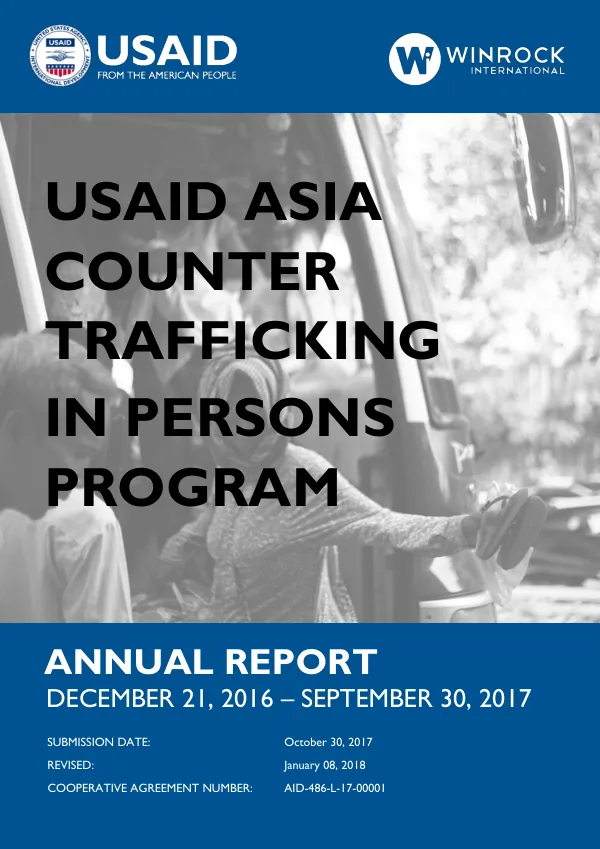
USAID Asia Counter Trafficking in Persons (CTIP) Program Year One Annual Report 2017
Sign inSSG ADVISORS, LLC
USAID Asia Counter Trafficking in Persons (CTIP) Program Year One Annual Report 2017
USAID Asia Counter Trafficking in Persons (CTIP) Program implementation began on December 21, 2016, with a five-year cooperative agreement awarded to Winrock International.
2017 · 124 pages
Sign in to readA free account is required to download.
Abstract
The program focuses on transnational and regional challenges to combat trafficking in persons, with activities aimed at strengthening learning around TIP, improving coordination and cooperation between source, transit, and destination countries, and reducing incentives for trafficking in persons through private sector engagement. During the first project year, Winrock established operations in Bangkok, assembled a strong core team, and formed a consortium with SSG Advisors, NEXUS Institute, Liberty Asia, the Mekong Club, and Global Alliance Against Trafficking in Women. The organization reached out and built relationships with a wide range of actors, civil society organizations, businesses, agencies, and officials active in CTIP throughout the region and beyond. These efforts were accompanied by the launch of foundational research and analysis and a range of initiatives across all three project Force Multipliers (FMs). Under FM 1, USAID Asia CTIP consulted stakeholders and initiated activities to understand how the project can generate, collect, and disseminate knowledge and strengthen learning. These efforts included NEXUS Institute's design and initiation of a comprehensive Research Review to determine key knowledge gaps around TIP and the most effective research methodologies focusing on Thailand, Lao PDR, Cambodia, Myanmar, and Vietnam. A Mapping of Research Institutes by GAATW identified potential local partners for ongoing TIP research, and a roadmap was developed to promote evidence-based practice and strengthen the knowledge-to-practice cycle. Winrock also established a Monitoring and Evaluation (M&E) Working Group to discuss and seek consensus on the measurement of USAID CTIP interventions in Asia, as well as for collaboration, learning, and adaptive management (CLA). The Working Group is comprised of M&E specialists from USAID-Winrock bi-lateral CTIP programs in Bangladesh, Cambodia, and Nepal, and is led by the USAID Asia CTIP MEL Specialist with support from a Senior Researcher from NEXUS. As part of their initial efforts to improve measurement of the USAID Asia CTIP interventions, the Working Group laid out their measurement logic for CTIP interventions, methods, and indicators. Under FM 2, USAID Asia CTIP initiated activities to improve coordination and cooperation between source, transit, and destination countries. These efforts included the launch of a range of initiatives across the region, including the establishment of a network of civil society organizations and the development of a private sector engagement strategy. The program also consulted with stakeholders to understand how to improve coordination and cooperation between countries. Under FM 3, USAID Asia CTIP initiated activities to reduce incentives for trafficking in persons through private sector engagement. These efforts included the launch of a range of initiatives across the region, including the development of a private sector engagement strategy and the establishment of a network of businesses and civil society organizations working together to combat TIP. The program also consulted with stakeholders to understand how to reduce incentives for trafficking in persons through private sector engagement. The USAID Asia CTIP program has made significant progress in its first project year, with a strong core team in place and a range of initiatives launched across the region. The program has established a Monitoring and Evaluation (M&E) Working Group to discuss and seek consensus on the measurement of USAID CTIP interventions in Asia, and has initiated activities to improve coordination and cooperation between source, transit, and destination countries, as well as to reduce incentives for trafficking in persons through private sector engagement. The program's research and analysis efforts have focused on understanding key knowledge gaps around TIP and the most effective research methodologies, and a roadmap has been developed to promote evidence-based practice and strengthen the knowledge-to-practice cycle. The program has also established a network of civil society organizations and developed a private sector engagement strategy to reduce incentives for trafficking in persons. Overall, the USAID Asia CTIP program has made significant progress in its first project year, with a strong core team in place and a range of initiatives launched across the region. The program is well-positioned to continue its efforts to combat trafficking in persons in the coming years.