MINISTRY OF THE ENVIRONMENT
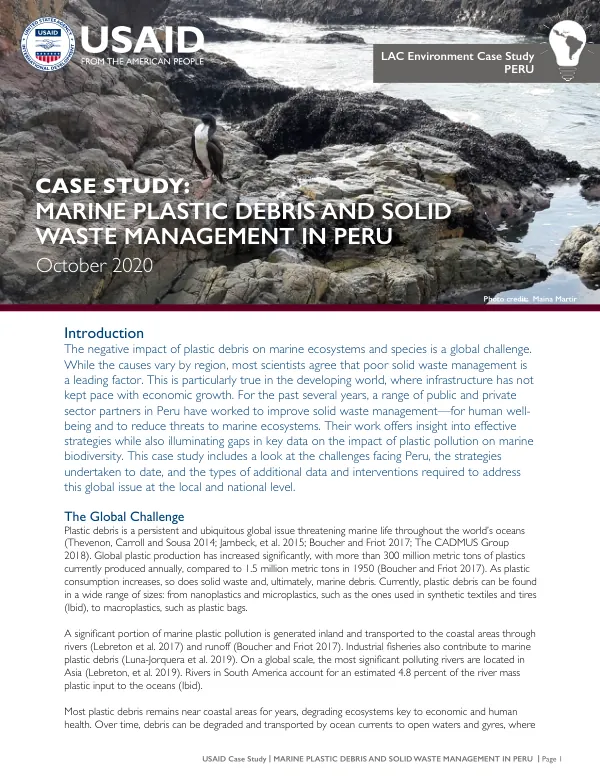
USAID Case Study: Marine Plastic Debris and Solid Waste Management in Peru
The global challenge of marine plastic debris is a persistent and ubiquitous issue threatening marine life throughout the world's oceans.
2020 · 12 pages
Sign in to readA free account is required to download.
Abstract
Plastic production has increased significantly, with more than 300 million metric tons of plastics currently produced annually, compared to 1.5 million metric tons in 1950. As plastic consumption increases, so does solid waste and, ultimately, marine debris. Plastic debris can be found in a wide range of sizes, from nanoplastics and microplastics to macroplastics, such as plastic bags. A significant portion of marine plastic pollution is generated inland and transported to coastal areas through rivers and runoff. Industrial fisheries also contribute to marine plastic debris. On a global scale, the most significant polluting rivers are located in Asia, while rivers in South America account for an estimated 4.8 percent of the river mass plastic input to the oceans. Most plastic debris remains near coastal areas for years, degrading ecosystems key to economic and human health. Over time, debris can be degraded and transported by ocean currents to open waters and gyres, where particles accumulate and create "garbage patches." Plastic debris has negative effects on marine wildlife, including entanglement, ingestion, the transport of invasive species, and toxic pollutants. Microplastics have been reported in a wide range of marine taxa, including amphipods living in six of the deepest marine ecosystems on Earth. However, a nuanced understanding of the impact of plastic on the biology of specific marine species is still poorly understood. The risk of exposure to plastics and microplastics depends on the distribution and abundance of the plastics and the biology of the species. Peru is a country with a significant coastline and diverse ecosystems, including five Ramsar sites, and economic activities, such as tourism. Peru's coastal waters are among the most biologically productive in the world, given the cold, nutrient-rich water brought by the Humboldt Current. From an economic standpoint, Peru is the world leader in fish meal and fish oil production, with industrial and artisanal fisheries supporting about 95,000 jobs. In 2019, Peru exported 1.81 million tons of fish and fish products, valued at $3.5 billion. Efforts are underway to generate information on the impacts of plastics and microplastics on Peru's fisheries and coastal ecosystems. Initial studies documented the presence of microplastics in three commercial species off the coast of Peru, with higher concentrations found in carnivorous species. The authors concluded that bioaccumulation and proximity to a megacity with poor waste management contributed to these findings. In 2019, Peru's Ministry of Production transferred $760,000 to the Peruvian Institute of the Sea (IMARPE) to assess the presence of marine debris in areas of extraction of hydrobiological resources along the coast of Peru and Lake Titicaca. The majority of Peru's population lives in coastal cities located on the country's 3,000 km coastline, generating concerns about land-based marine debris. In Peru, 19,000 tons of solid waste are generated each day, of which about 52 percent goes to sanitary landfills, and the rest is disposed of in unpermitted and unmanaged dumps, often located near rivers or in wetlands. As the economy grows, so does plastic consumption and marine debris. Peru has a GDP per capita of $6,941, which is associated with plastic waste production of 0.1-0.2 kg per capita. This is comparable to the per capita plastic waste production of other Latin American countries, such as Colombia, Nicaragua, and Honduras. The positive relationship between GDP and plastic waste is further borne out at the municipal level. Within Lima's greater metropolitan area, the more affluent the area, the greater volume of waste produced. Middle-income countries like Peru typically have the highest rates of mismanaged plastic waste because waste management infrastructure has not kept pace with increasing consumption. In 2016, Peru generated 708,000 tons of plastics per year, of which 43.7 percent was inadequately disposed. Further, the Ministry of Environment (MINAM) estimates that only about 1.9 percent of the recyclable materials are recycled.