FOOD AND AGRICULTURE ORGANIZATION OF THE UNITED NATIONS IN GEORGIA
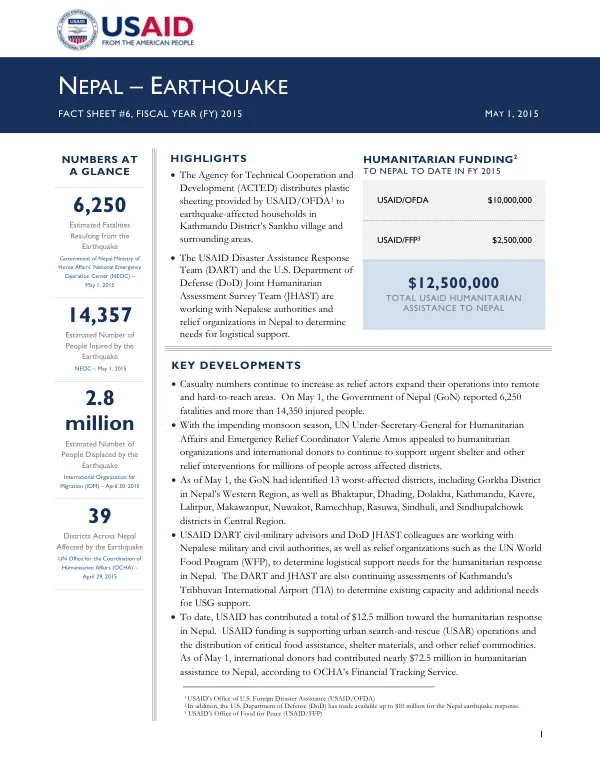
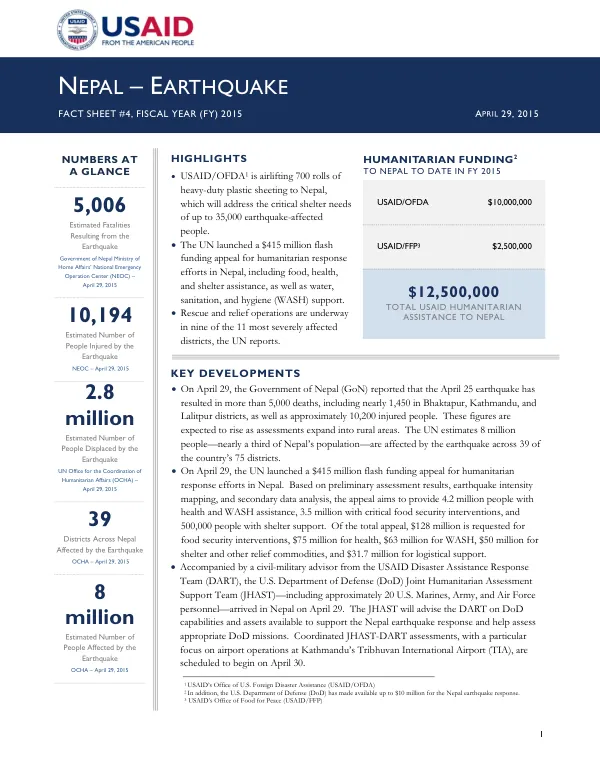
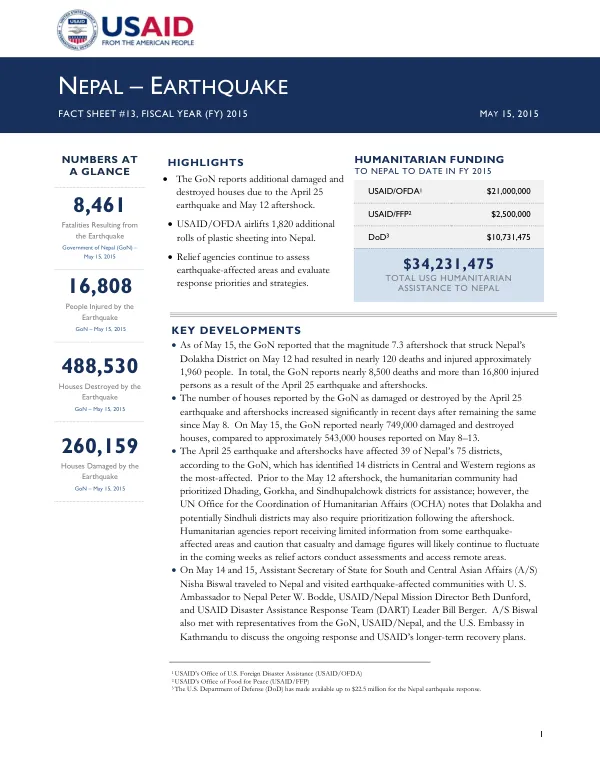
Nepal – Earthquake Fact Sheet #5, Fiscal Year (FY) 2015
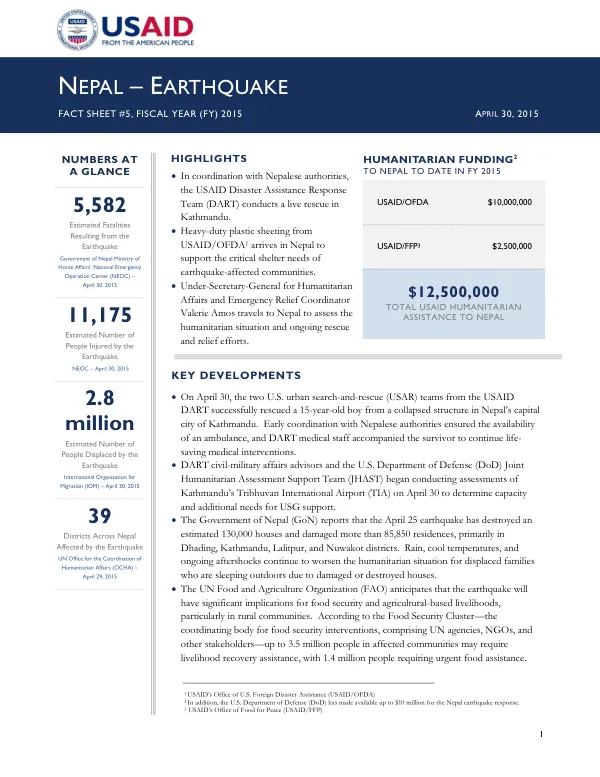
The Nepal earthquake occurred on April 25, with a magnitude of 7.8 at a shallow depth of approximately 15 kilometers.
2015 · 5 pages
Sign in to readA free account is required to download.
Abstract
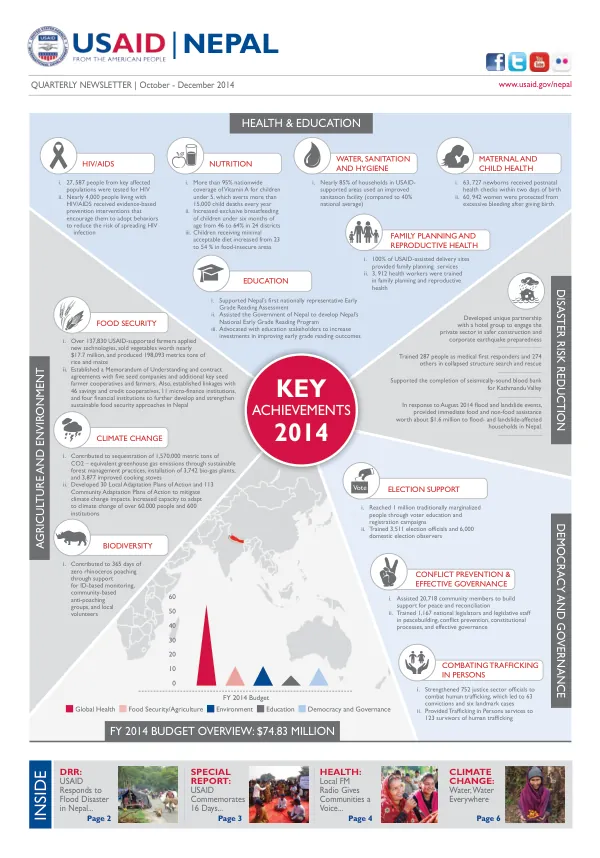
The epicenter was located approximately 77 kilometers northwest of Kathmandu, the country's capital city. The US Government immediately issued a disaster declaration for Nepal due to the effects of the earthquake. Initial assessments conducted by the Government of Nepal (GoN) and humanitarian partners reported significant damage to infrastructure, including roads, bridges, and buildings. The GoN estimates that the earthquake destroyed more than 130,000 houses and damaged over 85,850 residences, primarily in Dhading, Kathmandu, Lalitpur, and Nuwakot districts. The UN Office for the Coordination of Humanitarian Affairs (OCHA) reports that 39 districts across Nepal were affected by the earthquake. The USAID Disaster Assistance Response Team (DART) conducted a live rescue in Kathmandu, and international USAR teams continued search-and-rescue operations in the city. The DART's USAR teams from Fairfax County, Virginia, and Los Angeles County, California, successfully rescued a 15-year-old boy from a collapsed structure on April 30. Rescue operations beyond Kathmandu Valley were limited due to debris, access challenges, and damage to communication infrastructure. The GoN and humanitarian partners highlighted the urgency of providing medical resources in areas outside of Kathmandu Valley. The GoN Ministry of Health and Population, in coordination with the UN World Health Organization (WHO), plans to begin identifying in-country foreign medical teams (FMTs) that may be able to offer medical support in areas beyond Kathmandu following the immediate response. At present, OCHA reports that more than 30 FMTs, comprising a total of 365 personnel, are providing health services and medical supplies in Nepal. The UN Food and Agriculture Organization (FAO) anticipates a significant impact on food security and livelihoods due to disruptions to the agricultural planting season and the likely loss of livestock, food supplies, and agricultural inputs following the earthquake. The FAO had requested $8 million to provide Nepalese farmers with key agricultural inputs needed to resume preparations for rice sowing season, as well as animal feed and veterinary services to maintain remaining livestock. USAID's Office of Food for Peace (USAID/FFP) has contributed $2.5 million to WFP's Corporate Response Emergency Operation for the purchase of 1,390 metric tons of rice to address the urgent food needs of approximately 120,000 people for one month.
Related documents