GLOBAL FUND
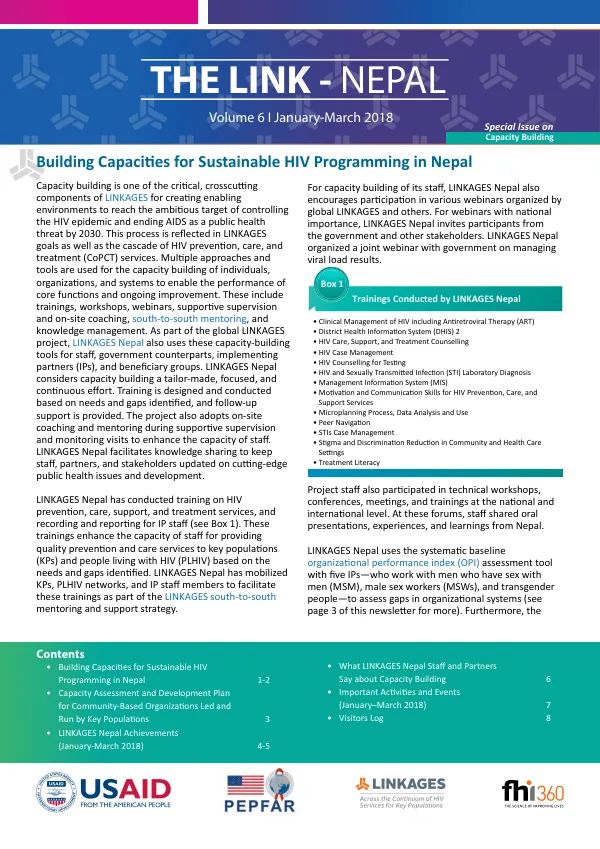
Building Capacities for Sustainable HIV Programming in Nepal
Capacity building is a critical component of the LINKAGES project in Nepal, aimed at creating enabling environments to control the HIV epidemic and end AIDS as a public health threat by 2030.
2018 · 8 pages
Sign in to readA free account is required to download.
Abstract
This process is reflected in the project's goals and the cascade of HIV prevention, care, and treatment (CoPCT) services. Multiple approaches and tools are used for capacity building, including trainings, workshops, webinars, supportive supervision, and on-site coaching. The project focuses on building the capacity of individuals, organizations, and systems to enable the performance of core functions and ongoing improvement. Trainings are designed and conducted based on needs and gaps identified, and follow-up support is provided. The project also adopts on-site coaching and mentoring during supportive supervision and monitoring visits to enhance the capacity of staff. LINKAGES Nepal facilitates knowledge sharing to keep staff, partners, and stakeholders updated on cutting-edge public health issues and development. The project has conducted training on HIV prevention, care, support, and treatment services, and recording and reporting for IP staff. These trainings enhance the capacity of staff for providing quality prevention and care services to key populations (KPs) and people living with HIV (PLHIV) based on the needs and gaps identified. LINKAGES Nepal has mobilized KPs, PLHIV networks, and IP staff members to facilitate these trainings as part of the LINKAGES south-to-south mentoring and support strategy. The project also encourages participation in various webinars organized by global LINKAGES and others. For webinars with national importance, LINKAGES Nepal invites participants from the government and other stakeholders. The project staff also participated in technical workshops, conferences, meetings, and trainings at the national and international level. At these forums, staff shared oral presentations, experiences, and learnings from Nepal. LINKAGES Nepal uses the systematic baseline organizational performance index (OPI) assessment tool with five IPs to assess gaps in organizational systems. The project also supports IPs with organizational development opportunities, including technical support to Sudur Paschim Samaj (SPS) in connecting with international organizations and Out in Tech for the development of their website. The project contributes to the capacity-building activities of the Government of Nepal, particularly National Centre for AIDS and STD Control (NCASC) and National Public Health Laboratory (NPHL). This includes facilitation of sessions during training organized by NCASC and NPHL, conducting continued medical education (CME) at ART centers, and reviewing and providing technical inputs for national guidelines, training manuals, and strategic behavioral communication (SBC) materials. LINKAGES Nepal supported NCASC and NPHL to conduct training via session facilitation on health care waste management and biosafety, early infant diagnosis (EID), CD4 count, HIV and STI laboratory diagnosis, and logistics management of HIV commodities. The project also provided technical and financial support to NCASC to organize a workshop on designing mHealth messages to improve ART retention and adherence among PLHIV in Nepal. The project conducted CME on test and treat including National HIV Testing and Treatment Guidelines 2017 at ART centers, followed by clinical mentoring and supportive supervision. The project organized technical workshops engaging the target population and promoting learnings, and sustainability appraises an IP's capacity to provide quality services.