USAID DEC
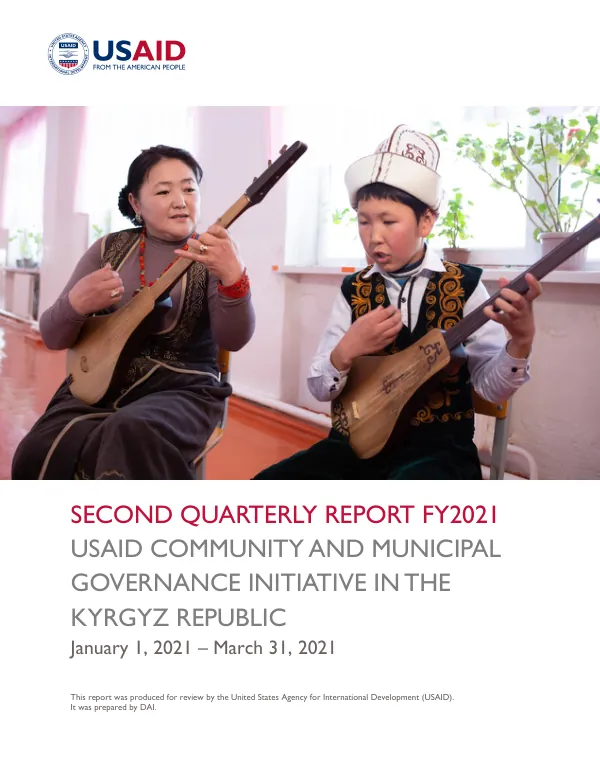
USAID Community and Municipal Governance Initiative in the Kyrgyz Republic: Second Quarterly Performance Report Year 5 (January 2021 – March 2021)
Sign inDAI
USAID Community and Municipal Governance Initiative in the Kyrgyz Republic: Second Quarterly Performance Report Year 5 (January 2021 – March 2021)
The USAID Community and Municipal Governance Initiative in the Kyrgyz Republic supports the Government of the Kyrgyz Republic in strengthening the relationship between local governing bodies and the public they serve.
2021 · 37 pages
Sign in to readA free account is required to download.
Abstract
The project focuses on service delivery improvements that are highly visible to the public, such as solid waste management, water, lighting, transportation, and local economic development, while building the capacity of partner local self-governments (LSGs) across all service areas for which they are responsible. The activity encourages peer learning and bolsters existing mechanisms for local self-governments to engage in a national dialogue. The project has three components: Increasing LSG Effectiveness, Increasing LSG Legitimacy, and Furthering and Sustaining Indigenous Kyrgyz LSG Support Capabilities. Component 1 aims to improve LSGs' ability to deliver more accessible and effective services, while Component 2 focuses on increasing citizen engagement through effective communications strategies and improving dialogue between LSGs and citizens. Component 3 promotes peer-learning and experience exchange, extends the project's successes through networking and replication among partner LSGs, and works closely with the Union of LSGs. During the reporting period, January 1, 2021, to March 31, 2021, the project conducted several activities to achieve its objectives. The final Effectiveness Survey was conducted in all 50 partner LSGs, and the project monitored the implementation of all 12 VIS steps. Targeted coaching was provided to enable achievement of the Effectiveness Indicators, and support was given to NGOs in their coaching sessions concerning CAMI's major products. Training events were conducted on organization of local service delivery for municipal servants in five raions in Osh region and Osh city, and a study tour was conducted on management of municipal enterprises showcasing the best practice developed in Nookat. The project also assisted Nookat city administration in writing-off its deteriorated assets and prepared an analytical note on the problems of introducing tax administration responsibilities for LSGs and submitted it to the relevant ministries and agencies. In addition, the project conducted focus group discussions as part of its final Legitimacy Survey in all of the 50 partner municipalities and provided technical support to the Union of LSGs to assist 15 pilot LSGs in development and approval of their codes of ethics for local council members. The project faced challenges related to the upcoming local elections and the COVID-19 situation in the country. However, the project staff have been working remotely since March 19, 2020, and the project will follow the Government's and DAI's instructions related to the COVID-19 situation in the country. The project will also monitor the situation with the upcoming elections and their results. The project has made solid progress in implementing the following activities: Conducted the final Effectiveness Survey in all 50 partner LSGs, monitored the implementation of all 12 VIS steps, provided targeted coaching to enable achievement of the Effectiveness Indicators, and provided support to the NGOs in their coaching sessions concerning CAMI's major products. The project also conducted training events on organization of local service delivery for municipal servants in five raions in Osh region and Osh city, and a study tour on management of municipal enterprises showcasing the best practice developed in Nookat. The project's progress in increasing LSG effectiveness is evident in the final Effectiveness Survey conducted in all 50 partner LSGs, which showed improvements in service delivery and citizen engagement. The project's efforts to increase LSG legitimacy are also reflected in the focus group discussions conducted as part of the final Legitimacy Survey, which showed increased citizen engagement and participation in local governance. The project's success in promoting peer-learning and experience exchange is evident in the Peer-to-Peer Learning Platform sessions conducted in four raions, which brought together LSGs and NGOs to share best practices and experiences. The project's work with the Union of LSGs to assist 15 pilot LSGs in development and approval of their codes of ethics for local council members is also a significant achievement. Overall, the project has made significant progress in implementing its activities and achieving its objectives. The project's efforts to strengthen the relationship between local governing bodies and the public they serve have improved service delivery and citizen engagement, and have promoted peer-learning and experience exchange among LSGs and NGOs.