USAID DEC
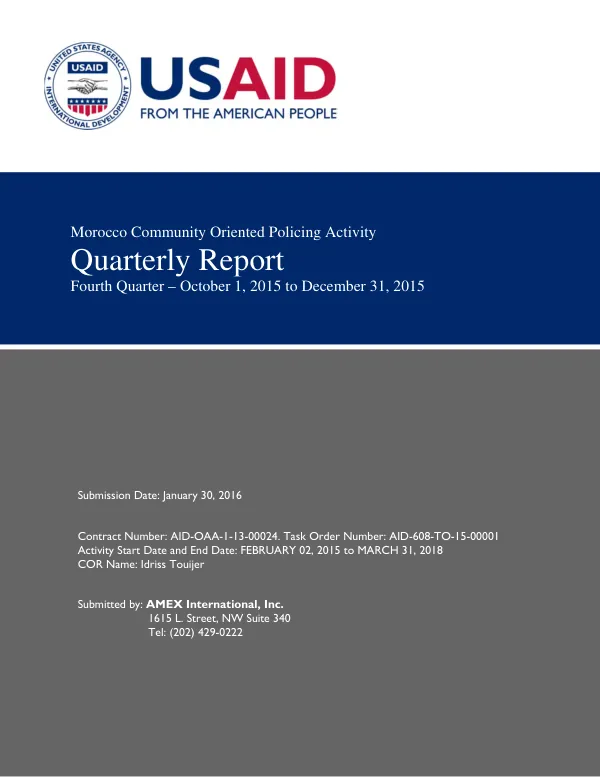
USAID Community Oriented Policing Activity Final Report Fourth Quarter – October 1, 2015 to December 31, 2015
Sign inAMEX INTERNATIONAL, INC.
USAID Community Oriented Policing Activity Final Report Fourth Quarter – October 1, 2015 to December 31, 2015
The Community-Oriented Policing Activity (COPA) in Morocco is a three-year effort to support innovative and effective approaches that improve the participation of citizens in promoting security and advancing community-oriented policing.
2016 · 26 pages
Sign in to readA free account is required to download.
Abstract
COPA works with civil society organizations, schools, at-risk youth, faith-based, youth, and private sector groups, in partnership with police and local government leaders, to identify and address problems related to crime, safety, security, and livability in targeted neighborhoods. The project's objective is to develop the capacity of police, government, and community stakeholders to communicate more effectively and work constructively together to solve problems of mutual concern. Key achievements this quarter include implementing the community crime prioritization, ongoing police trainings in Tetouan, launching the Grants Program, and utilizing the MSC - Most Significant Change - Approach. The MSC approach involves the collection and systematic participatory interpretation of stories of significant change. Unlike conventional approaches to monitoring, MSC does not employ quantitative indicators; instead, it is a qualitative approach to monitoring and evaluation outcomes, including unintended ones. This approach allows for a more nuanced understanding of the impact of COPA's activities and enables the project team to identify areas for improvement. Component 1 of the project focuses on improving community-police relationships in target neighborhoods. Task 2 of this component involves building the capacity of associations, communities, and government to work in cooperation. During the fourth quarter reporting period, the COPA team conducted community-level consultations with segments of each association's neighborhood and beneficiary populations. Training sessions were also provided to association members on crime prevention, the principles of community policing, and the prioritization of crime issues. Three training sessions were conducted with 62 association members and volunteers of 10 associations in Tangier and Tetouan. The trainings defined the first phase of the Crime Prevention Plan and consisted of presentations, hands-on exercises, and group discussions about the following subjects: introduction to the problem-solving approach for conflict resolution known as PAFI, introduction to the role of Core Teams, definition of the five crime issues and their characteristics, methods of identifying and prioritizing crime issues, and defining an action plan to organize consultation meetings on crime and other related issues affecting communities in the district. Following the presentations, the participants performed a workshop where they developed a presentation about their neighborhoods' community policing needs. Workshop results were presented in role-play fashion where participants simulated presenting Community Policing to the residents of their neighborhoods. The COPA team provided action plan models that included steps to organize community meetings and identify and prioritize crime problems. Each association will develop its own action plan and submit it to COPA. Community meetings were held in the presence of partner associations to present principles of community policing and identify and prioritize crime issues. Four community consultation meetings were held in the fourth quarter, with a total of 279 participants, including 115 women. The meetings identified crime problems such as drug trafficking, drug use, theft, and sexual harassment. A total of 182 persons volunteered to be part of the core team, including 59 women.
Related documents
![Atelier d'evaluation de la FNAM [Federation Nationale des Associations de Microcrdit] du 07 au 09 mai 2004 au centre de la CNSS Marrakech[, Maroc]](https://covers.devme.ai/gen/144273.webp)