PLAN INTERNATIONAL
Capacity Building Strategy for Child Protection in Humanitarian Action
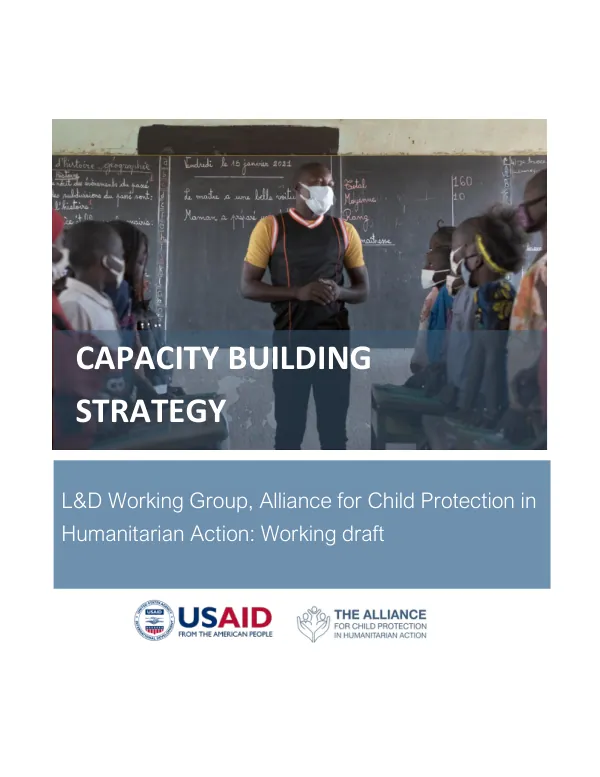
Capacity Building Strategy for Child Protection in Humanitarian Action The Capacity Building Strategy for Child Protection in Humanitarian Action (CPHA) is a comprehensive plan designed to strengthen the knowledge and skills of CPHA practitioners to protect children during the COVID-19 pandemic.
2021 · 12 pages
Sign in to readA free account is required to download.
Abstract
The strategy is made possible by the generous support of the American people through the United States Agency for International Development's Office of U.S. Foreign Disaster Assistance (USAID). The strategy is based on the results of a rapid capacity gaps analysis conducted in September-October 2020 by Plan International, in cooperation with the Learning and Development (L&D) Working Group of the Alliance for Child Protection in Humanitarian Action. The analysis identified specific target audiences, programmatic focus areas, and learning objectives that will most effectively support CPHA practitioners to adapt and continue their programming during the pandemic. The target audience for the capacity building plan includes three specific groups within the CPHA community: CP Coordinators and Managers, CP Officers, and Community Volunteers. Based on the capacity gaps analysis and conversations with practitioners, learning needs have been identified for each of these audiences in a number of priority technical areas. The objectives of the Covid-19 CPHA capacity building plan are to strengthen the knowledge and skills of CPHA practitioners to protect children during the COVID-19 pandemic. To achieve this, the plan will develop a range of capacity building resources and opportunities, including a Massive Online Open Course (MOOC) in two languages, a collection of case studies on capacity building adaptations during COVID-19, a series of video shorts on the safe use of platforms and apps for remote CP program delivery, a podcast on Protecting Children Online, and a series of training modules and learning tools. The MOOC will be developed, rolled-out, updated, and run for a second iteration. The learning objectives of the MOOC are that by the end of the course, learners will be able to assess the context set through public health measures and elaborate on how this affects protective and risk factors for children in preparedness, response, transition, and recovery to COVID-19 and other IDOs. The MOOC will also cover topics such as adapting child protection prevention and response programming in line with CPMS principles and standards, jointly implementing with other sectors to protect children, and identifying key actions to support risk-informed programming and contribute to system strengthening in future IDOs. In addition to the MOOC, the plan will collect five case studies of innovative adaptations to child protection capacity building initiatives during COVID-19 through interviews with practitioners. The case studies will be collated and shared in English, Arabic, French, and Spanish, and three capacity-sharing webinars will be run in Arabic, English, Spanish, and French to further disseminate the learning. The plan also includes the development of a series of video shorts on the safe use of platforms and apps for remote CP program delivery. For each platform and app discussed, the videos will highlight the possible use in remote programming and the pros and cons of choosing this tool. The key safety and security features of each tool will then be introduced, enabling practitioners to change their own settings. Furthermore, the plan includes the development of a podcast on Protecting Children Online, which will be recorded and disseminated. The plan also includes the development of a series of training modules and learning tools, broken down by Child Protection technical area and audience. Eight technical areas have been considered for each of the three target audience groups, and priority has been given to the following capacity building activities. One of the key capacity building activities is the development of a Community Volunteers Learning Package. This package will be developed to meet a range of learning objectives across the priority technical areas, including collaboration with health on UASC, collaboration with education, awareness raising and information dissemination, family strengthening, case management, and CAAFAG. The package will include learning tools such as tip sheets, infographics, key message posters, and checklists, as well as face-to-face training packages and role-play exercises. Another key capacity building activity is the development of Case Management for CP Coordinators and Managers. This will include the development of a face-to-face or text messaging course to support CP Coordinators and Managers to plan, implement, and monitor case management. The course will cover topics such as safely identifying and referring child protection cases during the pandemic, and providing examples of cases that would need to be referred in the context of a pandemic. Overall, the Capacity Building Strategy for Child Protection in Humanitarian Action is a comprehensive plan designed to strengthen the knowledge and skills of CPHA practitioners to protect children during the COVID-19 pandemic. The strategy includes a range of capacity building resources and opportunities, including a MOOC, case studies, video shorts, a podcast, and training modules and learning tools. The plan is designed to cater to three specific audiences within the CPHA community, and priority has been given to the following capacity building activities.
Related documents