ECODIT, INC.
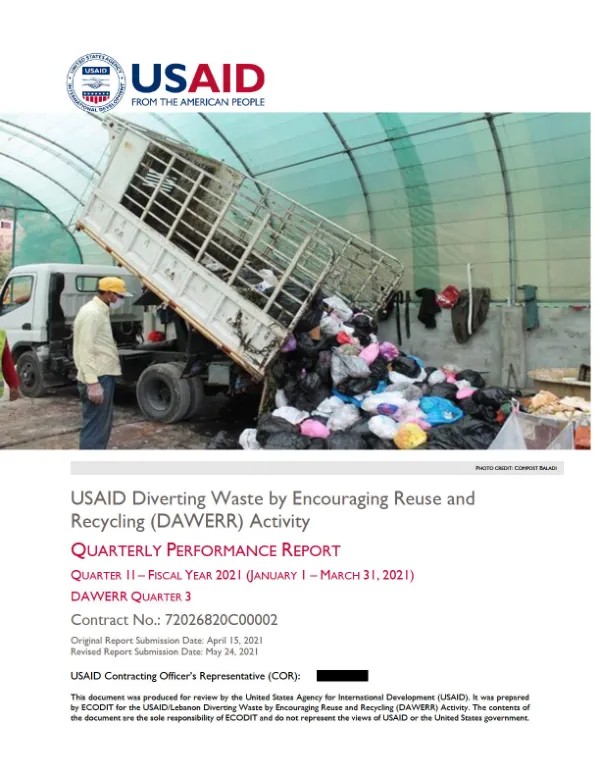
USAID DAWERR: Q2 FY2021/ Q3 Y1 – QUARTERLY PERFORMANCE REPORT
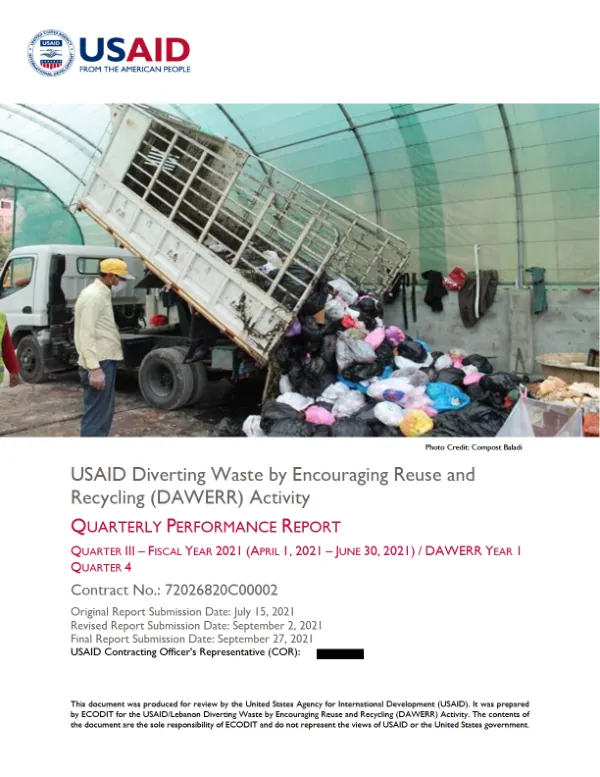
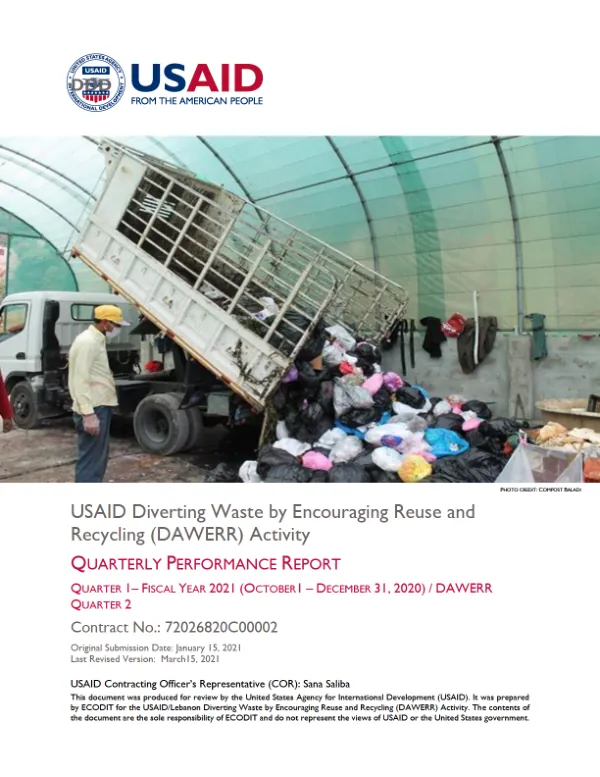
The USAID Diverting Waste by Encouraging Reuse and Recycling (DAWERR) Activity aims to establish sustainable and replicable integrated solid waste diversion and valorization solutions in rural areas of Lebanon.
2021 · 33 pages
Sign in to readA free account is required to download.
Abstract
The Activity aligns with USAID/Lebanon's desire to introduce financially sustainable solutions that increase the reuse, recycling, and monetization of solid waste to reduce the amount of solid waste that goes to landfills. The Activity's period of performance is August 1, 2020 to July 31, 2025. Solid Waste Management (SWM) in Lebanon has been poorly addressed through temporary fixes and emergency plans. A survey conducted in 2016 indicated that 5.7 million cubic meters of municipal solid waste are in 617 different dump sites across Lebanon. Of these, only 55 percent were operational. Short-term solutions were instituted instead of developing and implementing an integrated, sustainable strategy. These solutions did not encourage the reduction, reuse, recycling, and management of waste to protect human health and the environment. The central government has promised change but has struggled to deliver much-needed reforms of essential services. Although empowered by law to deliver many essential services, the vast majority of Lebanon's municipalities, particularly those in smaller and rural communities, lack the financial and human resources as well as the technical capacity to fulfill this mandate alone. Specifically, they do not have the know-how to plan, develop, and execute an Integrated SWM solution following principles of good governance. Democracy Reporting International (DRI) reports that 87 percent of Lebanese municipalities manage their own waste in one way or another. Of these, 93 percent are involved in waste collection. However, assessing the stages and technicalities of the SWM cycle, municipalities are less and less able to meet their responsibilities. A lack of resources is not their only challenge. Ineffective laws and regulations as well as the lack of central governance also play a part. The newly enacted Integrated SWM Law No. 80 dated October 10, 2018, favors the decentralization principle of SWM, but it also entrusts central government authorities with significant power to run SWM projects. The regulatory role of the National Solid Waste Management Authority is unclear, and the lack of a clear policy framework has hindered the development of an effective SWM system. The DAWERR Activity aims to address these challenges by establishing sustainable and replicable integrated solid waste diversion and valorization solutions in rural areas of Lebanon. The Activity will focus on the following key areas: (1) developing and implementing an Integrated SWM solution following principles of good governance, (2) increasing the reuse, recycling, and monetization of solid waste, and (3) reducing the amount of solid waste that goes to landfills. The Activity will be implemented in partnership with local municipalities, non-governmental organizations, and private sector entities. The Activity will also engage with local communities to raise awareness about the importance of SWM and to promote behavior change. The Activity will be monitored and evaluated regularly to ensure that it is meeting its objectives and to identify areas for improvement. The Activity's progress will be reported quarterly to USAID/Lebanon. The first quarterly report covers the period from January 1, 2021 to March 31, 2021. The report highlights the progress made during this period, including the development of an Integrated SWM solution, the establishment of partnerships with local municipalities and non-governmental organizations, and the engagement with local communities. The report also highlights the challenges encountered during this period, including the lack of resources and the unclear regulatory role of the National Solid Waste Management Authority. The report identifies areas for improvement and outlines the plans for the next quarter. The DAWERR Activity has the potential to make a significant impact on the SWM sector in Lebanon. By establishing sustainable and replicable integrated solid waste diversion and valorization solutions, the Activity can help to reduce the amount of solid waste that goes to landfills, increase the reuse, recycling, and monetization of solid waste, and promote behavior change among local communities.