MINISTRY OF AGRICULTURE
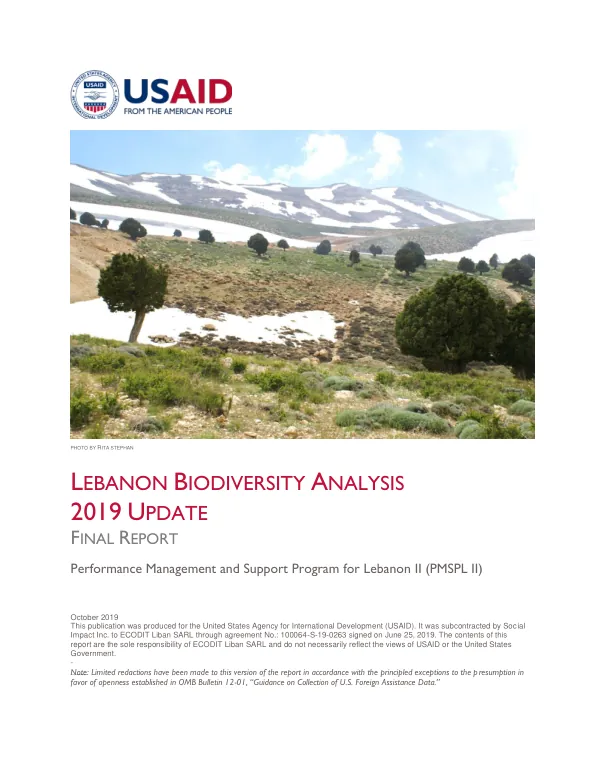
Lebanon Biodiversity Analysis 2019 Update - Redacted
Lebanon's biodiversity is characterized by a rich diversity of natural ecosystems, driven by its physical environment.
2019 · 93 pages
Sign in to readA free account is required to download.
Abstract
The country's location at middle latitudes and at the crossroads of three continents and biogeographic realms has resulted in a unique combination of Mediterranean, temperate, and subtropical ecosystems. Five major ecosystems are identified, including forests and woodlands, riparian thickets and wetlands, grasslands and rocky outcrops, coastal, and marine ecosystems. The total number of species in Lebanon is estimated to be approximately 9,000, with almost half being fauna. The terrestrial vertebrate fauna of Lebanon is more studied than the invertebrate fauna, comprising over 50 species of mammals, more than 300 species of birds, less than 10 species of amphibians, and over 40 species of reptiles. Lebanon is considered a biodiversity hotspot, with a varying richness according to regions, habitats, and threats. Three percent of Lebanon's total area could be classified as Important Plant Areas, hosting simultaneously 80% of the total flora and endemic species. Major threats to biodiversity in Lebanon include habitat fragmentation and destruction, primarily due to quarrying, fires, and dams execution. Pollution and population growth are also beyond the capacity of biodiversity to regenerate and recover damages. Invasive species have become a serious threat, particularly in marine ecosystems. Since the last assessment in 2012, the country has taken significant steps to shore up its conservation efforts. Notable achievements include the approval of a new law for protected areas, the increase of the number of nature reserves from 10 in 2010 to 15 in 2019, and the initiation of the 40 million trees program. The assessment identifies actions necessary to conserve biodiversity, including the control of urban expansion through land use planning and management, raising awareness on the importance of biodiversity, capacity building, and advocacy for the enforcement of existing laws and regulations. Interventions under USAID/Lebanon's Livelihoods in Forestry (LiF) activity have had a direct impact on biodiversity conservation, while other activities have had indirect effects. The USAID's Country Development Cooperation Strategy for 2014-2019 does not directly address biodiversity conservation, but the Mission has implemented activities to address biodiversity conservation both directly and indirectly. The assessment provides a framework of priority conservation needs and identifies other specific actions that the country can undertake. The report concludes that interventions under USAID/Lebanon's Livelihoods in Forestry (LiF) activity have had a direct impact on biodiversity conservation, while other activities have had indirect effects. The USAID's Country Development Cooperation Strategy for 2014-2019 does not directly address biodiversity conservation, but the Mission has implemented activities to address biodiversity conservation both directly and indirectly. The assessment highlights the importance of continued conservation efforts in Lebanon, including the control of urban expansion, raising awareness on the importance of biodiversity, capacity building, and advocacy for the enforcement of existing laws and regulations. The report emphasizes the need for a coordinated approach to biodiversity conservation, involving government agencies, non-governmental organizations, and local communities. The assessment provides a framework for priority conservation needs and identifies specific actions that the country can undertake to conserve its rich biodiversity. The report concludes by emphasizing the need for continued support and funding for biodiversity conservation efforts in Lebanon. The assessment highlights the importance of addressing the major threats to biodiversity, including habitat fragmentation and destruction, pollution, and invasive species. The report emphasizes the need for a coordinated approach to biodiversity conservation, involving government agencies, non-governmental organizations, and local communities. The assessment provides a framework for priority conservation needs and identifies specific actions that the country can undertake to conserve its rich biodiversity.
Related documents