FOOD AND AGRICULTURAL ORGANIZATION
USAID-DCHA Horn of Africa Drought Fact Sheet #2
The eastern Horn of Africa is currently experiencing a severe food security emergency due to prolonged drought conditions.
2011 · 4 pages
Sign in to readA free account is required to download.
Abstract
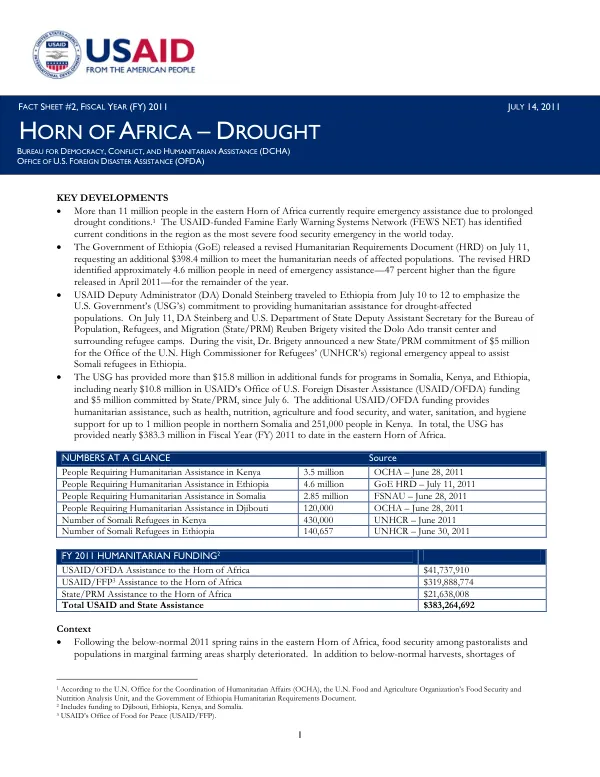
More than 11 million people in the region require emergency assistance, with the USAID-funded Famine Early Warning Systems Network (FEWS NET) identifying the current conditions as the most severe food security emergency in the world today. The Government of Ethiopia has released a revised Humanitarian Requirements Document (HRD) requesting an additional $398.4 million to meet the humanitarian needs of affected populations. The revised HRD identified approximately 4.6 million people in need of emergency assistance, a 47 percent increase from the figure released in April 2011. USAID Deputy Administrator Donald Steinberg traveled to Ethiopia from July 10 to 12 to emphasize the U.S. Government's commitment to providing humanitarian assistance for drought-affected populations. Steinberg and U.S. Department of State Deputy Assistant Secretary for the Bureau of Population, Refugees, and Migration (State/PRM) Reuben Brigety visited the Dolo Ado transit center and surrounding refugee camps, where Brigety announced a new State/PRM commitment of $5 million for the Office of the U.N. High Commissioner for Refugees' (UNHCR's) regional emergency appeal to assist Somali refugees in Ethiopia. The U.S. Government has provided more than $15.8 million in additional funds for programs in Somalia, Kenya, and Ethiopia, including nearly $10.8 million in USAID's Office of U.S. Foreign Disaster Assistance (USAID/OFDA) funding and $5 million committed by State/PRM, since July 6. The additional USAID/OFDA funding provides humanitarian assistance, such as health, nutrition, agriculture, and food security, and water, sanitation, and hygiene support for up to 1 million people in northern Somalia and 251,000 people in Kenya. In total, the U.S. Government has provided nearly $383.3 million in Fiscal Year (FY) 2011 to date in the eastern Horn of Africa. Food security in the Horn of Africa is unlikely to improve significantly in the immediate future and may continue to deteriorate further in certain areas, according to FEWS NET. Commodity prices will likely remain high, further exacerbating food insecurity across the region. The U.N. World Food Program (WFP) reports that wholesale maize prices in Kenya have doubled and the price of milk has increased by 300 percent in Wajir and Garissa counties in North Eastern Province. WFP announced on July 14 that it is working with the U.N. Humanitarian Coordinator to explore possibilities to return to areas in southern Somalia, pending U.N. security clearance and if conditions allow. Humanitarian agencies have indicated that approximately half of newly arrived children under the age of five in the Dolo Ado transit center in Ethiopia are malnourished. USAID/OFDA partners in Ethiopia report that malnutrition in many areas is worse than during the 2008 drought. Relief agencies report that approximately 17.5 percent of children between the ages of six months and five years residing in the outskirts of the Dagahaley camp of the Dadaab refugee complex in Kenya's North Eastern Province are severely malnourished. In response to critical nutrition needs in Somalia, the Nutrition Cluster—the coordinating body for nutrition activities—is operating 216 outpatient therapeutic feeding programs in south-central Somalia and planning to scale up operations to respond to increased needs. Relief agencies report that drought- and conflict-affected people continue to flee central and southern Somalia for Mogadishu and camps in southern Ethiopia and northeastern Kenya, where assistance is more readily available. UNHCR released an emergency appeal for $136.3 million to address the ongoing refugee crisis in the Horn of Africa, estimating that more than 135,000 Somalis have fled the country to date in FY 2011, straining available resources and resulting in crowded conditions in refugee camps in Ethiopia and Kenya. UNHCR is scheduled to open the Ifo II camp extension at the Dadaab refugee complex in 10 days, in consultation with the Government of Kenya, which has the capacity to house nearly 40,000 refugees.
Related documents