ADVENTIST DEVELOPMENT AND RELIEF AGENCY INTERNATIONAL
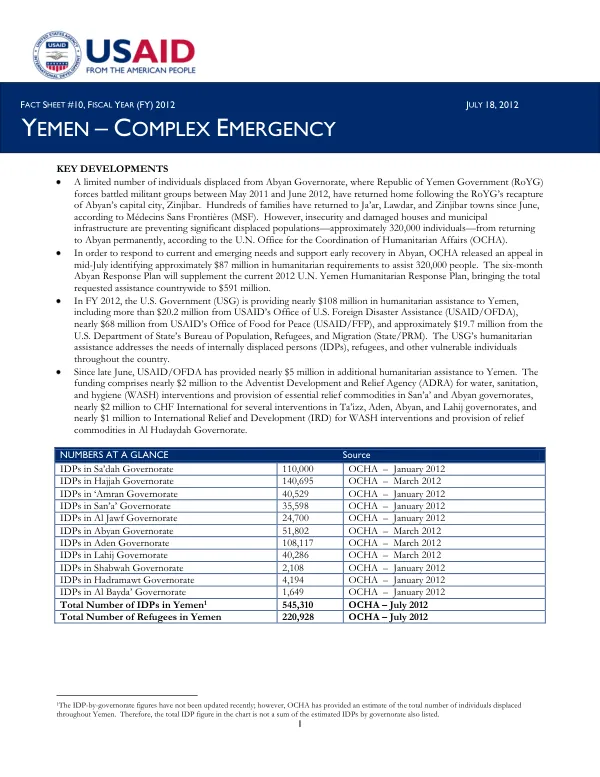
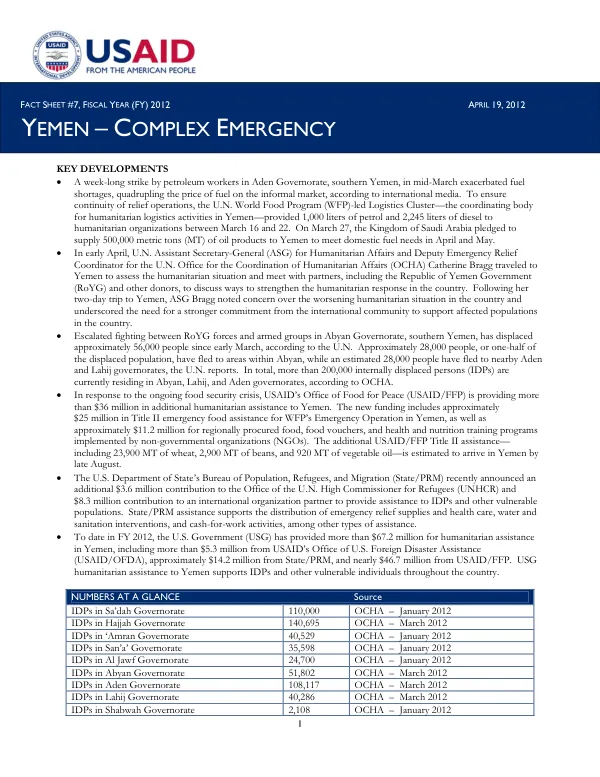
USAID-DCHA Yemen Complex Emergency Fact Sheet #10
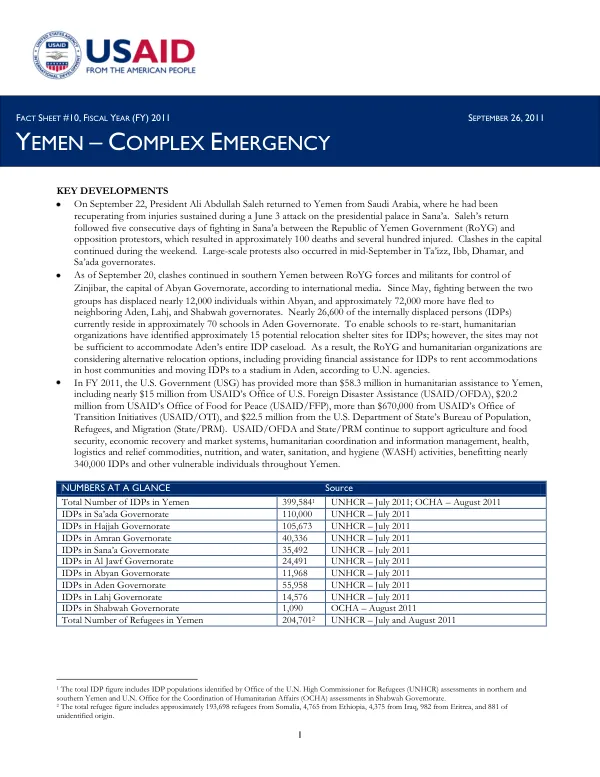
Yemen's complex emergency situation has been ongoing since 2004, affecting over 1 million people and repeatedly displacing populations in northern Yemen.
2011 · 5 pages
Sign in to readA free account is required to download.
Abstract
Conflict between the Republic of Yemen Government (RoYG) and al-Houthi opposition forces has resulted in the need for humanitarian assistance. In April 2011, a fragile February 2010 ceasefire collapsed when al-Houthi groups took control of Sa'ada Governorate and the majority of Al Jawf Governorate. Since February 2, 2011, numerous protests throughout Yemen demanding the resignation of President Ali Abdullah Saleh have resulted in escalating clashes between RoYG security forces and pro-Saleh demonstrators against opposition demonstrators. The fighting has resulted in political instability, which has limited the RoYG's capacity to provide basic services, contributing to increased humanitarian needs among vulnerable populations. In July 2011, a USAID humanitarian and transition assessment team found that while current humanitarian needs are concentrated in conflict-affected areas of northern and southern Yemen, vulnerability among a significant portion of the Yemeni population has increased. Humanitarian agencies continue to provide emergency assistance to conflict-affected populations in northern and southern Yemen despite ongoing security and access constraints. In August, more than 3,700 Somali refugees arrived in Yemen, representing the highest monthly arrival figure to date in 2011. The refugees fled Somalia due to drought and related food insecurity, economic instability, and conflict. As of the end of August, Yemen hosted nearly 193,700 Somali refugees, including approximately 16,000 who have arrived since January. UNHCR expects more Somali refugees to arrive in Yemen in the coming months. The U.S. Government has provided more than $58.3 million in humanitarian assistance to Yemen in FY 2011, including nearly $15 million from USAID's Office of U.S. Foreign Disaster Assistance (USAID/OFDA), $20.2 million from USAID's Office of Food for Peace (USAID/FFP), more than $670,000 from USAID's Office of Transition Initiatives (USAID/OTI), and $22.5 million from the U.S. Department of State's Bureau of Population, Refugees, and Migration (State/PRM). USAID/OFDA and State/PRM continue to support agriculture and food security, economic recovery and market systems, humanitarian coordination and information management, health, logistics and relief commodities, nutrition, and water, sanitation, and hygiene (WASH) activities, benefitting nearly 340,000 internally displaced persons (IDPs) and other vulnerable individuals throughout Yemen. As of the end of August, the risk of increased household food insecurity persisted in nine of Yemen's 21 governorates as a result of ongoing civil unrest and violence, according to the USAID-funded Famine Early Warning Systems Network (FEWS NET). Domestic crop shortages have also contributed to rising food prices. By the end of August 2011, the price of wheat flour had increased approximately 50 percent since August 2010. To date in FY 2011, USAID/OFDA has provided more than $600,000 to CARE for agriculture and food security activities, including livestock rearing, in Hajjah Governorate, benefitting approximately 3,500 IDPs and conflict-affected individuals.