USAID
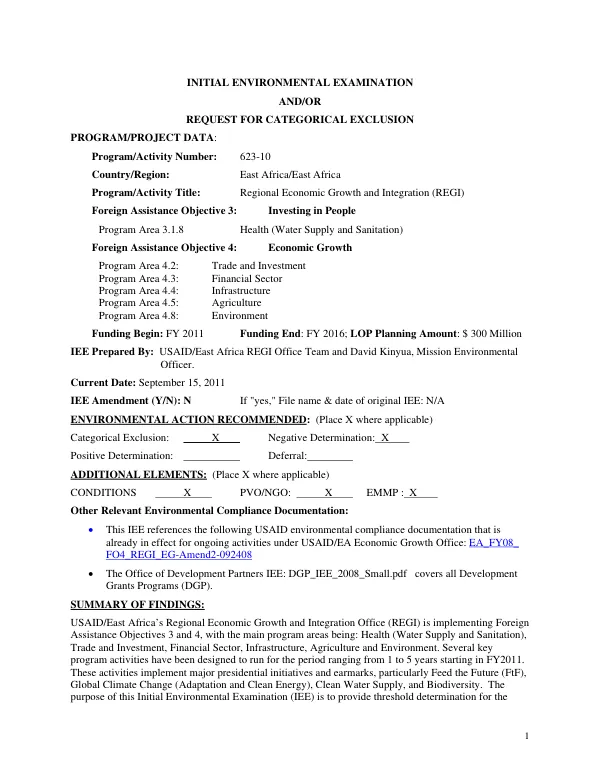
USAID-EA Final Environmental Examination and Request for Categorical Exclusion
Regional Economic Growth and Integration (REGI) Program The REGI program is a USAID-funded initiative aimed at promoting economic growth and integration in East Africa.
2012 · 38 pages
Sign in to readA free account is required to download.
Abstract
The program focuses on several key areas, including Health (Water Supply and Sanitation), Trade and Investment, Financial Sector, Infrastructure, Agriculture, and Environment. The program's activities are designed to run for a period of 5 years, starting from FY 2011. The REGI program is implementing Foreign Assistance Objectives 3 and 4, with a focus on investing in people and promoting economic growth. The program's activities are categorized into several key program areas, including: * Health (Water Supply and Sanitation): The program aims to improve access to safe drinking water and sanitation facilities in rural areas. * Trade and Investment: The program seeks to promote trade and investment in the region, with a focus on small and medium-sized enterprises (SMEs). * Financial Sector: The program aims to strengthen the financial sector in East Africa, with a focus on improving access to financial services for SMEs. * Infrastructure: The program seeks to improve the region's infrastructure, with a focus on transportation, energy, and energy efficiency. * Agriculture: The program aims to improve agricultural productivity and income for smallholder farmers. * Environment: The program seeks to promote sustainable natural resource management and reduce the environmental impact of economic activities. The REGI program has a budget of $300 million, which will be allocated over a period of 5 years. The program is being implemented by the USAID/East Africa REGI Office, in collaboration with local partners and stakeholders. Environmental Assessment The REGI program has undergone an environmental assessment, which has identified potential environmental impacts associated with the program's activities. The assessment has recommended several measures to mitigate these impacts, including: * Categorical Exclusion: The assessment has recommended a categorical exclusion from environmental examination for all activities, except those involving construction, rehabilitation, and rehabilitation of facilities, water supply systems, and sanitation facilities, which are subject to conditions. * Negative Determination: The assessment has recommended a negative determination for several activities, including construction activities, water/sanitation activities, improved seed varieties, and genetically modified organisms. * Conditions: The assessment has recommended several conditions to mitigate the potential environmental impacts of the program's activities, including the preparation of a Water Quality Assurance Plan, the identification and mitigation of direct adverse impacts on the physical environment and human health and safety, and the submission of a proposal for approval by USAID before transferring bioengineered organisms to a developing country. Implementation The REGI program is being implemented in several countries in East Africa, including Kenya, Tanzania, Uganda, and Uganda. The program's activities are being implemented by local partners and stakeholders, in collaboration with the USAID/East Africa REGI Office. The program's implementation is being monitored and evaluated regularly, with a focus on ensuring that the program's activities are environmentally sound and comply with local environmental laws and regulations. Timeline The REGI program is being implemented over a period of 5 years, starting from FY 2011. The program's activities are being implemented in several phases, with a focus on achieving the program's objectives and outcomes. Budget Conclusion The REGI program is a USAID-funded initiative aimed at promoting economic growth and integration in East Africa. The program's activities are designed to run for a period of 5 years, starting from FY 2011. The program's implementation is being implemented by local partners and stakeholders, in collaboration with the USAID/East Africa REGI Office. The program's activities are being monitored and evaluated regularly, with a focus on ensuring that the program's activities are environmentally sound and comply with local environmental laws and regulations.