DAI
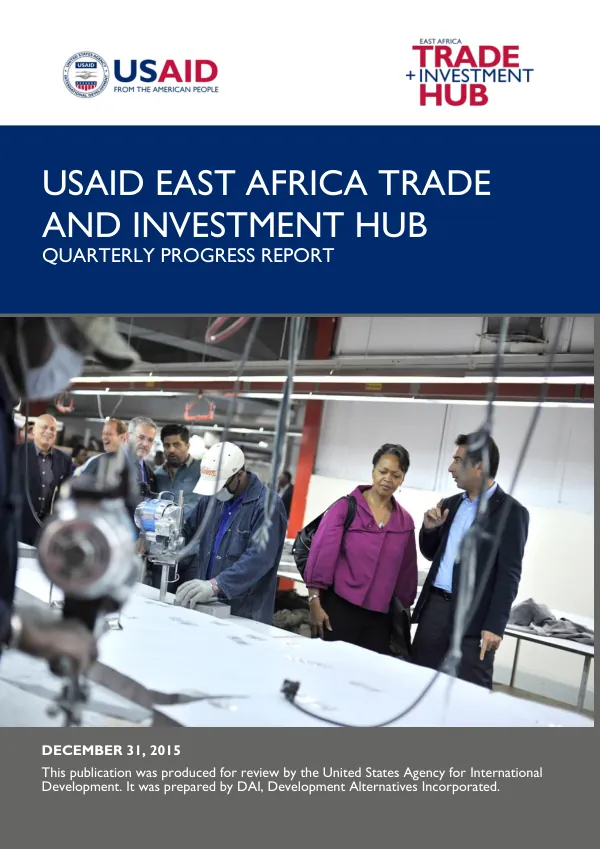
USAID EAST AFRICA TRADE AND INVESTMENT HUB QUARTER 1 PROGRESS REPORT FOR FY 2016
The East Africa Trade and Investment Hub (the Hub) is a project that aims to boost trade and investment with and within East Africa.
2016 · 47 pages
Sign in to readA free account is required to download.
Abstract
It does this by deepening regional integration, increasing the competitiveness of select regional agricultural value chains, promoting two-way trade with the United States under the African Growth and Opportunity Act (AGOA), and facilitating investment and technology to drive trade growth intra-regionally and to global markets. The Hub supports the U.S. Government's presidential Trade Africa and Feed the Future initiatives. In the first quarter of fiscal year (FY) 2016, the Hub supported four Ambassador-level events, one in Ethiopia and three in Kenya, and a U.S. Trade Representative (USTR) factory visit. The events included a U.S. Ambassador to Ethiopia delivering remarks at Origin Africa 2015 in October, a U.S. Ambassador to Kenya delivering remarks to 500 small and medium-sized enterprises (SMEs) during an AGOA workshop in Nairobi in November, and a U.S. Ambassador to Kenya taking questions from 50 export-ready Kenyan SMEs at the Hub offices in Kenya in November. The Hub's investment transaction advisory team has supported the financial close of $18.2 million in new investments as of December 31, 2015. Three of the closed transactions are in the agribusiness sectors of Ethiopia, Kenya, and Uganda, while one transaction is in the financial services/ICT sector of Uganda. The team has an additional four transactions, valued at $14 million, that are pending close post transaction advisory, and one transaction that is receiving ongoing advisory support. The team is reviewing an additional nine transactions, valued at $129.5 million, for further advisory support. The Hub's Trade Promotion and AGOA Team supported nearly $15 million in AGOA exports to the U.S. between October 1 and December 31. Standout achievements include $8 million in apparel from Kenya and $3.1 million in footwear exports from Ethiopia. The Hub derived its results from ongoing firm-level technical assistance, the support of two trade shows, and several AGOA workshops and seminars. The Hub's Trade Policy Team is supporting the implementation of the East African Community (EAC)-U.S. Cooperation Agreement by advancing ICT solutions and Electronic Notification Systems for expanded transparency and simpler trade procedures. The U.S. - EAC Cooperation Agreement seeks to implement critical customs reforms, harmonize standards, and undertake multilateral commitments that support greater EAC regional economic integration and strengthen the EAC's trade relationship with the U.S. and other global partners. The Trade Policy Team is also supporting the implementation of key elements of the EAC Common Market Protocol. The Protocol is designed to integrate the region into a single market in which there is free flow of goods and services, labor, and capital. The Hub is building private sector capacity to influence the implementation of the EAC Common Market Protocol by providing technical support to identify and remove measures affecting the protocol and by facilitating solution-oriented dialogue with the public sector. In December, the Hub supported a public-private sector dialogue (PPD) in Tanzania, which was attended by 30 private sector players, industry regulators, and government ministry representatives. In October, the Hub partnered with the Eastern Africa Grain Council (EAGC) to promote structured trading systems and regional market linkages for staple foods through the 6th African Grain Trade Summit in Kigali, Rwanda. The event supported 26 buyer/seller linkages for trade.