THE GOVERNMENT OF THE UNITED STATES
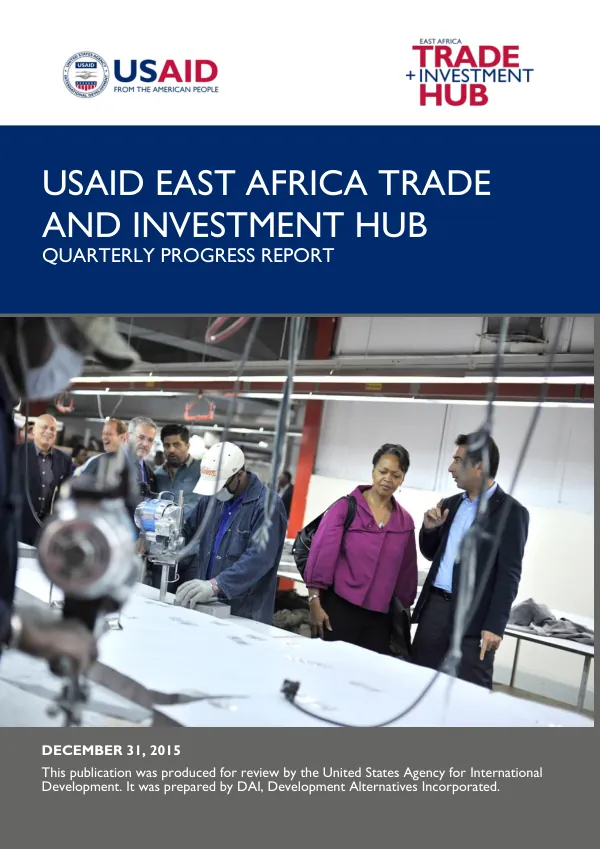
USAID EAST AFRICA TRADE AND INVESTMENT HUB ANNUAL PROGRESS REPORT
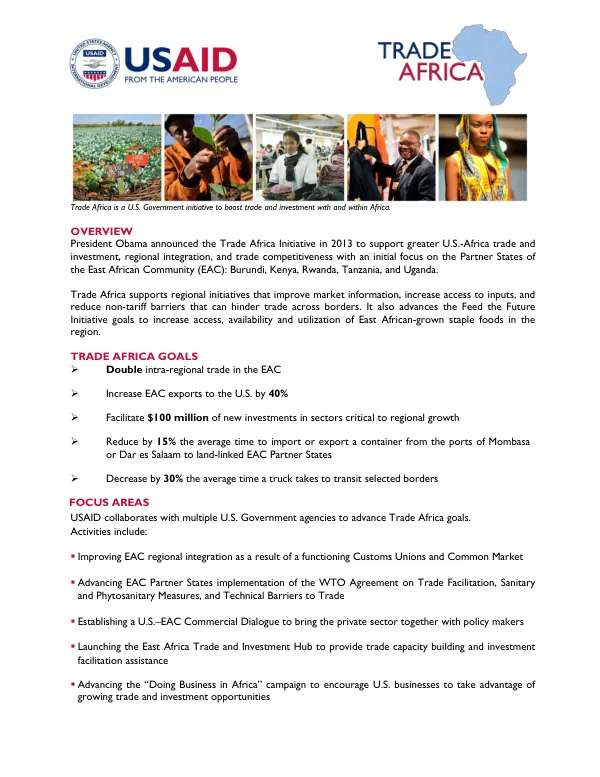
The East Africa Trade and Investment Hub (the Hub) boosts trade and investment with and within East Africa.
2015 · 61 pages
Sign in to readA free account is required to download.
Abstract
It does this by deepening regional integration, increasing the competitiveness of select regional agricultural value chains, promoting two-way trade with the U.S. under the African Growth and Opportunity Act (AGOA), and facilitating investment and technology to drive trade growth intra-regionally and to global markets. The Hub is the U.S. Government's flagship project under the presidential Trade Africa initiative. The Hub's investment transaction advisory team has identified 22 transactions for possible investment facilitation, with an estimated total value of $148.2 million. The investments will increase intra-regional trade and create thousands of new full-time and part-time jobs in the Hub's targeted sectors. One of the 22 transactions has reached financial close, a $1.57 million mobile money transaction in Uganda, and two have signed terms sheets. The signed term sheets are for two separate dairy processing transactions, one worth $7 million in Kenya and the other worth $4.8 million in Ethiopia. The Hub has also facilitated 170 buyer linkages, yielding $81 million in Hub-facilitated AGOA exports. The highest value of exports came from the textile and apparel sector, with a total of 25 companies reporting exports worth $64 million. The next highest value of exports was in Ethiopian footwear, with two companies reporting $12 million in exports to the U.S. Floriculture and home décor contributed to $4 million and $750,000 respectively. The Hub's Trade Policy and Agricultural Components are supporting policies and systems that create a more conducive trade and investment environment. The two components supported the East African Community Secretariat to make progress toward implementing the East African Community (EAC) -- U.S. Government Cooperation Agreement. The EAC Secretariat now has a set of draft work plans that match identified trade priorities. The Trade Policy Component is advancing regional trade and investment through implementation of key elements of the EAC Common Market Protocol. The component is also providing training to participants from the public and private sectors on the key obligations and status of implementation of the EAC Common Market Protocol. The Hub trained 120 individuals in year one. In quarter four of year one, the team held two Public-Private Sector Dialogue workshops that identified measures inconsistent with the Common Market Protocol (CMP) and Customs Union Protocol (CUP). The Partnership Fund issued an Annual Program Statement (APS) to solicit Partnership Fund concept applications on a rolling basis. The response for the first round of review was overwhelming - 155 concepts from across East Africa. As of September 2015, the Hub has given seven grants to support activities that lead to better policy implementation, association-level matchmaking opportunities, and the development of innovative tools to support trade and investment. The Hub's goal is to facilitate $100 million in new investments and create 10,000 jobs by August 2019. Target sectors include ICT, agribusiness, financial services, and cotton, textile, and apparel. Eligible investors include private equity funds, commercial banks, impact funds, and development finance institutions. Priority transactions include those that promote regional trade and investment, increase competitiveness, and create jobs. The Hub's work plan is guided by survey responses from 150 experts from the East African public and private sector. The survey helped identify chokepoints and areas for improvement in the trade and investment environment. The Hub is working to address these issues and create a more conducive environment for trade and investment. The Hub's progress is being monitored through a Performance Monitoring Plan (PMP). The PMP tracks the Hub's progress against its goals and objectives. The Hub is also working to ensure the sustainability of its projects and programs. This includes developing exit strategies and transitioning projects to local ownership. The Hub's financial information is reported in the Annual Program Statement (APS). The APS provides information on the Hub's budget, expenditures, and financial performance. The Hub's financial information is audited annually to ensure compliance with U.S. Government regulations. The Hub's activity administration is overseen by the Chief of Party (COP) and the Deputy Chief of Party (DCOP). The COP and DCOP are responsible for ensuring the effective implementation of the Hub's projects and programs. They work closely with the Hub's staff and partners to achieve the Hub's goals and objectives.
Related documents