USAID DEC
USAID Enterprise Energy Efficiency (3E) EE Year in Tuzla Canton and Signing of the Energy Charter Fact Sheet
Sign inADVANCED ENGINEERING ASSOCIATES INTERNATIONAL, INC. /SGGA
USAID Enterprise Energy Efficiency (3E) EE Year in Tuzla Canton and Signing of the Energy Charter Fact Sheet
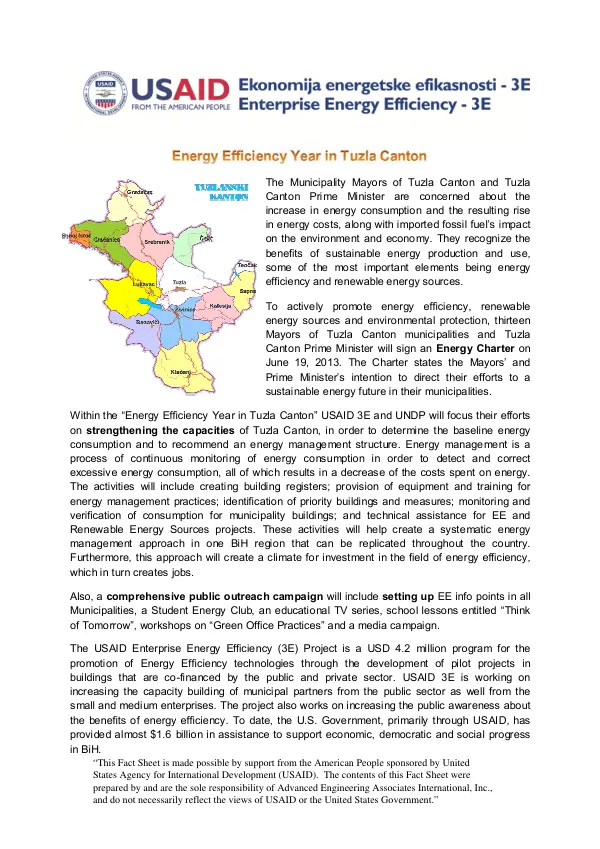
The USAID Enterprise Energy Efficiency (3E) Project implemented an Energy Efficiency Year in Tuzla Canton, Bosnia and Herzegovina, in 2013.
2013 · 3 pages
Sign in to readA free account is required to download.
Abstract
The project aimed to promote a sustainable energy future in the region by reducing energy consumption and costs. A kick-off conference was held on June 19, 2013, to mark the start of the initiative, and the Tuzla Canton Municipalities and Prime Minister signed an Energy Charter, committing to promote energy efficiency, renewable energy sources, and energy management in public buildings and communal systems. The Energy Charter obliges the municipalities to establish an energy management structure and promote energy efficiency measures. The USAID 3E project provided technical assistance to the municipalities, including the appointment of energy efficiency personnel and the development of energy management plans. The project also supported the municipalities in conducting energy audits and preparing feasibility studies for energy efficiency measures. The estimated energy costs in Tuzla Canton for 2012 were BAM 5 million for public sector buildings and street lighting, and BAM 240 million for private sector buildings. The USAID 3E project aimed to reduce energy costs by implementing energy efficiency measures and promoting a systematic energy management approach. The project also planned a comprehensive public outreach campaign, including the establishment of an Energy Efficiency Info Center in Tuzla, which would serve as a hub for information sharing and a meeting place for supply and demand of energy efficiency technologies. The public outreach campaign included educational activities, such as school classes and an educational TV series, as well as a media campaign and support for the Student Energy Club in Tuzla. The goal of the USAID 3E project was to create a climate for investment in energy efficiency by educating and informing citizens on the potential of these technologies and practices. The project aimed to create a systematic energy management approach in one region that could be replicated throughout the country. The USAID 3E project's efforts focused on two fronts: technical assistance to the municipalities to establish an energy management structure, and an educational and public awareness effort aimed at the general public. The project's activities included the appointment of energy efficiency personnel, energy audits, feasibility studies, and the development of energy management plans. The project also planned to create additional capacity within the municipalities, enabling new investment in energy efficiency.