THE AMERICAN INSTITUTES FOR RESEARCH
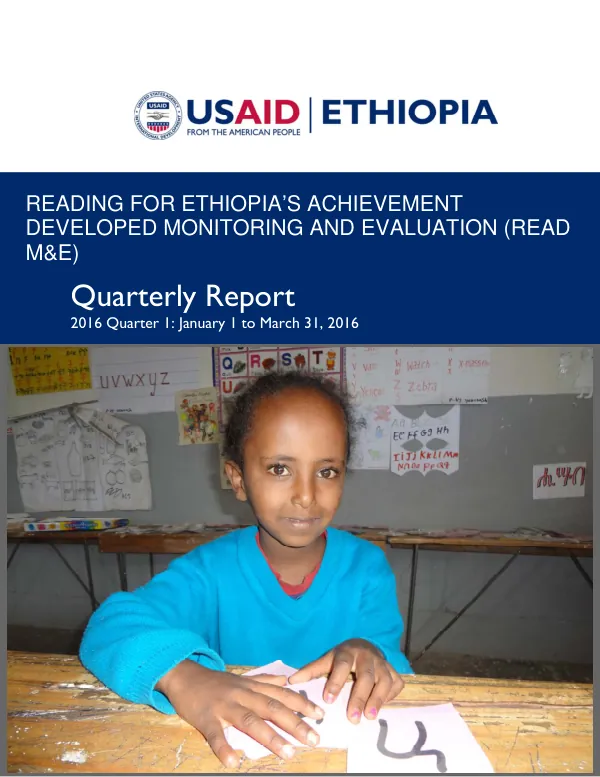
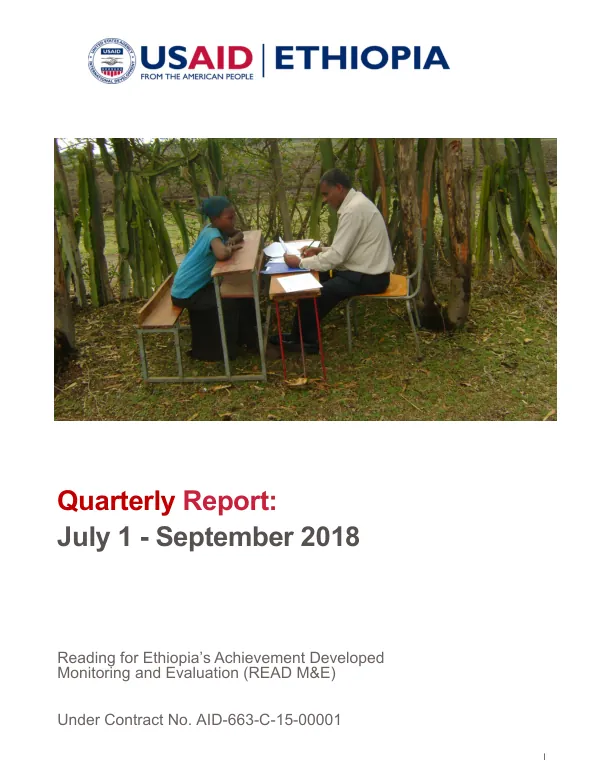
USAID Ethiopia Quarterly Report: July 1 - September 2018
The Reading for Ethiopia's Achievement Developed Monitoring and Evaluation (READ M&E) project is a 5-year U.S.
2018 · 26 pages
Sign in to readA free account is required to download.
Abstract
Agency for International Development (USAID)-supported activity implemented by American Institutes for Research (AIR). The project focuses on monitoring and evaluating early grade reading as well as on the M&E needs of the overall USAID READ program. READ M&E works closely in partnership with the Ethiopian Ministry of Education (MoE) and the National Educational Assessment and Examinations Agency (NEAEA). The project also collaborates with Regional State Education Bureaus (RSEBs) and City Administration Education Bureaus (CAEBs). The objectives of READ M&E are to assess student learning progress by analyzing and synthesizing nationally representative EGRA data collected for seven local languages, collect additional EGRA data annually to show reading skill gains for seven local languages, and collect nationally representative EGRA baseline data for English. The project also undertakes National Learning Assessments (NLA) at Grades 4 and 8 for reading, comprehension, and writing aligned to the new national reading curriculum developed through the READ TA program. READ M&E tracks progress and measures the performance and impact of key interventions supported by USAID through regular monitoring of READ projects to determine if implementation is on track and if outputs are leading to results, and evaluating READ projects at defined intervals to gauge the results. These efforts provide information to USAID and other stakeholders, including the federal MOE, the NEAEA, RSEBs, and CAEBs, about how combined investments across the READ projects are producing the desired changes and how implementation can be improved. The project has made significant progress in the third quarter of FY18. In terms of standardized learning assessments, 28 data collectors and 3 supervisors were trained on FCA data collection at Bishoftu, and 7 experts from NEAEA attended Data Management training in the same place. Additionally, 154 data collectors and supervisors were trained, with 135 men and 19 women participating. These efforts have been successful, with all targets met. The project also undertakes National Learning Assessments (NLA) at Grades 4 and 8 for reading, comprehension, and writing aligned to the new national reading curriculum developed through the READ TA program. The project has collected EGRA data for seven local languages and has conducted midterm evaluations of the three READ projects. In terms of capacity building, the project has provided technical assistance to the MOE, RSEBs, and other development partners. The project has also collaborated and coordinated with key partners, including other donors and NGO partners, as well as projects in other sectors that relate to READ. The project has adapted to the evolving M&E needs and priorities of the READ program. The project's financial report indicates that the project has made significant progress in the third quarter of FY18. The project has met all its targets, and the financial report indicates that the project is on track to meet its overall objectives. The project's planned activities for the next quarter include continuing to track progress and measure the performance and impact of key interventions supported by USAID, and evaluating READ projects at defined intervals to gauge the results.
Related documents