USAID DEC
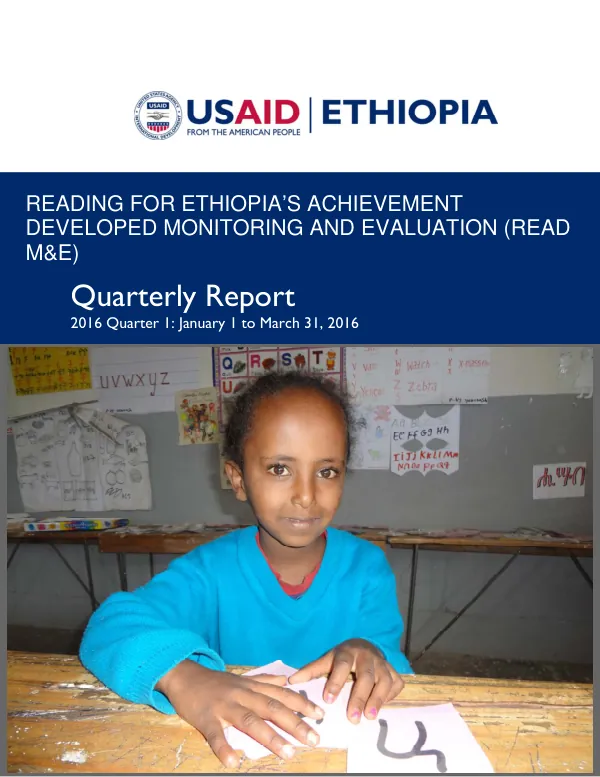
Quarterly Report 2016 Quarter 1: January 1 to March 31, 2016 for USAID Reading for Ethiopia’s Achievement Developed Monitoring and Evaluation (READ M&E)
Sign inTHE AMERICAN INSTITUTES FOR RESEARCH
Quarterly Report 2016 Quarter 1: January 1 to March 31, 2016 for USAID Reading for Ethiopia’s Achievement Developed Monitoring and Evaluation (READ M&E)
The USAID Reading for Ethiopia's Achievement Developed Monitoring and Evaluation (READ M&E) project is a 5-year activity implemented by American Institutes for Research (AIR) in partnership with the Ethiopian Ministry of Education (MoE) and the National Educational Assessment and Examinations Agency (NEAEA).
2016 · 40 pages
Sign in to readA free account is required to download.
Abstract
The project focuses on monitoring and evaluating early grade reading and writing, as well as the M&E needs of the overall USAID READ program. READ M&E works closely with regional state education bureaus (RSEBs) and city administration education bureaus (CAEBs) to track progress and measure the performance and impact of key interventions supported by USAID. The objectives of READ M&E are to assess student learning progress by analyzing and synthesizing nationally representative EGRA data collected for seven local languages, collect additional EGRA data annually to show reading skill gains for seven local languages, and collect nationally representative EGRA baseline data for English. Additionally, READ M&E aims to support National Learning Assessments (NLAs) at grades 4 and 8 for reading, comprehension, and writing aligned to the new national reading curriculum developed through the READ TA program, support continuous assessment in schools, monitor the performance of USAID's READ projects, and conduct midterm and final evaluations of the three READ projects and other projects that may take over or add to any of the major functions of these READ projects. During the first quarter of 2016, READ M&E continued to work on assessment activities, evaluations, teacher support, and special research topics. Activities on evaluations included reporting to members of the Ministry of Education on the success of the evaluation of the Reading for Ethiopia's Achievement Developed Institutional Improvement (READ II) project and progress continued on the coding of qualitative data on the midterm evaluation of Reading for Ethiopia's Achievement Developed Technical Assistance (READ TA). Assessment activities focused on analyzing results of the 2015 Early Grade Reading Assessment (EGRA) pilot, incorporating lessons learned from the pilot into the plan for the 2016 EGRA in seven languages, and creating a viable, cost-effective method of equating the 2014 and 2016 versions of the EGRA tests. READ M&E also completed and delivered to USAID a literature review on Formative Continuous Assessment (FCA), which analyzed literature on FCA with a focus on Sub-Saharan Africa and specifically Ethiopia. The review looked at materials developed for Ethiopia by past programs and analyzed best practices. Additionally, READ M&E created a plan for measuring the number of students with hearing and vision challenges currently attending schools to assist USAID and the Directorate of Inclusive Education. READ M&E also participated in the Emergency Education Cluster to assist the team think through and test a system for collecting data on handheld devices to aid drought relief. The implementation status of READ M&E activities falls under sub-intermediate Result 4, which is monitoring and evaluation conducted to ensure that implementation is on track and results are achieved. The Mini-EGRA, a snapshot of the reading fluency and comprehension levels of Grades 2 and 3 students in three selected languages, was conducted from November 21 to December 1, 2015, with data collected from 45 schools and a total of 1,719 Grade 2 and 3 students. The data collecting tool for each language was composed of timed letter name knowledge, familiar words reading, and invented spelling. The Mini-EGRA was conducted parallel with the pilot study whose main purpose was field testing e-data collection.