THE AMERICAN INSTITUTES FOR RESEARCH
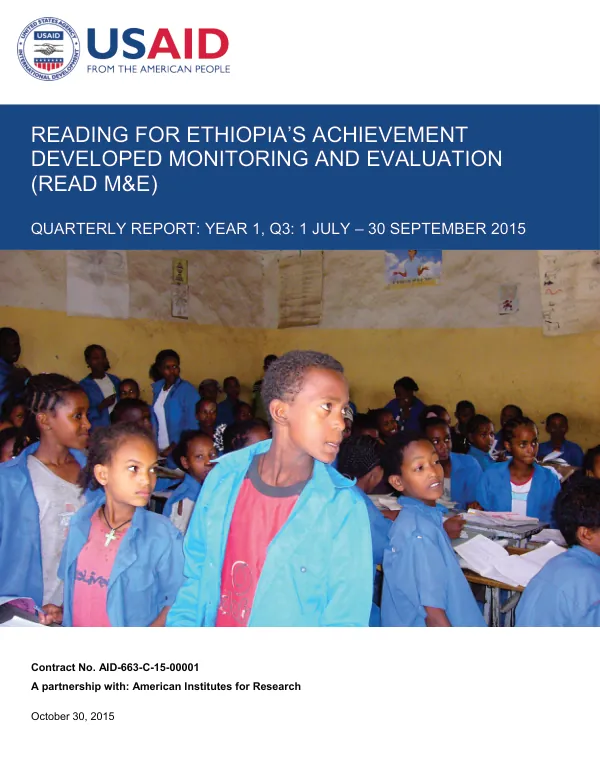
Quarterly Report: Year 1, Q3: 1 July – 30 September 2015
The Reading for Ethiopia's Achievement Developed Monitoring and Evaluation (READ M&E) project is a 5-year U.S.
2015 · 21 pages
Sign in to readA free account is required to download.
Abstract
Agency for International Development (USAID)-supported activity implemented by American Institutes for Research (AIR). READ M&E focuses on monitoring and evaluating early grade reading and writing as well as the M&E needs of the overall USAID READ program. The project works closely in partnership with the Ethiopian Ministry of Education (MOE) and the National Educational Assessment and Examinations Agency (NEAEA). The project also works in collaboration with regional state education bureaus (RSEBs) and city administration education bureaus (CAEBs). During the third quarter of READ M&E, the project continued to engage in start-up activities and launched substantive technical work. This included analyzing data for the READ Institutional Improvement (READ II) performance evaluation, developing and delivering a concept paper on continuous assessment to USAID, and gathering data for the Annual Data Assurance exercise. READ M&E also moved into a new office in the PACT Building in Bole and hired four additional staff members, and procured office supplies to furnish the new office. One of the most crucial start-up activities has been continuing to work on registration with the Charities and Societies Agency (CSA) of Ethiopia, an ongoing project registration process. The objectives of READ M&E are to assess student learning progress by analyzing and synthesizing nationally representative Early Grade Reading Assessment (EGRA) data collected for seven local languages, collect additional EGRA data annually to show reading skill gains for seven local languages, and collect nationally representative EGRA baseline data for English. The project also aims to support national learning assessments (NLAs) at grades 4 and 8 for reading, comprehension, and writing aligned to the new national reading curriculum developed through the READ program, support continuous assessment in schools, monitor the performance of USAID's READ projects, and conduct midterm and final evaluations of the three READ projects and other projects related to the READ program. The project's progress and accomplishments in the third quarter included the launch of substantive technical work, the analysis of data for the READ II performance evaluation, and the development of a concept paper on continuous assessment. The project also continued to work on registration with the CSA of Ethiopia and moved into a new office in the PACT Building in Bole. Additionally, the project hired four additional staff members and procured office supplies to furnish the new office. The READ M&E project works closely with various stakeholders, including the federal MOE, RSEBs, and NEAEA, to improve early grade reading and writing in Ethiopia. The project's objectives are aligned with USAID's global- and mission-level learning agendas, and its efforts inform USAID and other stakeholders on how combined investments across the READ projects are producing the desired changes and how implementation can be improved. The project's technical assistance focuses on curricula revisions, textbook development, teachers' guides, training manuals, supplementary reading materials, training of teacher trainers, and technical assistance support in improving early grade reading and writing to the MOE, RSEB, and colleges of teacher education (CTEs). READ II consists of direct grants to the MOE and RSEBs to conduct in-service teacher training and build the capacity of the education system to improve early grade reading and writing. READ Community Outreach (CO) engages parents and communities in promoting early grade reading and writing, and supports school reading centers and community libraries. The project's monitoring and evaluation efforts track progress and measure the performance and impact of key interventions supported by USAID. This includes regular monitoring of READ projects to determine if implementation is on track and if outputs are leading to results, and evaluating READ projects at defined intervals to gauge the results. These efforts inform USAID and other stakeholders on how combined investments across the READ projects are producing the desired changes and how implementation can be improved.
Related documents
Documents in this collection
 2016
2016USAID DEC
Quarterly Report 2016 Quarter 2: April 1 to June 30, 2016 for USAID Reading for Ethiopia’s Achievement Developed Monitoring and Evaluation (READ M&E)
Open record 2016
2016USAID DEC