USAID DEC
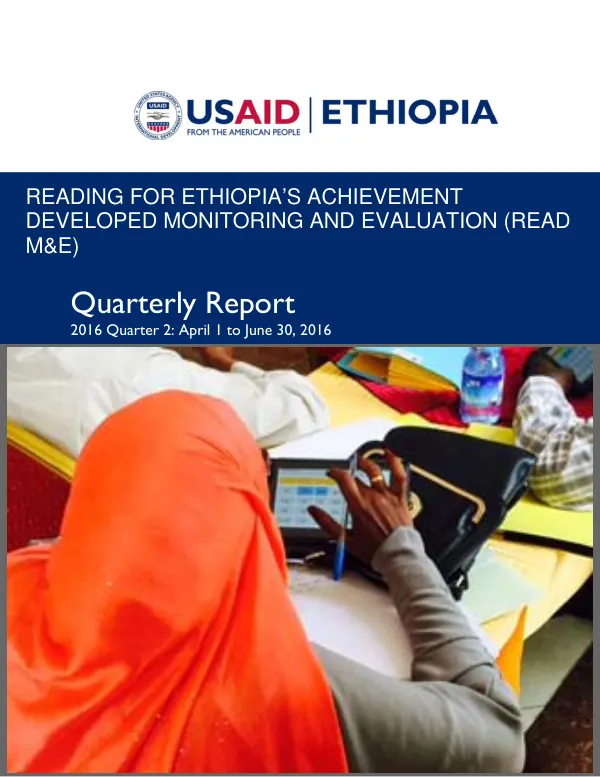
Quarterly Report 2016 Quarter 2: April 1 to June 30, 2016 for USAID Reading for Ethiopia’s Achievement Developed Monitoring and Evaluation (READ M&E)
Sign inTHE AMERICAN INSTITUTES FOR RESEARCH
Quarterly Report 2016 Quarter 2: April 1 to June 30, 2016 for USAID Reading for Ethiopia’s Achievement Developed Monitoring and Evaluation (READ M&E)
The Reading for Ethiopia's Achievement Developed Monitoring and Evaluation (READ M&E) project is a 5-year U.S.
2016 · 131 pages
Sign in to readA free account is required to download.
Abstract
Agency for International Development (USAID)-supported activity implemented by American Institutes for Research (AIR). The project focuses on monitoring and evaluating early grade reading as well as the M&E needs of the overall USAID READ program. READ M&E works closely in partnership with the Ethiopian Ministry of Education (MoE) and the National Educational Assessment and Examinations Agency (NEAEA). The project also works in collaboration with regional state education bureaus (RSEBs) and city administration education bureaus (CAEBs). The objectives of READ M&E are to assess student learning progress by analyzing and synthesizing nationally representative EGRA data collected for seven local languages, collect additional EGRA data annually to show reading skill gains for seven local languages, and collect nationally representative EGRA baseline data for English. Additionally, READ M&E aims to support National Learning Assessments (NLAs) at grades 4 and 8 for reading, comprehension, and writing aligned to the new national reading curriculum developed through the READ Technical Assistance (TA) program, support continuous assessment in schools, monitor the performance of USAID's READ projects as well as other key projects related to the READ program, and conduct midterm and final evaluations of the three READ projects and of other projects that may take over or add to any of the major functions of these READ projects. During the second quarter of 2016 (April-June), READ M&E focused on two major tasks: the administration of the Early Grade Reading Assessment (EGRA) and preparation, including a needs assessment, for the July Material Development Workshop on Formative Continuous Assessment. Additional activities included presentations at Technical Working Group meetings, security preparations with AIR's international security advisor, and the completion of the midterm evaluation of Reading for Ethiopia Achievement Developed Technical Assessment (READ TA). READ M&E also initiated a Community of Practice centered on issues in monitoring and evaluation. The Early Grade Reading Assessment tool for each language is composed of timed (letter name knowledge, familiar words reading, invented words reading, and passage words reading) and untimed (phonemic awareness, reading comprehension, and listening comprehension) subtasks. Data collectors present each task to the assessed child one-by-one orally. Each timed task is given 60 seconds, and fluency levels are recorded as correct letters per minute or correct words per minute. For the 2016 EGRA, READ M&E sampled 350 schools from five regions and in seven languages, with 50 schools per language. This sample size includes eight schools per language beyond the minimum number estimated for statistical significance. The goal was to assess 40 students per school, 20 pupils of Grade 2 and another 20 of Grade 3 students. An equal number of girls and boys were to be selected from grade 2 and grade 3 students. READ M&E delivered a needs assessment for Formative Continuous Assessment, which included a report on 30 interviews with teachers and 29 classroom observations, a plan of action for Formative Continuous Assessment, the READ TA midterm evaluation report, and a presentation at The Working Group meeting. These diverse activities were accomplished with the assistance and support from directorates in the Ministry of Education, including the National Educational Assessment and Examination Agency (NEAEA) under the leadership of Ato Araya, the Planning Directorate under the leadership of Ato Eshetu, and the Directorate of Curriculum Development and Implementation under the leadership of Ato Daniel. The AIR team works closely with these coordinating bodies to ensure that their work is of the highest quality and meets the needs of the Ethiopian people. The READ M&E project has made significant progress in implementing its activities, including the administration of the Early Grade Reading Assessment (EGRA) and preparation for the July Material Development Workshop on Formative Continuous Assessment. The project has also initiated a Community of Practice centered on issues in monitoring and evaluation. The project's objectives are to assess student learning progress, support National Learning Assessments, support continuous assessment in schools, monitor the performance of USAID's READ projects, and conduct midterm and final evaluations of the three READ projects and of other projects that may take over or add to any of the major functions of these READ projects.
Related documents