THE CLOUDBURST GROUP
USAID Evaluation Questions Glossary
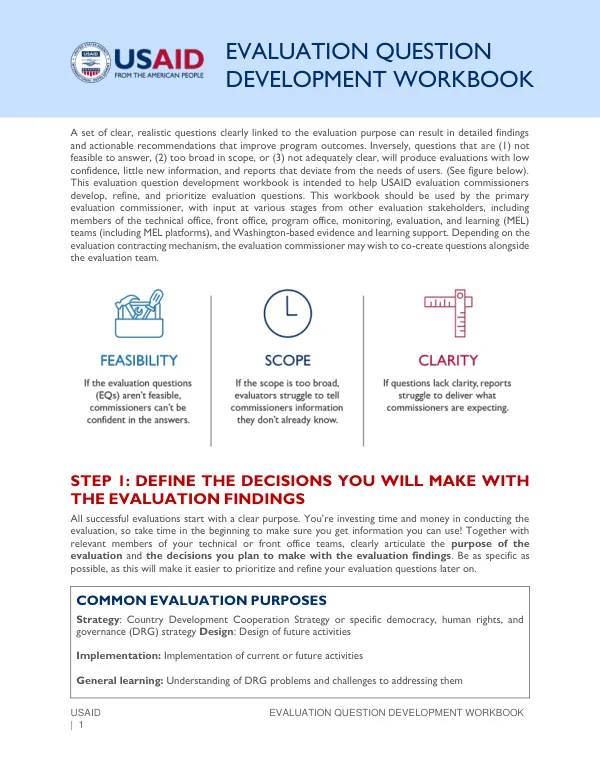
The USAID Performance Evaluation framework emphasizes the importance of clear, realistic, and well-defined evaluation questions.
2024 · 1 pages
Sign in to readA free account is required to download.
Abstract
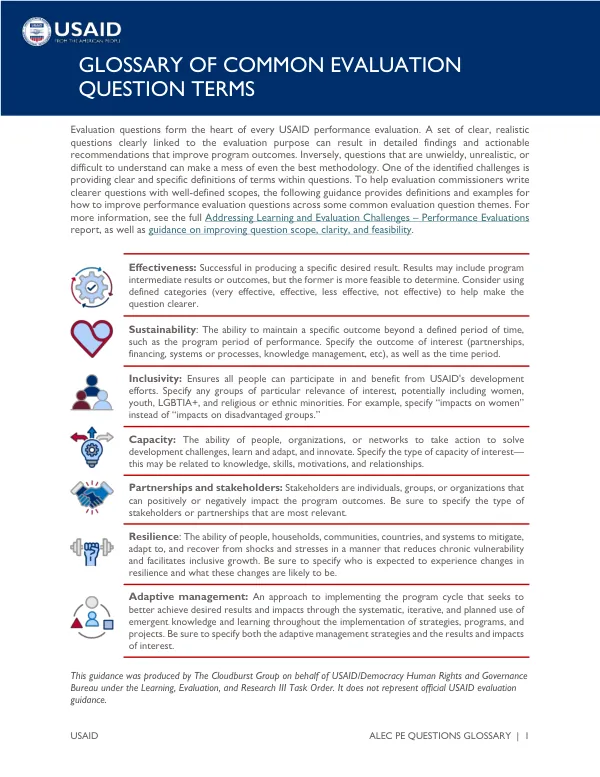
These questions serve as the foundation for detailed findings and actionable recommendations that can improve program outcomes. A set of unwieldy, unrealistic, or difficult-to-understand questions can undermine even the best methodology. Effectiveness is defined as the ability to produce a specific desired result. This can include program intermediate results or outcomes, with the former being more feasible to determine. To clarify effectiveness questions, defined categories such as "very effective," "effective," "less effective," and "not effective" can be used. Sustainability refers to the ability to maintain a specific outcome beyond a defined period of time, such as the program period of performance. To assess sustainability, it is essential to specify the outcome of interest, as well as the time period. This can include partnerships, financing, systems or processes, knowledge management, and other relevant factors. Inclusivity ensures that all people can participate in and benefit from USAID's development efforts. To evaluate inclusivity, it is crucial to specify any groups of particular relevance, including women, youth, LGBTIA+, and religious or ethnic minorities. For example, instead of asking about "impacts on disadvantaged groups," a more specific question would focus on "impacts on women." Capacity refers to the ability of people, organizations, or networks to take action to solve development challenges, learn and adapt, and innovate. To assess capacity, it is necessary to specify the type of capacity of interest, which may be related to knowledge, skills, motivations, and relationships. Partnerships and stakeholders are individuals, groups, or organizations that can positively or negatively impact program outcomes. To evaluate partnerships and stakeholders, it is essential to specify the type of stakeholders or partnerships that are most relevant. Resilience is the ability of people, households, communities, countries, and systems to mitigate, adapt to, and recover from shocks and stresses in a manner that reduces chronic vulnerability and facilitates inclusive growth. To assess resilience, it is necessary to specify who is expected to experience changes in resilience and what these changes are likely to be. Adaptive management is an approach to implementing the program cycle that seeks to better achieve desired results and impacts through the systematic, iterative, and planned use of emergent knowledge and learning throughout the implementation of strategies, programs, and projects. To evaluate adaptive management, it is essential to specify both the adaptive management strategies and the results and impacts of interest. This guidance was developed by The Cloudburst Group on behalf of USAID/Democracy Human Rights and Governance Bureau under the Learning, Evaluation, and Research III Task Order.