USAID
Performance Evaluation Question Development Workbook
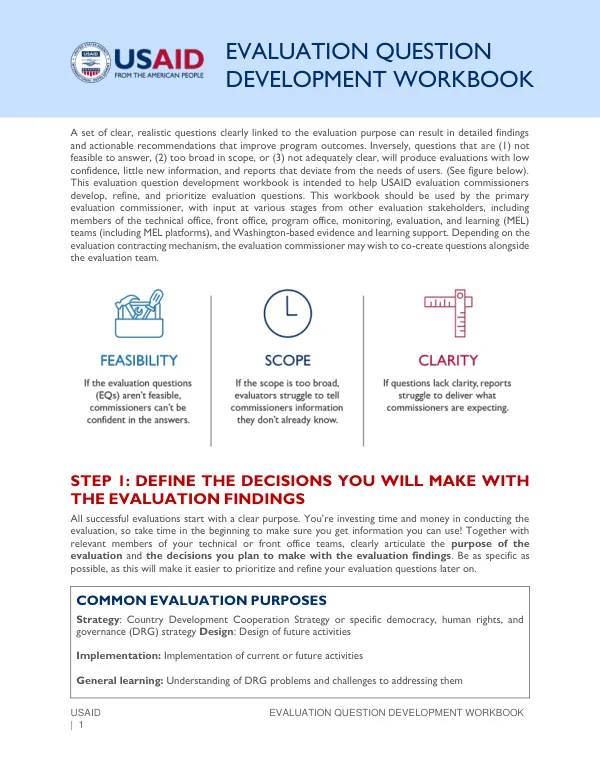
The USAID Evaluation Question Development Workbook is a tool designed to help USAID evaluation commissioners develop, refine, and prioritize evaluation questions.
8 pages
Sign in to readA free account is required to download.
Abstract
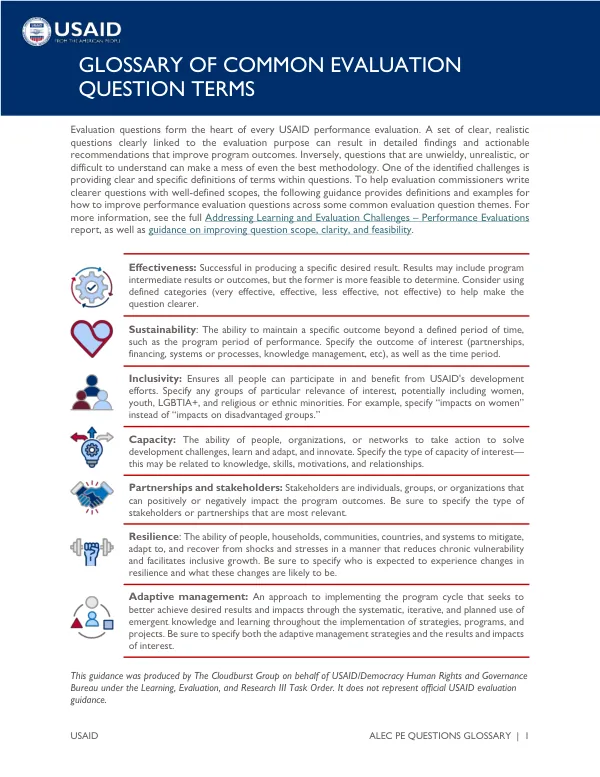
The workbook is intended to be used by the primary evaluation commissioner, with input from various stakeholders, including technical office, front office, program office, monitoring, evaluation, and learning (MEL) teams, and Washington-based evidence and learning support. The workbook outlines a five-step process for developing evaluation questions: defining the decisions to be made with the evaluation findings, brainstorming questions, confirming feasibility, prioritizing questions, and refining scope and clarity. The process begins with defining the purpose of the evaluation and the decisions to be made with the findings. This involves articulating the purpose of the evaluation and identifying the decisions that need to be made. The next step is to brainstorm questions that the evaluation should answer. This involves holding a brainstorming session with stakeholders to generate a list of potential questions. The questions should be linked to the evaluation purpose and the decisions to be made. The workbook provides guidance on common question types, including program outcomes and effectiveness, program implementation and adaptation, sustainability, theory of change, and inclusivity. Once the list of potential questions has been generated, the feasibility of each question is reviewed. This involves using a flow chart to determine if a question is feasible, and eliminating or revising questions that are not. The remaining questions are then prioritized using a variation of the RICE framework, which considers reach, impact, confidence, and effort. The final step is to refine the scope and clarity of the priority questions. This involves developing a paragraph for each question to provide context, define terms, and identify lines of inquiry. The workbook provides guidance on refining questions and consulting with MEL specialists and learning experts. The workbook also provides a checklist for refining the scope, feasibility, and clarity of the question. This includes considering whether the question is too broad or too narrow, whether it is feasible to answer, and whether it is clear and concise. The workbook also provides guidance on developing a paragraph for each priority question to provide context, define terms, and identify lines of inquiry. The USAID Evaluation Question Development Workbook is a valuable tool for USAID evaluation commissioners and stakeholders. It provides a structured approach to developing evaluation questions and ensures that the questions are linked to the evaluation purpose and the decisions to be made. The workbook also provides guidance on refining questions and consulting with MEL specialists and learning experts. The workbook is designed to be used in conjunction with other USAID evaluation tools and resources, including the Three Keys for Performance Evaluation Questions and the Performance Evaluation Glossary. By following the steps outlined in the workbook, evaluation commissioners and stakeholders can develop clear, realistic, and feasible evaluation questions that will inform decision-making and improve program outcomes. The workbook is intended to be used by a variety of stakeholders, including evaluation commissioners, technical office staff, front office staff, program office staff, MEL teams, and Washington-based evidence and learning support. The workbook provides guidance on how to use the tool and how to involve stakeholders in the evaluation question development process. The USAID Evaluation Question Development Workbook is a critical tool for ensuring that evaluations are well-designed and effective. By following the steps outlined in the workbook, evaluation commissioners and stakeholders can develop evaluation questions that are linked to the evaluation purpose and the decisions to be made, and that will inform decision-making and improve program outcomes. The workbook provides a structured approach to developing evaluation questions, which is essential for ensuring that evaluations are well-designed and effective. The workbook also provides guidance on refining questions and consulting with MEL specialists and learning experts, which is critical for ensuring that evaluation questions are feasible and answerable.