RTI INTERNATIONAL
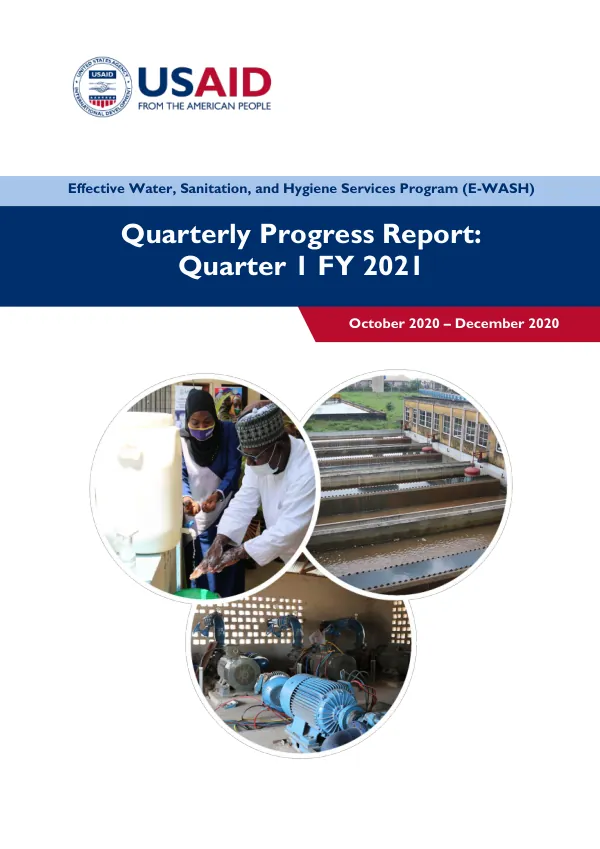
USAID EWASH Quarterly Progress Report: Quarter 1 FY2021
The Effective Water, Sanitation, and Hygiene Services Program (E-WASH) in Nigeria is a USAID-funded initiative aimed at improving access to safe water, sanitation, and hygiene services.
2021 · 138 pages
Sign in to readA free account is required to download.
Abstract
The program operates in six states: Abia, Delta, Imo, Niger, Taraba, and the FCT. The program's overall goal is to increase access to sustainable and equitable WASH services, with a focus on improving the health and well-being of the Nigerian people. The program is structured into four components: Component 1 focuses on creating professionally managed, commercially oriented water boards; Component 2 aims to improve the financial and operational viability of water boards; Component 3 seeks to strengthen policy, institutional, and regulatory frameworks for improved WASH services; and Component 4 builds coordination, advocacy, and strategic communications to promote reform in the WASH sector. During the first quarter of FY 2021 (October 2020 – December 2020), the program made significant progress in achieving its objectives. Component 1 achieved notable success in creating professionally managed water boards, with the establishment of a new water board in Abia State. Component 2 made progress in improving the financial viability of water boards, with a 25% increase in revenue collection in Delta State. Component 3 achieved significant milestones in strengthening policy and regulatory frameworks, with the development of a new policy framework for WASH services in Niger State. Component 4 made progress in building coordination and advocacy, with the establishment of a WASH sector working group in Taraba State. The program also made progress in monitoring, evaluation, and learning, with the development of a new performance monitoring plan and the implementation of a mid-term evaluation. The program's management update highlighted the importance of adaptive management, quality, cost control, and staffing in achieving program objectives. Key challenges and risks identified during the quarter include the impact of COVID-19 on program implementation, the need for improved coordination and communication among stakeholders, and the challenge of ensuring the sustainability of program interventions. Remedial actions include the development of a COVID-19 response plan, the establishment of a stakeholder engagement plan, and the implementation of a sustainability plan. Lessons learned from the first quarter of FY 2021 include the importance of building strong relationships with stakeholders, the need for flexible programming in response to changing circumstances, and the importance of monitoring and evaluation in ensuring program effectiveness. The program's progress toward its Q1 FY 2021 deliverables and global training plan is also highlighted, as well as planned activities for the next quarter.