USAID DEC
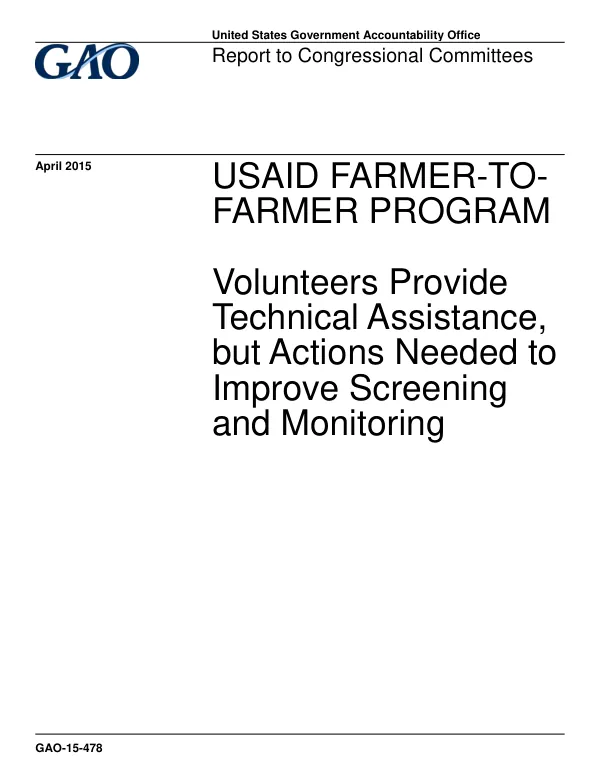
USAID FARMER-TO-FARMER PROGRAM: Volunteers Provide Technical Assistance but Actions Needed to Improve Screening and Monitoring
Sign inU.S. GOVERNMENT ACCOUNTABILITY OFFICE
USAID FARMER-TO-FARMER PROGRAM: Volunteers Provide Technical Assistance but Actions Needed to Improve Screening and Monitoring
The Farmer-to-Farmer (F2F) program is a voluntary technical assistance program implemented by the U.S.
2015 · 30 pages
Sign in to readA free account is required to download.
Abstract
Agency for International Development (USAID) to promote sustainable improvements in food security and agricultural processing, production, and marketing in developing and transitional countries. The program was first authorized in the 1985 Farm Bill and has been funded annually since then. During fiscal years 2009 through 2013, the F2F program funded approximately 2,984 volunteer assignments and obligated an average of $11.5 million annually. USAID administers the F2F program through implementing partners under 5-year cooperative agreements. The implementing partners are responsible for executing program activities, while USAID provides overall direction and establishes the partners' objectives, tasks, and responsibilities. The partners create work plans for USAID's approval, which describe potential volunteer assignments, such as providing expertise on grain processing and storage or groundnut production. Volunteers provide technical assistance to farmers, farm groups, and agribusinesses in developing and transitional countries. The volunteers are typically short-term, with assignments lasting 2 to 4 weeks. According to USAID, volunteers have completed more than 15,000 assignments in 103 countries since the program's inception. The F2F program has been instrumental in promoting sustainable improvements in food security and agricultural processing, production, and marketing in developing and transitional countries. USAID's partners follow consistent practices to implement volunteer assignments, but they have inconsistent practices for screening volunteer candidates against terrorist watch lists. Only two partners screen candidates against the terrorist watch lists as expected by USAID. These partners and one other partner screen candidates against other watch lists. In addition, partners do not have a means to systematically report negative volunteer assessments to USAID or each other, even though 41 percent of volunteers in the last program cycle were repeat volunteers. USAID uses its monitoring and evaluation process to adjust the program, but does not review information on a key aspect of the program's implementation. In response to a program-wide evaluation, USAID revised performance indicators, established a committee that discusses best practices, and increased training for implementing partner staff. However, USAID does not systematically review information on the extent to which volunteers meet the objectives identified in the scopes of work. Reviewing volunteer trip reports against scopes of work could improve USAID's understanding of the volunteers' performance and provide additional insight on implementation progress and whether volunteers are being effectively used. The F2F program has been successful in promoting sustainable improvements in food security and agricultural processing, production, and marketing in developing and transitional countries. However, there are areas for improvement, including the need for consistent practices for screening volunteer candidates against terrorist watch lists and the need for USAID to systematically review information on the extent to which volunteers meet the objectives identified in the scopes of work.