DELOITTE CONSULTING, LLP
USAID-Funded Nepal Hydropower Development Project (NHDP)
The USAID-Funded Nepal Hydropower Development Project (NHDP) aimed to improve the efficiency and sustainability of Nepal's hydropower sector.
2019 · 23 pages
Sign in to readA free account is required to download.
Abstract
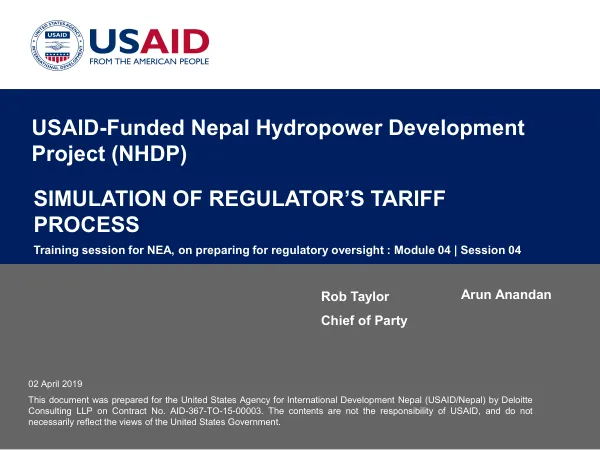
The project focused on enhancing the regulatory framework and capacity of the Nepal Electricity Authority (NEA) to oversee the sector. A key component of the project was the development of a tariff simulation workshop to train NEA officials on regulatory oversight. The workshop, led by Deloitte Consulting LLP, was designed to simulate the regulator's tariff process. Participants were divided into three teams, each tasked with assuming the role of a regulator and determining the tariff for the NEA. The teams were provided with a comprehensive information pack, including excerpts from the annual report of the Nepal Electricity Regulatory Commission (NERC) and communications from the Energy Regulatory Commission (ERC). The simulation exercise focused on two critical issues: the treatment of past losses and the calculation of equity base. NEB, the Government-owned transmission and distribution utility, had accumulated losses of 27,158 million NVR up to FY18. The utility requested ERC to allow an additional Allowance for Rate of Return (ARR) component to eliminate these losses over the next ten years. However, the ERC Act did not explicitly provide jurisdiction over past tariffs and actions of regulated entities, raising questions about the ERC's responsibility to allow recovery of past losses. The teams were also required to decide on the equity base for NEB, which had been calculated as 30% of the asset base in the utility's petition. However, the assumption did not match the equity recorded in NEB's balance sheet, and ERC's own order on tariff process was ambiguous about the exact manner of calculation. The teams had to choose between adopting NEB's methodology, using the balance sheet, or an alternative method. The simulation exercise aimed to enhance the capacity of NEA officials to make informed decisions on tariff setting, taking into account the complexities of regulatory oversight. The exercise also aimed to improve the regulatory framework and ensure that the interests of consumers, investors, and the utility are balanced.