USAID DEC
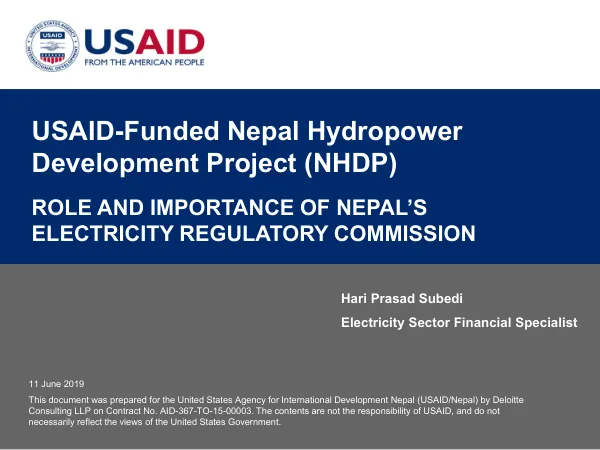
USAID-Funded Nepal Hydropower Development Project (NHDP) - Role and Importance of Nepal’s Electricity Regulatory Commission
Sign inDELOITTE CONSULTING, LLP
USAID-Funded Nepal Hydropower Development Project (NHDP) - Role and Importance of Nepal’s Electricity Regulatory Commission
Nepal's Electricity Regulatory Commission plays a crucial role in the country's hydropower development.
2019 · 27 pages
Sign in to readA free account is required to download.
Abstract
The commission was established in August 2017, marking the beginning of a new era in Nepal's hydropower and electricity sector development. Independent regulation is considered a better idea due to its ability to limit monopoly power and protect the interests of all stakeholders. In the context of electricity utilities, regulation refers to the supervision and oversight exercised on utilities through a well-defined regulatory framework, supported by legal powers. This framework ensures that the interests of all relevant stakeholders are protected in an efficient and socially beneficial manner. Regulators serve as watchdogs to ensure that utilities are responsive to customers' needs and provide adequate and reliable service. The key players in the regulatory framework include the regulator, government, utility, and consumers. The regulator formulates policies, laws, and guidelines, while the government issues regulations, guidelines, and rulings/orders. The utility complies with directives from the regulator and files tariff petitions or rate cases. Consumers participate in public hearings and respond to relevant public notices. Nepal's Electricity Regulation Commission has several key tasks, including access to markets, pricing, preventing abuse of monopoly power, and resolving disputes and technical issues. The commission operates transparently and protects the principal stakeholders, including the government, NEA, consumers, and the environment. It also promotes competition and protects the environment. Independent regulation is considered better suited than government regulation for network infrastructure industries, such as water utilities, telecoms, and electricity. This is because independent regulators are insulated from conflicts of interest, bureaucratic inertia, and lack of capacity. They are also better equipped to protect consumers from undue influence and regulatory "capture" by government, industry, or special interests. The establishment of the Electricity Regulation Commission of Nepal marks a significant step towards promoting competition and protecting the interests of all stakeholders in the country's hydropower development. The commission's role in regulating the electricity sector is critical to ensuring that utilities provide adequate and reliable service to customers while also promoting competition and protecting the environment. The commission's key stakeholders include service providers, government, end consumers, society, and the environment. Its principal activities include access to markets, pricing, preventing abuse of monopoly power, and resolving disputes and technical issues. The commission operates transparently and protects the principal stakeholders, including the government, NEA, consumers, and the environment. The commission's establishment has been a long time coming, with efforts dating back 20 years. The passage of the Electricity Regulation Commission Act in August 2017 marked a significant milestone in Nepal's hydropower development. The commission's role in regulating the electricity sector is critical to ensuring that utilities provide adequate and reliable service to customers while also promoting competition and protecting the environment. The commission's regulatory tasks include access to markets, pricing, preventing abuse of monopoly power, and resolving disputes and technical issues. It operates transparently and protects the principal stakeholders, including the government, NEA, consumers, and the environment. The commission's establishment has been a significant step towards promoting competition and protecting the interests of all stakeholders in the country's hydropower development.
Related documents