USAID
USAID FY 2009 Small Business Procurement Scorecard
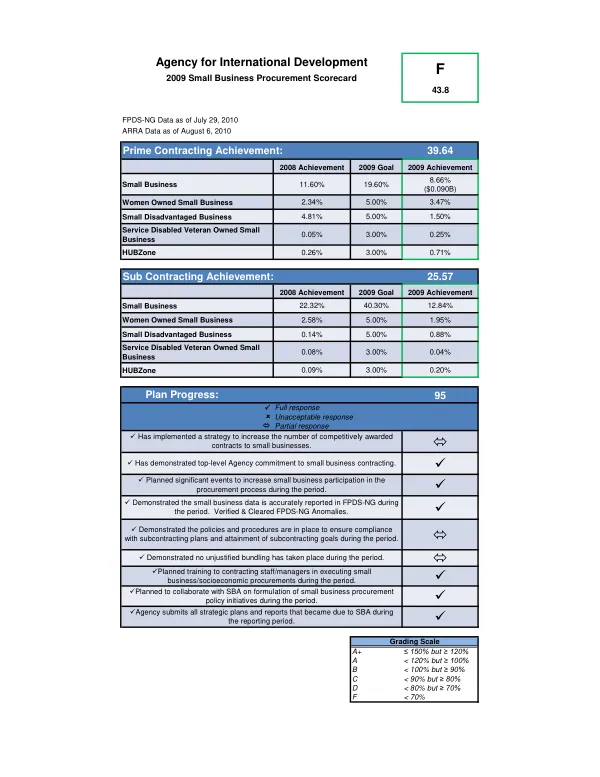
The United States Agency for International Development (USAID) did not meet its projected small business goals in FY 2009.
2009 · 2 pages
Sign in to readA free account is required to download.
Abstract
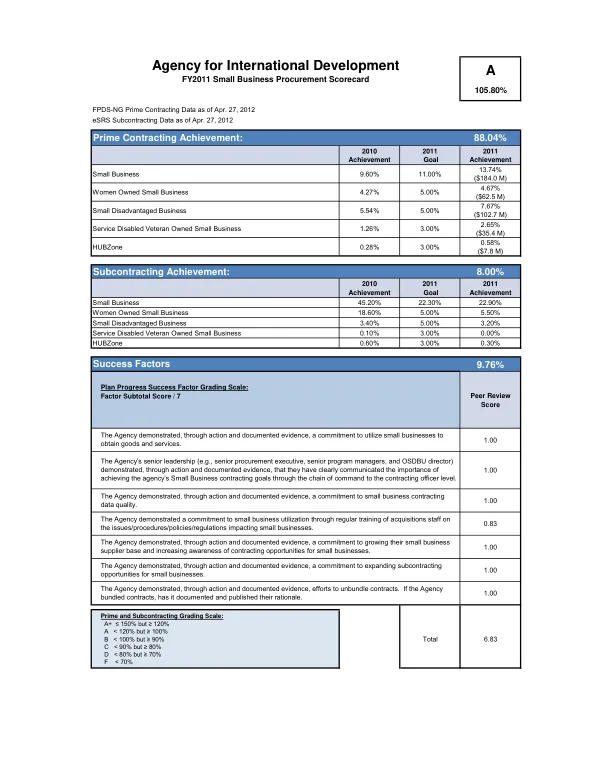
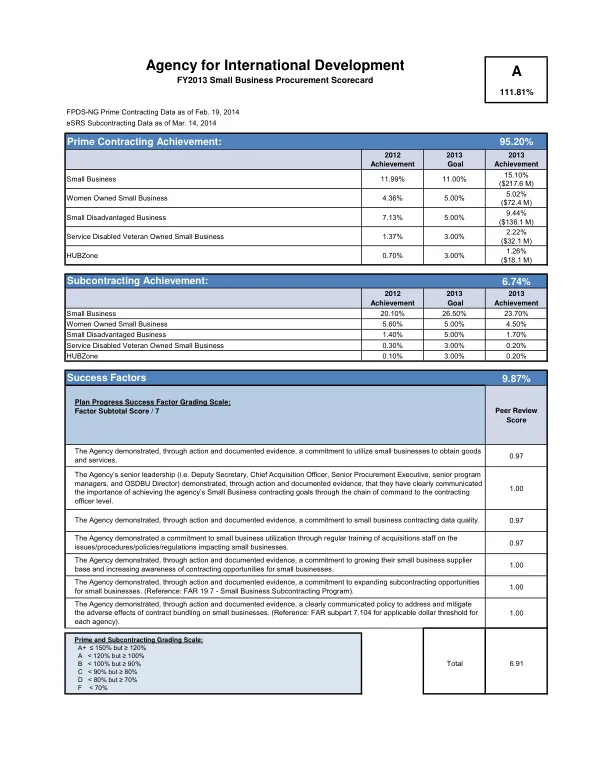
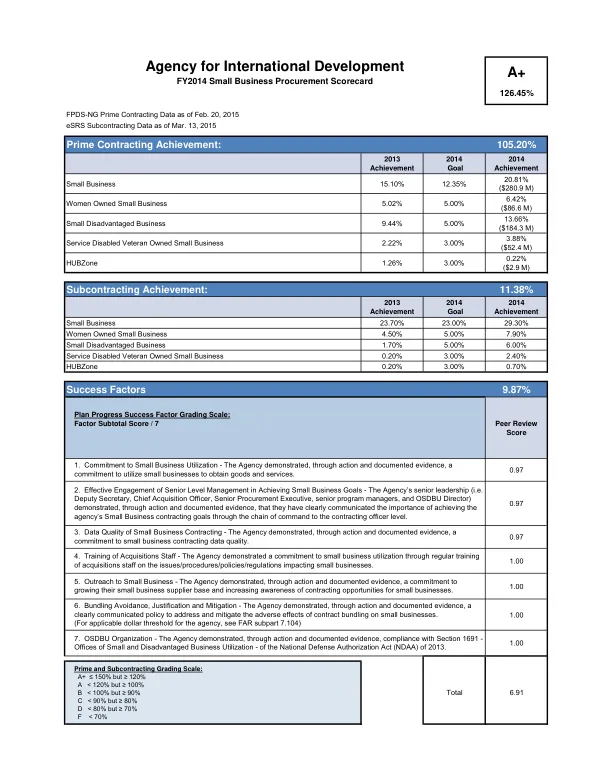
The agency awarded 8.7%, or $89M, of its total dollar obligations to small businesses. This is considered very low, but the small business percentage was driven, in large part, by the agency's obligations in support of USAID's Global Health Bureau. Global Health acquisitions represented approximately half of the agency's total obligated dollars. The vast majority of this was for the Supply Chain Management System contract that supplies essential medicines in support of the President's Emergency Plan for AIDS Relief (PEPFAR). PEPFAR commodities are procured by a consortium of 16 large organizations through a competitive contract awarded in 2005, which mainly procures generic, life-saving ARV-related medicines from manufacturers based outside the United States. When the contract was awarded, market research determined that there were no small pharmaceutical firms that could provide these commodities. This contract will be re-competed in 2012, and USAID will explore options for increasing the role of small business consistent with PEPFAR's goal of providing an uninterrupted supply of quality life-saving medicines to HIV-infected individuals at the best value to the USG. If the Global Health Bureau is excluded, USAID actually awarded 18% of its total obligated dollars to small businesses, just below the 19% goal. To ensure increased small business utilization in the future, USAID is implementing a new comprehensive procurement reform strategy. This includes, as one of its key objectives, increasing competition and expanding the use of small, minority, and women-owned businesses on direct contract awards. The agency recently established a new Board for Acquisition & Assistance Reform (BAAR), which is responsible for reviewing and restructuring large Indefinite Quantity Contracts and small business participation is a key factor in this review. The BAAR is ensuring that the required small business market research is conducted, and that there is an appropriate use of small business set asides. This is encouraging widespread use of creative approaches such as small business thresholds. USAID also directed 45.1% of their Recovery Act funds toward small businesses since the enactment of the American Reinvestment and Recovery Act. The agency regularly attended the SBA chaired Small Business Procurement Advisory Council meetings hosted at the SBA and responded on-time to SBA's contracting data anomaly report, fully addressing submitted anomalies.