USAID DEC
Step-by-step: A Roadmap to Gender and Youth Integration in Food Security and Resilience Programs
Sign inUSAID
Step-by-step: A Roadmap to Gender and Youth Integration in Food Security and Resilience Programs
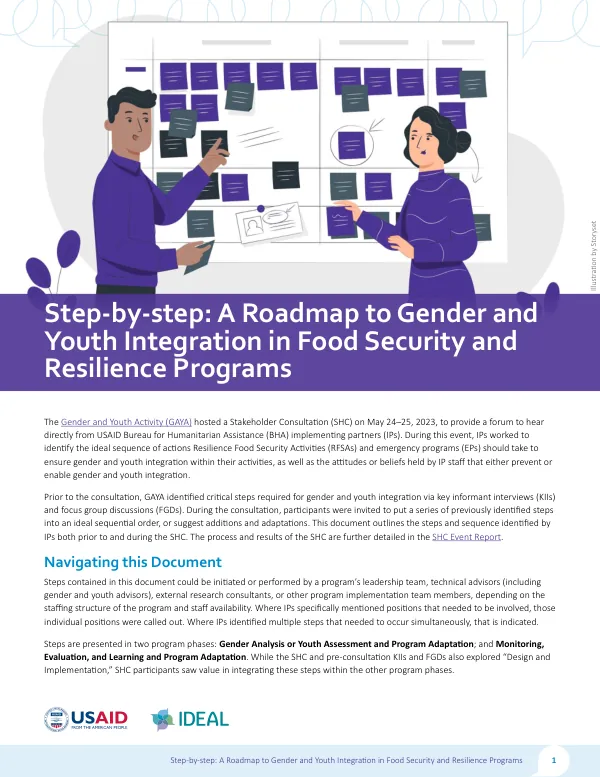
The Gender and Youth Activity (GAYA) hosted a Stakeholder Consultation on May 24-25, 2023, to identify the ideal sequence of actions implementing partners (IPs) should take to ensure gender and youth integration in food security and resilience programs.
2023 · 11 pages
Sign in to readA free account is required to download.
Abstract
The consultation aimed to provide a forum for IPs to work together to identify the ideal sequence of actions and attitudes or beliefs held by IP staff that either prevent or enable gender and youth integration. Prior to the consultation, GAYA identified critical steps required for gender and youth integration through key informant interviews (KIIs) and focus group discussions (FGDs). During the consultation, participants were invited to put a series of previously identified steps into an ideal sequential order, or suggest additions and adaptations. This document outlines the steps and sequence identified by IPs both prior to and during the Stakeholder Consultation. The steps contained in this document can be initiated or performed by a program's leadership team, technical advisors, external research consultants, or other program implementation team members, depending on the staffing structure of the program and staff availability. The steps are presented in two program phases: Gender Analysis or Youth Assessment and Program Adaptation; and Monitoring, Evaluation, and Learning and Program Adaptation. The first phase, Gender Analysis or Youth Assessment, involves several steps, including defining the budget and timing for the research, consulting the program team on the research scope, and selecting a conceptual framework for the analysis or assessment. The sequence of these sub-steps will depend on timing considerations and staff availability. The second phase, Monitoring, Evaluation, and Learning, involves several steps, including selecting indicators and setting targets based on which marginalized participants are targeted by which outcomes and activities, and presenting and discussing disaggregated findings with teams, ensuring findings are included in updated implementation plans. The steps outlined in this document are designed to be flexible and adaptable to the specific needs and context of each program. The goal is to ensure that gender and youth integration is a core component of food security and resilience programs, and that the needs and perspectives of marginalized populations are taken into account. The document also highlights the importance of involving the program team in the research process, including data collection and analysis, to ensure that the research is contextually and programmatically relevant. Additionally, the document emphasizes the need to involve different members of the research population in the research scope, particularly the most marginalized, to ensure that their priorities and needs are taken into account. Overall, the steps outlined in this document provide a roadmap for implementing partners to ensure gender and youth integration in food security and resilience programs. By following these steps, programs can ensure that they are taking a comprehensive and inclusive approach to addressing the needs of marginalized populations.