SPRING
Integrating Gender and Nutrition within Agricultural Extension Services
The INGENAES initiative integrates gender and nutrition within agricultural extension services.
2015 · 10 pages
Sign in to readA free account is required to download.
Abstract
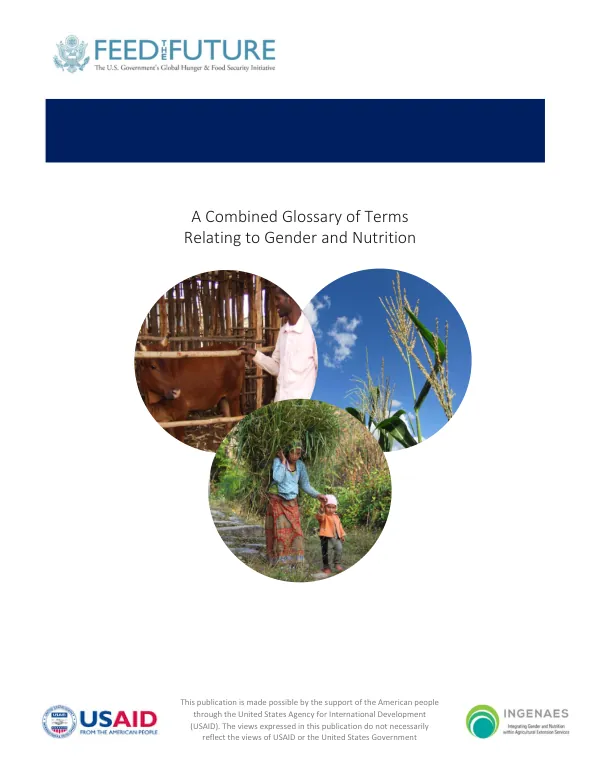
This combined glossary of terms relates to gender and nutrition, providing definitions for concepts commonly used by health and nutrition practitioners. The glossary is a living reference document for the INGENAES consortium members to facilitate cross-sectoral work on agriculture, nutrition, and gender. Nutrition-sensitive approaches address the underlying and systemic causes of malnutrition. These approaches focus on food security, adequate caregiving resources, and access to health services and a safe and hygienic environment. Nutrition-sensitive programs can serve as delivery platforms for nutrition-specific interventions, potentially increasing their scale, coverage, and effectiveness. Examples of nutrition-sensitive approaches include agriculture and food security, early child development, women's empowerment, social safety nets, and water, sanitation, and hygiene. Nutrition-specific interventions address the immediate determinants of malnutrition, including adequate food and nutrient intake, feeding, caregiving, and parenting practices, and a low burden of infectious diseases. These interventions work best when combined with interventions to reduce infections, such as water, sanitation, and hygiene. The first thousand days, from pregnancy to a child's second birthday, is considered the most significant period in which malnutrition can have irreversible negative impacts on children's health and development. Essential nutrition actions, proposed by the World Health Organization (WHO), include exclusive breastfeeding for six months, adequate complementary feeding starting at six months, and adequate intake of essential nutrients such as vitamin A, iron, and iodine. The SUN Movement aligns with the WHO recommendation on exclusive breastfeeding, where infants receive only breast milk, no other liquids or solids, for the first six months of life. Exclusive breastfeeding protects against common childhood diseases and may have longer-term benefits such as lowering mean blood pressure and cholesterol, and reducing the prevalence of obesity and type-2 diabetes. Food fortification is the addition of one or more essential nutrients to a food to prevent or correct a demonstrated deficiency of one or more nutrients in the population or specific population groups. Food security is defined as access by all people at all times to sufficient, safe, and nutritious food needed for a healthy and active life, encompassing access, availability, utilization, and stability. Global acute malnutrition (GAM) is a measurement of undernutrition, representing the total proportion of children aged between 6 and 59 months in a given population who have moderate or severe acute malnutrition. When the GAM rate is equal to or greater than 15 percent of the population, the nutrition situation is defined as "critical" by WHO. Incidence is the number of newly diagnosed cases of a disease, and an incidence rate is the number of new cases of a disease divided by the number of persons at risk for the disease. Infant and young child feeding (IYCF) programs focus on the protection, promotion, and support of exclusive breastfeeding for the first six months, timely introduction of complementary feeding, and continued breastfeeding for two years and beyond. Kwashiorkor is a severe form of acute malnutrition characterized by bilateral edema. The Lancet Series on Maternal and Child Undernutrition, published in 2008 and 2013, demonstrated the devastating and largely irreversible impact of malnutrition on young children.
Related documents