GHANA HEALTH SERVICE
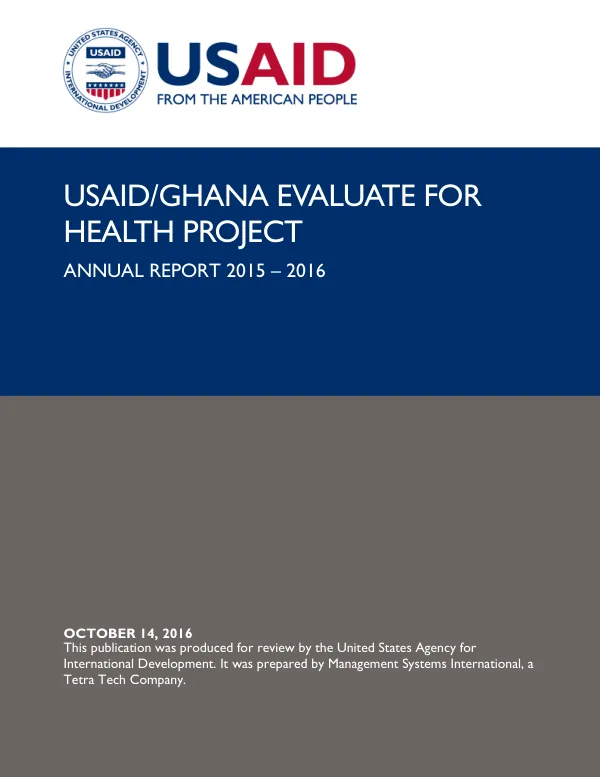
USAID/Ghana Evaluate for Health Annual Report 2015 – 2016
The Evaluate for Health project in Ghana aimed to improve accountability, learning, and evidence-based decision-making in the health sector.
2016 · 25 pages
Sign in to readA free account is required to download.
Abstract
The project, which began in 2015, was implemented by Management Systems International, a Tetra Tech Company, under contract with the United States Agency for International Development (USAID). The project's primary objective was to build Ghana's local capacity to sustain monitoring, evaluation, and research functions, and provide overall evaluation support to the entire health portfolio. One of the key components of the project was Evaluations, Studies, and Assessments. During the reporting period, Evaluate delivered regional data tables and analysis to the Health, Population and Nutrition Office (HPNO) and implementing partners (IPs). The project also conducted a Health Systems Baseline Study, which provided baseline results to the Ghana Health Service's (GHS) director general and department directors. Additionally, Evaluate began preparations for the 2017 midline survey, which will use the same design and employ the same mixed-methods approach as the baseline. Another significant component of the project was Performance Monitoring and Evaluation (M&E) Assistance. Evaluate provided technical assistance to HPNO and IPs on an as-needed basis, including reviews of IP Activity M&E Plans (AMEPs), work plans, performance indicator reference sheets, and baselines. The project also supported the rollout of AIDTracker+, a performance monitoring system, and conducted Data Quality Assessments (DQA) for nine IPs and 46 indicators. Furthermore, Evaluate and the GHS signed a Framework for Access to Routine Health Service Data (FARHSD), which sets standard operating procedures for IP access to select GHS routine service data. The project also focused on strengthening local capacity for research management. Evaluate provided training and technical assistance to Ghana's research institutions, including the Dodowa Health Research Center (DHRC) and the Navrongo Health Research Center (NHRC). The project also supported the development of a Research and Development Directorate (RDD) at the GHS, which will oversee research activities in the health sector. In terms of crosscutting issues, the project addressed gender equality and female empowerment, local capacity development, and science, technology, and innovation. Evaluate conducted a gender analysis of the Resilience in Northern Ghana (RING) project to assess the extent to which RING Component 1 activities stimulate female-controlled assets within households in the Northern Region. The project also supported the development of a Monitoring and Evaluation Community of Practice (MECOP), which enables HPNO IP M&E officers to exchange best practices and discuss challenges in data collection, analysis, and reporting. Overall, the Evaluate for Health project made significant progress in improving accountability, learning, and evidence-based decision-making in the health sector in Ghana. The project's focus on building local capacity, providing technical assistance, and supporting research activities has contributed to the development of a more robust and sustainable health system in the country.