TETRA TECH DPK
USAID Government Integrity Project Bulleted Monthly Report October 2016
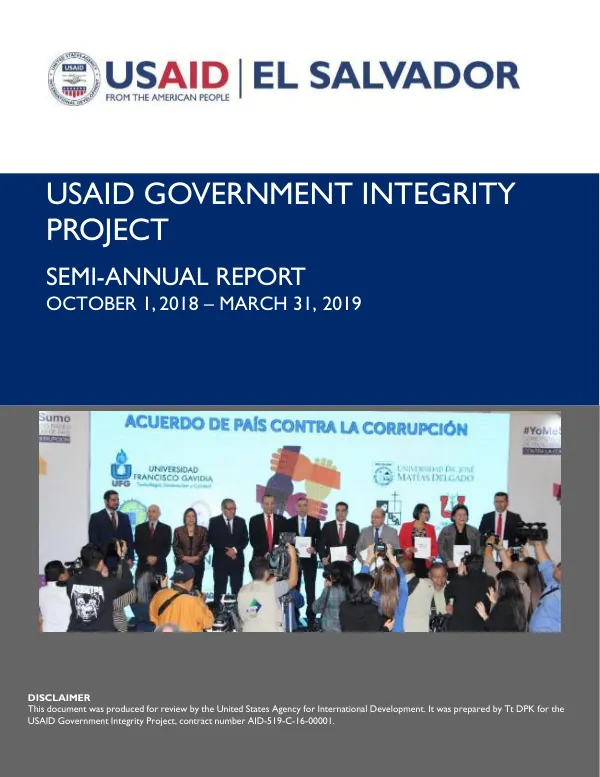
The USAID Government Integrity Project was implemented in March 2016, with Tetra Tech DPK (Tt DPK) as the contractor.
2016 · 10 pages
Sign in to readA free account is required to download.
Abstract
The project's purpose is to work in partnership with the Government of El Salvador (GOES) to enhance transparency and accountability in government. The project's main objective is to support the effective implementation and compliance with regulations that promote a culture of public integrity. The project's work plan for fiscal year 2017 (FY17) was completed and submitted to USAID on October 17. The project also supported the visit of Senator Tom Carper, a senior ranking member of the Homeland Security and Governmental Affairs Committee, to El Salvador. The project organized the agenda for the visit and facilitated a presentation by the Institute for Access to Public Information (IAIP) about its creation and achievements. The project developed a strategic training program to train key public officials in selected central and local government agencies, as well as civil society organizations, in subject matters that promote a culture of public integrity in El Salvador. The fifth module of the program is an accountability module, which is expected to be delivered in February 2017. The project worked with various government agencies and institutions to achieve its objectives. The Institute for Access to Public Information (IAIP) validated and finalized a number of deliverables, including the Confidential Information Guidelines, the Training Strategy Roadmap, Strategic Processes Mapping, and the Records Management Guidelines. The project also requested a meeting with the Government Ethics Tribunal (TEG) to discuss delays in the implementation of the work plan, but the meeting was cancelled by the TEG. The project provided technical assistance and training to 11 target municipalities, with FUNDAUNGO and AV Consultores as the local subcontractors. The project municipal team carried out a first round of visits to the municipalities to share a draft of the Memorandum of Understanding (MOU) and to invite them to the November 22nd best practices workshop. The interest for the project was high in most of the municipalities visited, with some mayors expressing their willingness to carry out the project and others showing eagerness to begin with the project activities. The project also supported the reform to the current civil service law, with USAID leading the discussion with the Technical and Planning Secretariat of the President's Office (STP) Director of Professionalization. The project sent graphic and messaging products, including posters, publicity ads, press releases, mobile apps, and a brochure, to the STP for validation. The project also initiated the discussion of how to adapt the Salvadoran version of the Institutional Integrity Model to the municipal context, with the municipal team and FUNDAUNGO beginning the discussion of how to adapt the Model to the municipal context.