ROBERT NATHAN ASSOCIATES
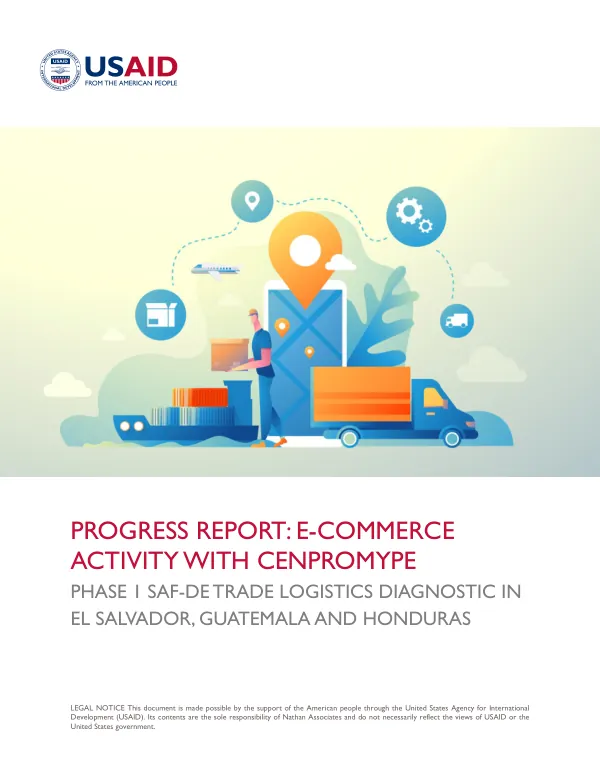
Progress Report: E-Commerce Activity with CENPROMYPE
The USAID Regional Trade Facilitation and Border Management Project (TFB) aims to strengthen trade-related capacity and competitiveness among Central American countries.
2021 · 24 pages
Sign in to readA free account is required to download.
Abstract
TFB supports the implementation of key elements within the framework of the Trade Facilitation Agreement (TFA) of the World Trade Organization (WTO). The project works with key national and regional institutions, including Customs Agencies and Ministries of Economy, Health, and Agriculture of El Salvador, Guatemala, and Honduras, as well as private sector organizations and companies in the three countries. CENPROMYPE, the Regional Center for the Promotion of Micro, Small-, and Medium-sized Enterprises (MSMEs), is developing a regional digital strategy to promote e-commerce development, particularly for MSMEs. Central to CENPROMYPE's approach is working with national governments to develop country-level strategies aimed at improving the public policy framework and strengthening institutional capacities while fostering skills development in MSMEs. The project's e-commerce initiative, approved by USAID, focuses on facilitating the growth of e-commerce and digital trade in El Salvador, Guatemala, and Honduras. The initiative is implemented in three phases, with Phase 1 focusing on the trade logistics pillar. Phase 1 began in May 2021 and involves a deep dive report examining policy considerations, legal foundations, core institutions, key stakeholders, and quantitative indicators in the trade logistics environment. Progress-to-date includes a review of existing reports, studies, and research to collect relevant data related to trade logistics in Guatemala, Honduras, El Salvador, and Central America more broadly. Inefficiencies in transport and logistics have a disproportionate impact on MSMEs, which are the engine of growth for developing economies, including in the three countries. MSMEs generate a significant portion of GDP and employ a large percentage of the workforce in each country. As of 2019, a significant percentage of the population in each country had access to the Internet, but each country performed relatively poorly on international indices measuring Information and Communications Technology (ICT) readiness and uptake. The World Bank's Logistics Performance Index (LPI) and Doing Business Report provide some initial context for the activity, with the three countries ranking relatively low among the 160 and 190 economies, respectively. During May and June, the team solicited applications for local experts on e-commerce and trade facilitation and legal/regulatory matters to assist with the next stage of the activity, which involves stakeholder outreach and interviews of key actors in government, business advocacy groups, private sector enterprises, logistics providers, lawmakers, and universities or training institutions, as appropriate. The initial data and benchmarking presented in this report will guide preparations for the next stage of work under Phase 1. The approach to stakeholder engagement will be adjusted to the national context, with a focus on prioritizing engagement with "anchor" stakeholders who have relationships and sufficient influence to ensure the widest possible participation by public and private sector representatives. The team will also consider separating various actors or institutions during interviews to ensure candid conversations. The project's e-commerce initiative aims to facilitate cross-border trade through more streamlined processes, greater accountability, and more regular public-private feedback channels, linking growing businesses to consumers in international markets. By promoting e-commerce and digital trade, the project seeks to improve the competitiveness of Central American countries and contribute to their economic growth and development.