ABT ASSOCIATES
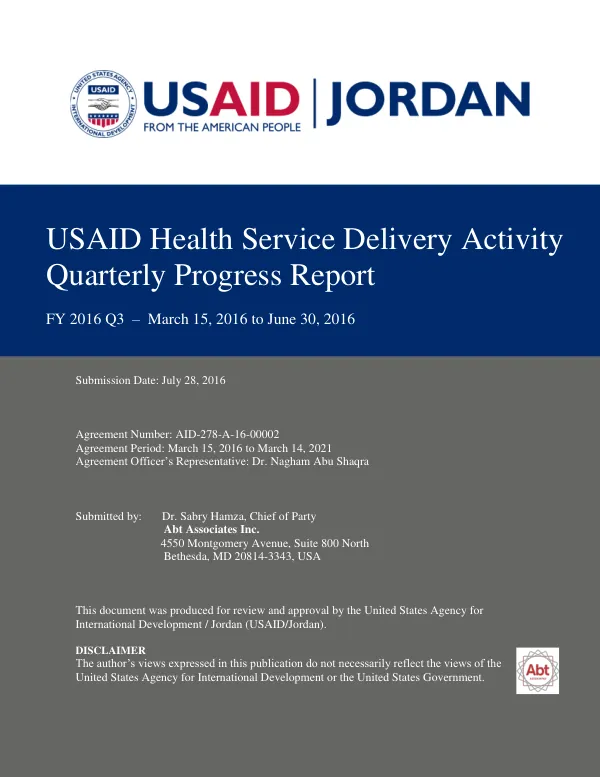
USAID Health Service Delivery Activity Quarterly Progress Report FY 2016 Q3
The Health Service Delivery Activity is a five-year initiative implemented by USAID/Jordan to improve health outcomes for women of reproductive age and children under the age of five, including Syrian refugees living in Jordanian host communities.
2016 · 28 pages
Sign in to readA free account is required to download.
Abstract
The Activity aims to stimulate management, clinical, and behavioral changes within Jordan's public and private health service system to achieve the intended results. The Activity is guided by the USAID/Jordan Country Development Cooperation Strategy, the Ministry of Health's Five Year Strategic Plan, and the Jordan Response Plan for Syria Crisis 2016-2018. The Activity directly supports the USAID/Jordan's Results Framework, with a focus on improving health status, increasing access to quality health services, and improving health seeking behaviors and practices. The Activity has several key objectives, including increasing access to quality health services, improving health seeking behaviors and practices, and alleviating the impacts of rapid population growth. To achieve these objectives, the Activity works with the Government of Jordan and other international and local partner organizations to expand access and availability of integrated health services and improve the quality of essential health services at national and sub-national levels in Jordan. The Activity is implemented by Abt Associates, Inc. in partnership with several subcontractors, including the Jordan Health Care Accreditation Council, EMPHNET, Population Council, and American College of Nurse-Midwives. The Activity has a nationwide geographic coverage, with a focus on improving health outcomes for women of reproductive age and children under the age of five. During the reporting period, FY 2016 Q3, the Activity made significant progress in achieving its objectives. The Activity expanded access and availability of integrated health services, improved the quality of essential health services, and fostered community ownership and engagement to increase health facility accountability. The Activity also facilitated access to quality health services for both Syrian refugees and Jordanian host communities, and improved the availability and quality of family planning services. The Activity's progress was monitored and evaluated through regular assessments and evaluations, which provided valuable insights into the effectiveness of the Activity's interventions. The Activity's results framework was used to track progress and identify areas for improvement. The Activity's sustainability and exit strategy were also a key focus during the reporting period. The Activity worked to ensure that the health system in Jordan was resilient and able to continue delivering high-quality health services after the Activity's completion. The Activity also facilitated the transfer of managerial and clinical knowledge to Jordanian counterparts, allowing them to assume full ownership of the health system and ensure its continuity. Overall, the Health Service Delivery Activity made significant progress during the reporting period, FY 2016 Q3, in achieving its objectives and improving health outcomes for women of reproductive age and children under the age of five in Jordan. The Activity's progress was monitored and evaluated through regular assessments and evaluations, and its sustainability and exit strategy were a key focus during the reporting period.
Related documents