ABT ASSOCIATES
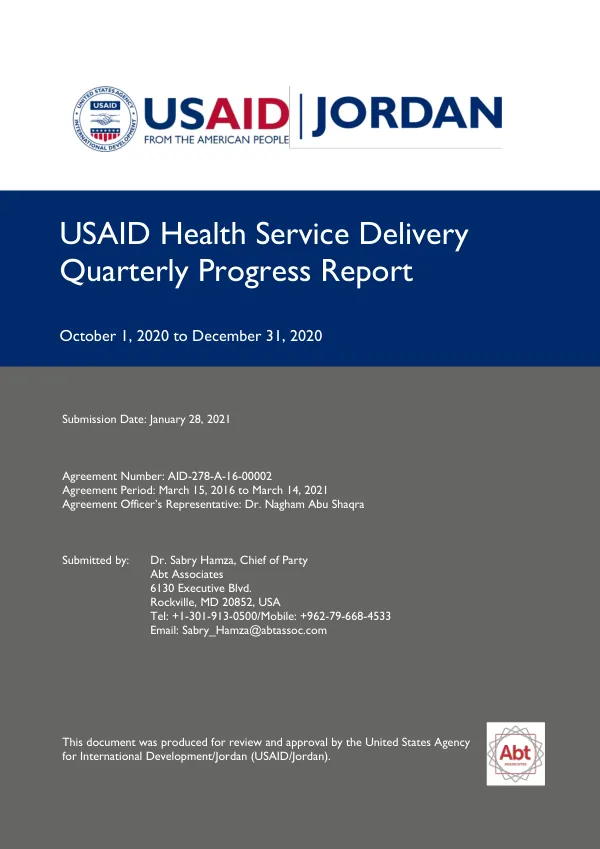
USAID Health Service Delivery FY21 Q1 Progress Report
The USAID Health Service Delivery initiative in Jordan aims to improve reproductive, maternal, newborn, and child health services.
2021 · 42 pages
Sign in to readA free account is required to download.
Abstract
The program began in 2016 and is set to conclude in 2021. The initiative is led by Abt Associates, with Dr. Sabry Hamza serving as the Chief of Party. The program is funded by the United States Agency for International Development (USAID) and is implemented in collaboration with the Jordanian Ministry of Health and other stakeholders. The program's vision is to improve the health and well-being of the Jordanian population, particularly in the areas of reproductive, maternal, newborn, and child health. The mission is to strengthen the health system in Jordan, improve the quality of health services, and increase access to these services for all segments of the population. The program's implementation approach focuses on improving the delivery of health services through a data-driven approach, facility-based supportive supervision, and collaborative sessions among Service Delivery Point teams. During the first quarter of fiscal year 2021, the program implemented several activities aimed at improving health service delivery in Jordan. These activities included the handover of programs to the Ministry of Health, the implementation of the Jordan's Maternal Mortality Surveillance and Response System, and the reduction of unnecessary cesarean section deliveries. The program also conducted a Family Planning Innovations Day amidst the COVID-19 pandemic and implemented Pillar 7: Case Management, Pillar 8: Operation Support and Logistics, and Pillar 2: Risk Communication and Community Engagement under the COVID-19 program. The program's collaboration and knowledge-sharing efforts involved working with implementing partners, host government entities, and other donor agencies. The program also planned activities for the next quarter, including outreach and communication events. The program's branding, communications, and dissemination efforts included key communication activities and a calendar of planned outreach and communication events for the second quarter of fiscal year 2021. The program's progress was monitored through a data-driven approach, which involved the use of assessment and research data to improve the delivery and management of services for reproductive, maternal, newborn, and child health. The program's decision support system aggregated and reported on key performance indicators in an easy-to-use format for program managers at all levels. The program's facility-based supportive supervision process guided, helped, trained, and encouraged staff to improve their performance continuously, focusing on monitoring the performance of service providers at the facility level. The program's baseline assessment identified gaps in the delivery of reproductive, maternal, newborn, and child health services, which were addressed through the implementation of change packages designed to improve the health service delivery process. The program's client service station was established within health facilities to improve and organize client flow and ensure receipt of integrated health care services. The program's continuum of care framework was based on integrated service delivery throughout the lifecycle and between places of care, including households, communities, and clinical care settings. The program's collaborative sessions allowed for the exchange of productive ideas and experiences among Service Delivery Point teams, facilitating greater improvement of SDPs. The program's data-driven approach promoted evidence-based decision-making and informed strategic planning, improving the delivery and management of services for reproductive, maternal, newborn, and child health.