DAI GLOBAL, LLC
DRC IGA YEAR 5 WORK PLAN
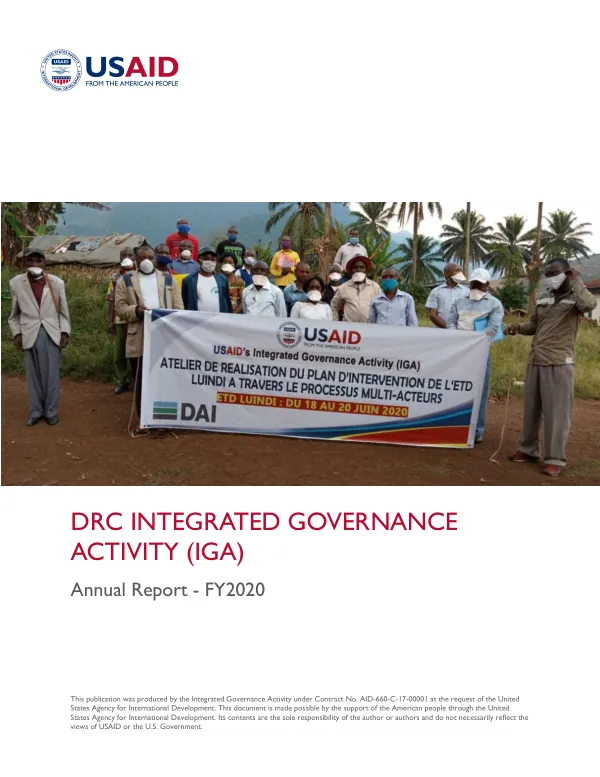
The Integrated Governance Activity (IGA) in the Democratic Republic of the Congo (DRC) aims to strengthen the capacity of government institutions and civil society to deliver key services, particularly in the areas of health, education, and economic development.
2020 · 123 pages
Sign in to readA free account is required to download.
Abstract
The IGA has emphasized sustainability as a key attribute of its work, focusing on replicable and sustainable approaches that can be operated within the means of those concerned. To achieve this goal, the IGA has been working on three fronts. Firstly, it has involved beneficiaries in planning and managing service provision, establishing joint civil society and government staff committees to oversee implementation of community-driven action plans and participatory budgets. Secondly, the IGA has helped stakeholders to look at their own resources and see how they should be used, partnering with civil society to improve service delivery, reduce corruption, and streamline taxation structures. Thirdly, the plans generated by the IGA, particularly "Recovery Plans" prepared at score card workshops, provide the basis for communities to become aware of what needs to be addressed and how to obtain funds to implement. In Year 5, the IGA will allocate increased resources to support economic growth, developing a strategy to support small business, particularly in the mining sector. The project will also focus on strengthening the role of civil society in holding the public sector accountable, and thereby improving service delivery. To achieve this, the IGA will work closely with the Ministry of Mines, the Ministry of Primary, Secondary and Professional Education, and the Ministry of Public Health, among other stakeholders. The IGA's geographic scope for activities is in the following provinces: Kasai Central, Kasai Oriental, Lualaba, Haut-Katanga, Sud Kivu, and the territory of Walikale in Nord Kivu. The project will also continue to work in Butembo and Baswagha in Nord-Kivu, where a satellite office was opened in 2020. The IGA's approach is designed to be replicable and sustainable, with a focus on empowering local actors to hold public officials accountable for better services. The project's tools, such as participatory budgeting and score cards, are being applied in most ETDs that participated in the USAID Programme de Bonne Gouvernance (PBG), demonstrating the effectiveness of this approach. The IGA's work will be reviewed on a quarterly basis, and amendments will be made as necessary to ensure that the project remains on track to achieve its objectives. Despite the challenges posed by the volatile political situation and the COVID-19 pandemic, the IGA remains committed to its goal of creating a good governance framework and local capacity that can deliver improved services to citizens. The IGA's results framework is designed to measure the project's progress towards its objectives, including the strengthening of capacity of government institutions and civil society, the improvement of service delivery, and the increase in citizen demand for accountable, transparent, and participatory services. The project's monitoring and evaluation system will track progress against these objectives, providing a basis for adjusting the workplan as necessary to ensure that the project remains on track to achieve its goals. The IGA's collaboration with USAID partners, including the Ministry of Mines, the Ministry of Primary, Secondary and Professional Education, and the Ministry of Public Health, will be critical to achieving the project's objectives. The project will also work closely with civil society organizations, including community-based organizations and non-governmental organizations, to ensure that the needs and perspectives of citizens are taken into account in the project's design and implementation. Overall, the IGA's Year 5 work plan is designed to build on the project's successes in previous years, while also addressing new challenges and opportunities. By focusing on sustainability, replicability, and local capacity, the IGA aims to create a good governance framework that can deliver improved services to citizens, even after the project has ended.