USAID DEC
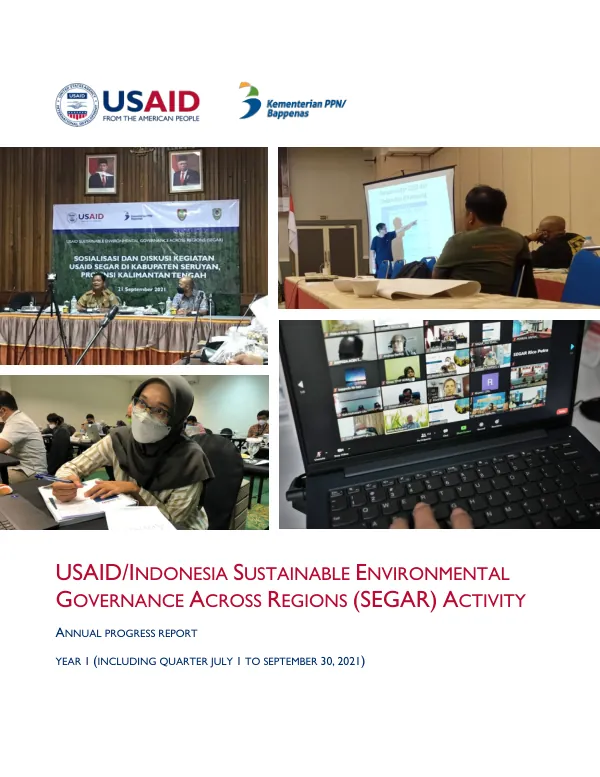
USAID/INDONESIA SUSTAINABLE ENVIRONMENTAL GOVERNANCE ACROSS REGIONS (SEGAR) ACTIVITY ANNUAL PROGRESS REPORT YEAR 1 (INCLUDING QUARTER JULY 1 TO SEPTEMBER 30, 2021)
Sign inCHEMONICS
USAID/INDONESIA SUSTAINABLE ENVIRONMENTAL GOVERNANCE ACROSS REGIONS (SEGAR) ACTIVITY ANNUAL PROGRESS REPORT YEAR 1 (INCLUDING QUARTER JULY 1 TO SEPTEMBER 30, 2021)
The Sustainable Environmental Governance Across Regions (SEGAR) Activity is a five-year initiative, financed by the United States Agency for International Development (USAID) and implemented by Chemonics International and its partners.
2021 · 49 pages
Sign in to readA free account is required to download.
Abstract
The Activity seeks to engender greater capacity and commitment for good environmental governance across a diverse group of stakeholders at the subnational level, including key government of Indonesia (GOI) institutions, as well as facilitating a greater role for village communities and the private sector. New sustainable livelihood opportunities will be created for women, youth, and indigenous populations as part of the Activity. A rigorous Landscape Baseline Assessment (LBA) was conducted during the first 120 days to define USAID SEGAR's focused geographies. The LBA validated some of the Activity's key indicator targets and USAID SEGAR is expected to bring seven million hectares of biologically significant area under improved management, reduce the emission of 55 million metric tons of carbon dioxide, and mobilize $45 million in additional investment for biodiversity conservation and sustainable landscape management. The focused geographies will initially cover twelve districts across four provinces, including Aceh, West Kalimantan, Central Kalimantan, and East Kalimantan. The Activity's Annual Report presents progress during the 2021 Fiscal Year (FY21), including the Activity's last quarter, from July 1 to September 30, 2021 (Q4, FY21). The report describes the transition from an orderly and efficient start-up under restrictive conditions imposed by the ongoing COVID-19 pandemic during the first quarter (Q3, FY21), to the solid implementation of a series of "foundational activities" during Q4, FY21. Work during FY21 reflected the realities of start-up during the COVID-19 global pandemic, with the bulk of interaction occurring virtually until the start of September, when essential in-person activities were resumed. The SEGAR Activity has made significant progress in building partner and stakeholder collaboration, with a focus on establishing a firm participatory platform for future implementation. The Activity has also conducted foundational activities, including Objective A and Objective B, which aim to build the capacity of key government of Indonesia (GOI) institutions and facilitate a greater role for village communities and the private sector. Cross-cutting activities, such as monitoring, evaluation, and learning, as well as communications and gender and social inclusion, have also been implemented. The Activity has also made progress in implementing its Work Plan, with a focus on achieving its key indicator targets. The report highlights the importance of the COVID-19 Operational Plan, which was approved by Chemonics and allowed for the resumption of essential in-person activities in September. The Activity has also made significant progress in hiring and onboarding its team, including all Jakarta-based staff. The SEGAR Activity is expected to bring significant benefits to the environment and local communities, including the creation of new sustainable livelihood opportunities for women, youth, and indigenous populations. The Activity's progress during FY21 reflects its commitment to good environmental governance and its ability to adapt to the challenges posed by the COVID-19 pandemic.