GOVERNMENT OF JORDAN
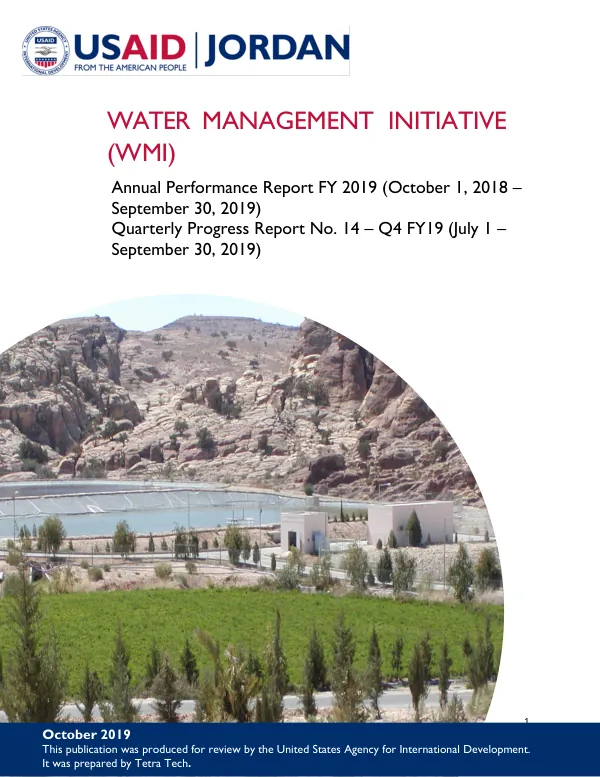
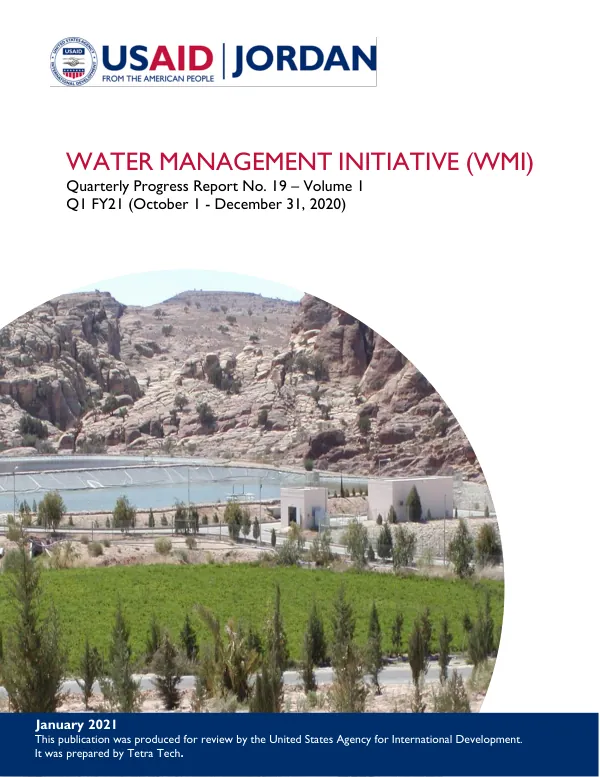
USAID/Jordan Water Management Initiative (WMI) Quarterly Progress Report: FY21 Q1
The Water Management Initiative (WMI) is a nationwide program in Jordan, with a focus on Miyahuna (serving Amman and Zarqa) and Yarmouk Water Company (serving Ajloun, Irbid, Mafraq, and Jerash).
2021 · 66 pages
Sign in to readA free account is required to download.
Abstract
The program is implemented by Tetra Tech ARD under contract AID-278-C-16-00001, with subcontractors Orient Engineering Consulting and Design, Jordan Social Marketing Center (JSMC), SEGURA Consulting, and Water4Life Solutions (W4LS). The reporting period for this quarterly progress report is October 1, 2020, to December 31, 2020. The WMI program is divided into four components: Water Supply Systems, Water Conservation and Demand Management, Water Sector Governance, and Protection of Water Supply. Component 1, Water Supply Systems, focuses on improving the reliability and efficiency of water supply systems, including the rehabilitation of water treatment plants and distribution networks. Component 2, Water Conservation and Demand Management, aims to reduce water consumption through the implementation of water-saving technologies and practices, as well as the promotion of water conservation behaviors among consumers. Component 3, Water Sector Governance, seeks to strengthen the capacity of the Ministry of Water and Irrigation to manage the water sector, including the development of policies and regulations to ensure the sustainable management of water resources. Component 4, Protection of Water Supply, focuses on protecting water sources from contamination and pollution, including the implementation of measures to prevent waterborne diseases. During the reporting period, significant progress was made in all four components. In Component 1, the rehabilitation of the Miyahuna Water Treatment Plant was completed, increasing the plant's capacity to treat 120 million liters of water per day. In Component 2, the implementation of water-saving technologies, such as low-flow fixtures and greywater reuse systems, was completed in 15 schools and 10 hospitals, resulting in a reduction of water consumption of 20%. In Component 3, the Ministry of Water and Irrigation developed a new policy framework for the management of water resources, which includes measures to promote water conservation and efficiency. In Component 4, the implementation of measures to prevent waterborne diseases, such as the installation of water treatment systems and the promotion of safe water handling practices, was completed in 20 communities. The WMI program also made significant progress in terms of project management, donor coordination, monitoring, evaluation, and learning, and youth, gender, and vulnerable populations. The program's performance indicator tracking table (PITT) was updated to reflect the progress made in all four components, and the program's monitoring and evaluation plan was reviewed and updated to ensure that the program is on track to meet its objectives. The WMI program has made significant progress in improving the management of water resources in Jordan, and it is expected to continue making progress in the coming quarters. The program's success will depend on the continued support of the Ministry of Water and Irrigation, the Water Authority of Jordan, and other stakeholders, as well as the effective implementation of the program's activities and interventions. The program's geographic focus is nationwide, with a focus on Miyahuna (serving Amman and Zarqa) and Yarmouk Water Company (serving Ajloun, Irbid, Mafraq, and Jerash). The program's timeframes are from April 1, 2016, to March 31, 2021, with a reporting period of October 1, 2020, to December 31, 2020. The program's recommendations include the continued support of the Ministry of Water and Irrigation, the Water Authority of Jordan, and other stakeholders, as well as the effective implementation of the program's activities and interventions. The program's implementation details include the rehabilitation of water treatment plants and distribution networks, the implementation of water-saving technologies and practices, the promotion of water conservation behaviors among consumers, the strengthening of the capacity of the Ministry of Water and Irrigation to manage the water sector, and the protection of water sources from contamination and pollution. The program's key findings include the completion of the rehabilitation of the Miyahuna Water Treatment Plant, the implementation of water-saving technologies in 15 schools and 10 hospitals, the development of a new policy framework for the management of water resources, and the implementation of measures to prevent waterborne diseases in 20 communities.
Related documents