MINISTRY OF WATER AND IRRIGATION
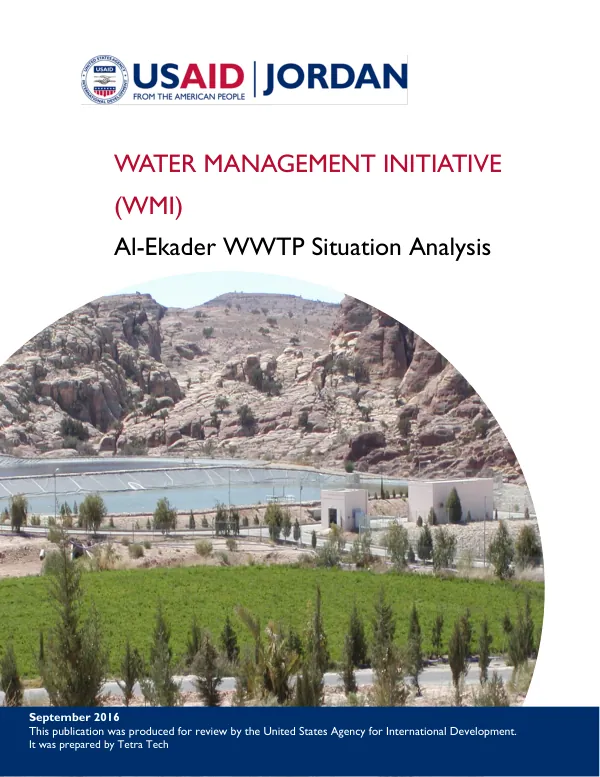
USAID Jordan WMI: Al-Ekader WWTP Situation Analysis
The Water Management Initiative (WMI) is a 5-year project to support the Government of Jordan (GOJ) in achieving measurable improvement and greater sustainability of the water sector.
2016 · 31 pages
Sign in to readA free account is required to download.
Abstract
This report presents the results of a detailed assessment of the current operational conditions of Al-Ekader Wastewater Treatment Plant (WWTP), which is located in Al Mafraq Governorate and operated by Yarmouk Water Company (YWC). Al Ekader WWTP serves the northern part of Jordan and receives the septage collected from communities unserved by sewer systems. The WWTP is currently overloaded in terms of biological loads, with individual ponds under operation or intentionally out of operation to keep them for emergency storage during the rainy season. The hydraulic load needs to be verified as there is no reliable registry system for received tankers and their capacities. The absence of WWTP management, including lack of qualified, trained operators and labors, nonexistence of any kind of house-keeping, and absence of civil preventive and correction maintenance, are also major obstacles facing the WWTP. The Situation Analysis (SA) recommends intervention measures to overcome these obstacles, including rehabilitation of the distribution piping system and manholes, desludging of anaerobic ponds if needed, fixing the septage receiving station, and clearing all ponds dikes from vegetation and grown trees. Enforcing the staffing capability and lab capacity of the WWTP, providing piped portable water to the administration building, and implementing management's improvements, including capacity building and providing safety equipment, are also recommended. In the long-term plan, the WWTP capacity is to be expanded to cope with projected coming 10 years' load. Construction of screens at the inlet of the splitting the flow between the two trains, recirculation of the final effluent to be used as wash-down water with ample pressure, hose, and spray nozzles, and other upgrades and renovations are also planned. The WWTP currently serves the northern part of Jordan, receiving septage from communities unserved by sewer systems. The plant's treatment process involves septage receiving, wastewater characteristics, treatment process, lagoons, and irrigation. However, the plant is currently overloaded in terms of biological loads, and the hydraulic load needs to be verified. The SA report recommends immediate, short-term plans for rehabilitation and long-term plans for upgrading, renovation, and expansion. The immediate and short-term plan includes rehabilitation of the distribution piping system and manholes, desludging of anaerobic ponds if needed, fixing the septage receiving station, and clearing all ponds dikes from vegetation and grown trees. Enforcing the staffing capability and lab capacity of the WWTP, providing piped portable water to the administration building, and implementing management's improvements, including capacity building and providing safety equipment, are also recommended. The long-term plan includes expanding the WWTP capacity to cope with projected coming 10 years' load, construction of screens at the inlet of the splitting the flow between the two trains, recirculation of the final effluent to be used as wash-down water with ample pressure, hose, and spray nozzles, and other upgrades and renovations. The WWTP's management, including qualified, trained operators and labors, nonexistence of any kind of house-keeping, and absence of civil preventive and correction maintenance, are also major obstacles facing the WWTP. The WWTP's treatment process involves septage receiving, wastewater characteristics, treatment process, lagoons, and irrigation. However, the plant is currently overloaded in terms of biological loads, and the hydraulic load needs to be verified. The SA report recommends immediate, short-term plans for rehabilitation and long-term plans for upgrading, renovation, and expansion. The immediate and short-term plan includes rehabilitation of the distribution piping system and manholes, desludging of anaerobic ponds if needed, fixing the septage receiving station, and clearing all ponds dikes from vegetation and grown trees. Enforcing the staffing capability and lab capacity of the WWTP, providing piped portable water to the administration building, and implementing management's improvements, including capacity building and providing safety equipment, are also recommended.